
22. Street Foods and the Missing Malaysians – Satay? Okay!
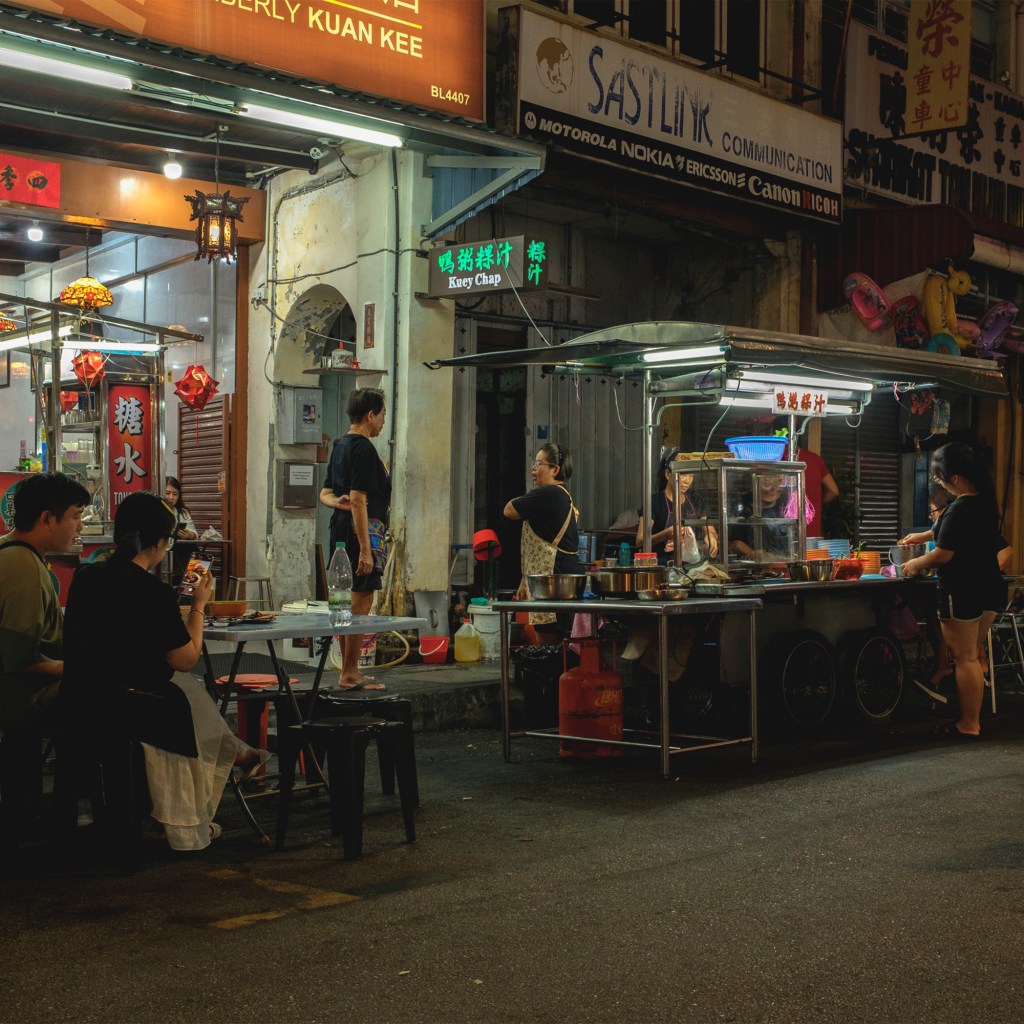
Visitors to Malaysia never quite understand the value of street food. Yes street food is delicious, but it’s also the pillar of the community and central to Malaysian identity. But why?
It’s the final episode of Season 2 and we ask just why food is so important to our identity. But whose identity are we talking about? Yours, mine or the entire country’s?
Anna Sulan Masing is the author of Chinese and Any Other Asian. She explores how food, place and identity intersect, and how ignoring identities can lead to violence.
Credits
Hosted by Dr Noby Leong and Philip Gibson
Produced by Dr Noby Leong and Philip Gibson
Sound Design by Jack Barr
Satay? Okay! is produced by Kopi Productions Limited and supported by the Golden Chopsticks Scholarship, by the Oxford Cultural Collective Trust
Resources and References
Chinese and Any Other Asian (2025), Anna Sulan Masing
Transcipt
Please note that this transcript may contain errors and typos
Thank you. Welcome to Satay. Okay. A podcast
about the foods that have shaped Malaysia. I’m
Dr. Noby Leong, scientist, food writer and broadcaster.
And I’m Philip Gibson, photographer and categorically
non -Malaysian. And in this series, we explore
the history, cultures and cuisines of Malaysia
from the ancient lands of Southeast Asia all
the way through to the creation of a modern day
nation. In today’s episode, we take a look at
street food and the missing Malaysians. So for
the very final time this season, get out your
napkins because it’s time for Satay. Okay. It’s
the final episode of the season, Philip. Yeah,
what a moment. I’m quite sad. Yeah, I think I
was definitely melancholy when we finished up
the last episode. I was a bit like, oh God, this
is it. Yeah. But yeah, what a journey from start
to finish. Comprehensive. I think so. The definitive
guide to Malaysian food history. I mean, we both
poured so much heart and soul into this project.
Yeah, it’s weird that it all started because
I had a massive identity crisis. And look at
what we’ve accomplished. Only you could turn
your identity crisis into something productive.
But before we get too sappy, let’s sort of, let’s
chug along. Missing Malaysians. We’re kind of
thinking about our identities because in the
last two episodes, we’ve taken a look at how
Malaysian culture and how Malaysian communities
have come to be defined. And we looked at the
role of cookbooks and cultural artifacts. We
looked at the role of national cuisine and the
dangers inherent in that. And in today’s episode,
So we’re kind of trying to tie this all in a
nice bow to see how food now shapes our identity.
The idea of ourselves as both individuals in
our personal identity and also as Malaysians,
which I guess is like a national identity. Sure.
There’s definitely something missing from this
conversation, which we will explore in full.
I feel like there’s going to be a big reveal.
Even I don’t know. Oh, now that feels like I’m
hyping it up too much. A little bit. There’s
no grand reveal. Oh, right. How disappointing.
Yeah. Last episode going out on a real big bang
there. Well, a special guest is a big bang, but
anyway. But before we get into all of that, let’s
look at the food of the day, and that is street
food. That’s not a food. That’s a category. Yes.
And to be honest, I don’t really know what street
food is sometimes. This is another kind of like
a… Is this you’re trying to put a label on
it, like queer again? Maybe, or maybe it’s one
of those things where when I was younger and
I would tell my friends, oh, I’m going to Malaysia.
I can’t wait to eat all the street food. What
am I actually talking about? I think I would
sort of describe dishes that you would commonly
find in quote unquote street food vendors in
Malaysia. Okay. So describing it kind of like
it was any other cuisine. So, oh, I can’t wait
to eat satay or char kway teow, blah, blah, blah,
blah, blah. The Venn diagram of street food and
hawker food must be pretty tight. Well, what’s
the difference between those? And then I would
hear people on like travel shows talk about,
oh, you have to come to Southeast Asia for the
street food. And it’d be all these images of,
you know, smoking rocks and charcoal, whatever.
Yeah, yeah, yeah, yeah, yeah. And I was like,
what is street food? This is, yeah, another one
of these hard to define things. And I actually
think probably with technology and like electrical,
like cooking appliances and stuff like that,
what can be considered food that you cook by
the roadside is now wildly different to what
it maybe was 50 to 100 years ago. And I think
the issue is that I’m trying to make street food
analogous to cuisine, which it isn’t at all.
And so rather than defining street food by a
particular set of dishes or associating it with
a specific culture it is really about where you
eat the street which sounds very obvious thanks
to me phd but we don’t often define food based
on like location right of where we eat it we
usually think about a particular culture or particular
sets of dishes yeah i’m trying to think of like
you know old fresh markets or fish markets or
like even If you went to a harbour, would you
get particular food served by a port? Yeah. I’m
sure you would. Fish and chips, for sure. Would
you eat picnic food? Picnic food? Picky bits.
Picky bits. Yeah, let’s get into the picky bits.
That’s a very British thing. Let’s not get into
picky bits. But anyway, I mean, to me, it’s very
much kind of, when I think of street food, I
just immediately think of night markets. But
having gone to Malaysia, I realise that street
food is served all throughout the day. Exactly.
In thinking of a new definition, I now think
of street food as food that is sold and eaten
on the street. It’s a very public way of eating.
The food isn’t confined to a private premises
in the way that a restaurant is. Yeah. Sit in
the car and munch. Sit in the car and munch,
yeah. And to a large degree, the chef or owner
has no control over the space in which the customer
eats the food. Right. So you don’t enter a building.
You simply are in public. You move through the
streets and doing so, you weave your way through
this culinary domain. And I think that’s what
makes street food so lively is that it is all
around you. Like when you go to a place like
Malaysia and you’re surrounded by street food,
you see ingredients being chopped and prepared.
You see chefs cooking. You see people eating
all out in the open. And you feel very, very
connected. to the experience like you don’t have
as many barriers to the food as you do in a traditional
restaurant i think the other definition of street
food is that i do think it needs to be affordable
to be called street food because it’s such a
public experience it has to be egalitarian so
the moment that street food is being sold at
a very high price right you’re excluding a large
proportion of the public right so therefore it’s
no longer accessible and it’s no longer available
on the street per se yeah because i mean by its
whole nature it’s you’re not paying for brand
identity or anything like that it’s the fact
that these individuals have been able to set
themselves up at fairly low cost as the consumer
you’re sitting there going like well i know your
overheads are absolutely um that’s not to say
of course that we shouldn’t undervalue the role
of street food vendors and the expertise and
the skills and the hard work and the labor involved
not remotely and i suppose i’m inadvertently
reinforcing the concept of why people undervalue
asian food or southeast asian food certainly
and yeah i would wonder how you separate those
two kind of concepts this feels like a whole
nother season three In Malaysia, there are many
different types of street food vendors. I would
say not all of these are on the street per se,
but they originated on the street. But due to
sort of like new policies and urban planning,
they’ve shifted indoors, but they still, in my
mind, come under the street food banner. So I
would class hawkers and hawker centres as street
food. So hawkers sometimes do go on the street,
but you have hawker centres, which are just permanent
structures now. Although many of those are, open
air you know it can still be a permanent structure
of the open air no no so what i’m saying is that
um so you reduce the barrier between this premises
and the street oh right okay in that way permeability
yeah uh night markets passamalam you know uh
warongs and they’re kind of like little stalls
on the side of the road oh yeah that often sell
um food products Like dried goods or things like
that. Oh, right, right, right. Okay. And then
you have like mamaks, which is a type of Indian
eatery. And kopitiams, which is like a Chinese
eatery. And again, those two are buildings, but
they do have their origins in the street. So
I kind of still think about them in the street
food experience of Malaysia. Each of these has
their own histories, so we can’t really… do
this all -encompassing history of street food
in Malaysia. But if you want to delve into the
history of hawkers, which is perhaps the most
well -known street food in Malaysia, we did an
episode a little while ago. So go back and take
a look at that. It’s definitely complicated.
It’s murky. It’s hard to classify. It defies
classification, I feel. But it is interesting
that street food has become such a massive drawcard
for tourists visiting Malaysia. Like if you watch
any travel program about Southeast Asia. They
will always have a huge segment on street food.
You’ll be close -up shots of like wok flames
and steam rising and people sitting on plastic
stools and then clustering and chatter and bartering
and haggling. Yeah, yeah. It’s become like that
culinary trope of the region. I can envision
this presenter doing this tracking shot piece
to camera. This is what it’s like to eat in Southeast
Asia. Yeah, come here or you’re missing out.
yeah it’s uh i think i’ve referred to it before
like the opening shots and like Crazy Rich Asians
where they arrive in Singapore and it’s this
frenetic, oh, let’s grab the chilli crab, let’s
grab this, let’s grab da -da -da -da -da -da
-da. And yeah, it’s a beautiful celebration of
what the cuisine is of the region. But yeah,
is it tropey? Yeah, there’s certainly a romanticisation
of street food in our Hawkers episode. Our interview
guest talked about a fetishisation of street
food, which I could definitely also see, especially
in this sort of social media food porn world
where everyone’s trying to get that. get that
perfect shot. You know what I mean? Yeah, yeah,
yeah. It’s always interesting to see all the
rankings of where to get the best street food
in Southeast Asia. Oh, yeah. So a lot of them
actually somehow have Michelin stars, don’t they?
Some of them do, depending on which city you’re
in, because Michelin’s not in every city. They’re
only in select cities. I do think these rankings
are not helpful. So sometimes it’ll be like top
10 cities to get street food in Southeast Asia.
What does that mean? How are you comparing Penang
with Bangkok? They’re two very different experiences.
One is not, you know, better than the other.
They’re just different. Ah, yeah. Yeah, again,
that’s white ignorance, isn’t it? Yeah, you’re
just sort of comparing apples and oranges. So
I think what I’m trying to get across with this
conversation that we’re having is that street
food is a bit of a nebulous concept. It… does
represent Malaysia and how Malaysians eat. It
does, to a degree, represent the food systems.
But I think when you present the argument that
street food represents this whole food ecosystem,
it kind of ends up representing nothing at the
same time. Because rightly or wrongly, it starts
to feel reductive. Right. Like it captures a
smidgen of what Malaysian food is all about,
but then erases any nuance behind it. Whether
that’s the cultural nuance, the fact that street
food vendors come from many different… cultural
background, speak many different languages, cooking
up very different foods from each other. Yeah.
Or the economics, as you were saying, about the
privileges associated with being a Westerner
coming into this space, being like, look how
cheap this is. Yeah, doing it for the gram. That
feels like reductive. It also doesn’t get across
the fact that street food is the layperson’s
food. Yeah, no, yeah, you’re right. It’s fetishizing.
Yeah, yeah. Because if you compare the world
of street food to the world of fine dining, for
instance, In the world of fine dining, you get
a whole profile of the chef who is talking about
their passion of why they made this restaurant,
of why they’ve served up these dishes. You get
an entire backstory. About philosophy and all
that stuff. Yeah, yeah. You as the customer gets
that, but we don’t get that with street food.
Even though street food chefs are Malaysia’s,
probably their most important culinary ambassadors.
Right, yeah, yeah. They’re not named as such,
but that’s their biggest drawcard. Yep. So if
Malaysia’s entire culinary repertoire can be
reduced to just street food, it does make you
question what does it say about Malaysian identity
as a whole. So if Malaysia is at a time where
we’re reflecting who we are, how do we encapsulate
that Malaysian identity either personal level
or national level through food? And so in the
previous two episodes, we talked about this from
various angles. We talked about how the 21st
century has been a time for a new generation
of Malaysians who are trying to understand who
they are. So we’ve seen how cookbooks of the
past can teach us about ourselves, how social
media can teach us about ourselves and transmit
information about our food like never before,
rightly or wrongly. And we’ve also talked about
the dangers of a national cuisine. In having
these very strict definitions of Malaysian cuisine,
we sort of erase our shared history with our
neighboring countries, Singapore, Indonesia in
particular. So to deepen this conversation, we
thought we’d speak to an expert in the field,
Dr. Anna Sulan Masing. Her work is all about
food, place and identity. She’s written numerous
articles on the subject and recently published
Chinese and Any Other Asian, a book that explores
East and Southeast Asian identity in Britain.
We’ve talked about Anna a lot throughout this
podcast. We reference her quite a bit because
she is so prolific in the field. She writes about
Tuak and Sarawak pepper and lots of different
things. So it was lovely to finally get her on
the podcast to share her story and her perspectives.
I am Dr. Anna Sulan Masing. and i am a writer an
academic an author i often write that i’m a poet
in my bio because i have written a lot of poetry
that’s been published but i haven’t done for
a while um and i’m a journalist as well so a
lot of a lot of writing hats i guess i look at
um food and drink as a way in often to talk about
identity and I explore ideas around gender, migration,
cultural heritage and you know how identity I
guess sort of changes with space and location.
So in the context of Malaysian identity, why
is food so important? In Malaysia we have such
an abundance of ingredients and actually speaking
of this in a kind of wider term and context is
Southeast Asia in general has such an abundance
of ingredients. new migrants to the space had
ingredients that were probably new to them. And
so coming to this new space and having these
new ingredients and then being able to work with
old techniques or migrants’ personal knowledge.
So people are coming with these different knowledges
and there is this wonderful… fusionness in
Malaysia because of all these migrants coming
to the space, colonialists as well as labor migrants
and economic migrants. And so it really has this
ability for people to share knowledge, to share
ingredients, to… create something new that
belongs to just them that belongs to just their
community that they can share with other communities
and i hate the word fusion but that is the lack
of a better word like that is that is what happened
in malaysia just so incredibly wow that like
it it has become such as a point of identity
to to all malaysians but also in creating your
own new foods and i think you you guys speak
so well on this and interview people so well
on this when you’re talking about pranakan food
is this kind of making something new and so it
becomes a new belonging and when you use food
you smell it you taste it you touch it literally
cooking in a new space coats the walls with the
sense that you can always walk into your kitchen
and you’ll be able to smell the cumin that was
cooking the day before or the build up of turmeric
over the weeks and suddenly it is your space
you know like So you get to build a space that
is yours and your belonging. It gets to be an
anchor, a physical anchor that is not just in
kind of like the physicality, but also in all
the senses as well. So you might not be able
to build the walls, but you can build what happens
within the walls. And food allows you to do that
and gives you a sense of place. So historically,
food became central to Southeast Asian identities,
something that has continued with migrants in
the 21st century. with cooking i guess you can
do this small everyday task right and and cooking
is incredibly creative cooking housework anything
about the home is incredibly creative and as
and as production like as cultural production
and this gets forgotten so often because we don’t
value cultural production that women do predominantly
right and it is predominantly women and you and
migrant women doing that cultural production
on daily basis that that is creative every day
just even cleaning and organizing your house
is a creative process right because you’re reorganizing
resorting redoing things cooking is obviously
a creative process and this idea of doing a daily
creative process is small but so important and
it builds up over years and it’s a language that
can be shared without using words without having
to know the history of that that that language
right And again, like when you are within a space
that’s where your object is to survive and firstly
to survive and then trying to find a way to thrive,
food can be a way that is the thriving, right?
And is the way to joy and is the way to passing
on language that doesn’t have to be taught in
a more structured way. These conversations around
food and identity have sprung up a lot in recent
years. And so I asked Anna why this was the case.
It is less often the first generation of migrants
to be speaking up about identity because they
are often arriving here and surviving. And that
is in itself an incredible thing to be doing
and an incredible expression of identity in its
own way. And then you kind of get second and
third generation who are often have moved up,
not always, but can have moved up the economic
ladder as such and feel maybe a little bit more
secure in financial stability or the social environment
that they live in and have a bit more feeling
of belonging to kind of test the boundaries and
borders in different ways and want to express
their… identity in different ways and question
their identity in different ways. But even if
food is a common thread to most Malaysians, Anna
stresses that it’s important to explore individual
stories. Every story is so different. We can’t
just make this idea of like, well, if they’ve
come from somewhere else, then this is their
experience and they are just ESEA. That is their
identity, East and Southeast Asian identity.
It’s exactly that, right? And I come from a minority.
and then became a minority and became another
minority. So my minority -ness is constant, as
is yours, which is different to your parents.
So all those migrations, I think, is so different.
That was a lot to stew over. Yeah, there’s always
something fascinating to dwell on when I talk
to Anna. I love this idea that there’s so many
ways… Well, I love… hearing about why food
is so important to so many Malaysians. Yeah,
yeah, yeah. And you can tell Anna’s a poet when
she paints this lovely visual picture of cooking
in a home and the cooking literally coating the
walls with the aromas of the food that you create
this new space when you cook. I’ve always called
that oil splatter in my head when I just like…
You know, I’m cooking and everything’s going
anywhere because I’m quite a messy cook sometimes.
Sure. But I love that I now have this new description
that I can use. So you can justify the mess you’re
creating that I have to repaint the walls every
couple of months. I think she made so many points
that I actually think summarises the entire podcast
because, you know, she was talking about how,
you know, it’s the labour of migrant women and
things like that. And it made me think of the
Melaka Chettis. like the point that she made right
at the beginning as well of like when a migrant
moves to a new country and they have new ingredients
to work with and but particularly talking about
those that have moved to malaysia and because
of the biodiversity and the availability of ingredients
there i always sort of frame that in my head
of oh they’re not going to find what they’re
looking for rather than this is an opportunity
for them to use something else yeah yeah and
that’s such a i don’t know a pessimistic mindset
or something that i must be having but like you
probably adopted that for me From when I’ve come
to Scotland. Where’s the hockey and me? And I’m
looking for ingredients that are familiar to
me because I’m trying to tether myself to the
location through food. I’m looking for comfort
through the food. Sure. But yeah, her description
was a nice reframing of that same problem. And
I suppose as well, you probably grew up with
your mum’s cooking, not as a kid having the awareness
of the fact that she was having to make compromises.
to find the ingredients yeah to make food for
you that was somehow nostalgic of what she grew
up eating at home yeah and there’s lots of things
that i’ve now realized that my mum does that
it’s very different to how a malaysian cooks
oh yeah because she couldn’t find the same ingredients
or the ingredients she could find were too expensive
so laksa is a classic example in malaysia a laksa
from malacca is typically seafood based you’d
have you know prawns or whatever In my house,
it was always chicken because chicken was cheaper
than prawns. And so you had to make that compromise.
I think you’ve come up with what your immigrant
lacks, haven’t you? Which is just kind of kitchen
sink. And it’s him going, chuck it in the broth.
And then didn’t you recently cook something that
you posted on Instagram? And friend of the podcast,
Christopher Tan, chimed in with the response.
What was it you made? So I made this dish called
pongteh, which I always just translate as black
bean chicken. And then Christopher was like…
black beans no they made using fermented soybeans
and then i had to kind of ask cousins and whatnot
and it turns out that yeah my family in malaysia
use fermented soybeans to make this but in my
family we use ground black beans okay because
i suspect that’s what was available in adelaide
when my mom cooked it in the early 90s yeah yeah
and i didn’t realize this so there’s all these
adaptations that my family does with cooking
that i have to unpack i don’t have to unpack
it but so australian paranacism paranacism is
uh on the cards then there’s a regional variation
look at unesco if you’re enjoying this episode
follow us on social media at satay okay we’ve
got more stories and more food to share you can
also find links to give us a donation or tip
We’re an independent podcast and every ringgit,
dollar and pound goes directly to supporting
our work. So give us a follow and say hello at
SatayOK. But I also do love that, you know, Anna
makes it clear that we should always think about
individual stories. So even if you are Malaysian,
you don’t like food, you know, it doesn’t take
away anything, you know. I think there’s lots
of ways to be Malaysian. Exactly. Now, sometimes
I do feel like… I’m overly indulgent with myself
when I sit back and constantly ask these intensely
personal questions about my identity that don’t
affect anyone else. Well, as Anna just spelled
out to you, it’s because you come from a position
of privilege, Navi. Well, yes. But as the interview
with Anna continued, I realised that that isn’t
really the case. It’s not the full story. And
how we identify ourselves and our community can
actually have quite wide -ranging effects. Anna
explored these ideas in her book, Chinese and
Any Other Asian. So Chinese and any other Asian
is exploring East and Southeast Asian identity
in Britain. The reason for the name is because
that is the tick box on the census forms. So
you either tick Chinese or you tick any other
Asian. And any other Asian is anything that isn’t
South Asian, basically, because South Asian have
different criterias. They’re a little bit more
detailed because of the… uh relationship the
colonial relationship with south asia uh and
so that’s you know it was really a starting point
of like why is this how it is like why why is
the census form broken up into this this format
with that book i wanted to tell the story of
and explore the reasons why east and southeast
asian people are in the uk to begin with um what
that experience is like highlight of uh a lot
of different stories and and really at the end
of the day to kind of prove and showcase that
um there’s a lot of different ways to be east
and southeast asian and so this kind of like
uh homogenizing of a group of people is is dangerous
um ultimately um and is is a violence um and
how do we break that down and understand it and
possibly change the way we look at people from
this part of the world. The dangers that come
from flattening identities are wide -reaching,
affecting not just individuals, but entire communities.
By homogenizing people, we make them other. And
so we don’t give people an individual identity
and how they relate to a wider group or people
or community or landscape. And by doing that,
it makes it easier to enact physical violence
on someone if you don’t see them as a person,
I guess, or as an individual within a society
that you live in and are part of. So that’s kind
of almost like a simplified way of looking at
it, but also is a really prevalent way at the
moment, I feel like, in the UK. Like, it feels
incredibly dangerous for people of colour. But
how that also looks, that violence also looks…
is through bureaucracy. So the bureaucracy in
naming, in generalizations, naming generalizations
such as East and Southeast Asia, is that you
don’t allow for smaller community identities
and smaller sort of histories such as anything
from kind of refugee histories to the different
migrant histories. And also it takes away like…
People have also privileges, which is also important
to acknowledge. So then you don’t build systems
like healthcare that allows for those individual
nuances. And so that is a violence as well. If
you are not able to look after communities, you’re
not able to plan for those communities. And this
comes down to very much like the census. If you’re
just lumping a whole lot of people together,
you can’t actually plan for the future. And in
my chapter… in my book on violence i look at
how when you report violence that that the way
that the reporting system works is that you can’t
say you know what your asian heritage is for
example so it all gets lumped in together so
we don’t really know how much of the violence
from covid was from covid and specifically at
people who were chinese or perceived to be chinese
and so we can’t really you know plan for the
future of other things happen we can’t change
narratives because you know it can be muddled
we know and anecdotally and research has shown
that there was so much more violence that happened
to people of chinese or perceived to be chinese
heritage from and because of covid but if we
can’t like kind of label it properly it doesn’t
get into to the bureaucracy and change can’t
really happen on a structural level. So we’re
constantly structurally being placed in unsafe
spaces or unsafe bureaucracy and structure can
be created. This homogenisation of identities
can also apply to the food world. And I asked
Anna what she thought about the term street food
and how it relates to Malaysian identity. is
the working man’s food, right? I think that would
be my way of looking at it, historically. Because
it’s the food that is cheap, accessible, en route
to work, from work, during lunchtime. It’s a
leveling ground, which is what people don’t understand
in the West. It is a place where everyone can
be. So it doesn’t matter if your working job
is a government official or a street cleaner.
you are all having that same food in the morning
for breakfast, right? You’re sitting at that
same table. Obviously in the West, street food
becomes this like romanticized bullshit exoticization
of the East. And yeah, and there is a barrier
in front of it. And it’s not to like be a dick
about it because obviously it’s changing its
space. Of course it has to be more expensive.
Of course you can be… to buy foods that you
find within street environments. I do kind of
hate it when restaurants say, we’re doing Malaysian
street food. And it’s just like, but it’s not
Malaysian street food because you can’t buy this
on the street. You can’t walk down the street
and sit on it, you know. So it can be inspired
by dishes that were traditionally street food.
Longer street food, right? Like put it in a restaurant
or you make it too expensive. It’s no longer
street food. So just like discussions on identity,
the labels and descriptions we apply to food
require careful consideration. It’s just the
commodification, right? Like when it leaves the
environment it was developed in, what happens
then? And I think that’s the question that people
should be asking. It’s like, what am I doing
by taking this dish out of its original place
so that it becomes actually a different form?
And that’s not a bad thing. And I think the one,
the biggest thing about people who have done
this well, regardless of whether from their culture
or not, is when they’ve sort of asked those questions,
even unconsciously, like Mandy Yin and her laksa,
you know, she calls it a laksa bar, you know,
it’s not like Malaysian street food. you know
it’s like and it’s her laksa like she she is taking
it out of the context of her home and she’s kind
of creating a laksa that is familiar to her which
takes in inspirations from the various laksas
she’s had And it’s using British ingredients.
Like it’s such a thoughtful process of like,
this is not like Malaysian laksa. This is a London
laksa from someone from Malaysia who grew up
with laksa, who loves laksa, who may, you know.
And I think that is that questioning. And I think
that’s what we need to think about. Like how
do these foods translate is like thinking about
them as ingredients and ingredients that are
embedded in culture and cultural practices, as
well as in the landscape that they came from.
And so that was Anna talking about her book.
And I always think of Anna when I fill out a
form these days. Now, whenever I see Chinese
and any other Asian on the form, I chuckle a
bit. Sure, yeah, yeah. But I really did appreciate
her. spelling this all out. When I was reading
her book, I think the first chapter or two talks
about this tick box and how this immediately
flattens all Asian identities into the one. That
we lose all the nuance of who we are as individuals
or who we are in communities and we’re all just
the same Chinese and the other Asian. yeah i
mean i guess if you measure from east to west
of indonesia you’re talking thousands of kilometers
yeah and not north to south like hundreds of
millions of people yeah yeah you know and you
know she was talking about covert there and you
know what if you were asian during covert and
everyone not everyone But there were certainly
some members of the public that were collectively
lumping all Asians as the source of the virus.
Well, racial hate crime did go up. Yeah, and
that was a very dangerous time. People would
just stare at me as I walked down the street.
People would sort of give me a wide berth sometimes.
Yeah, and not from a social distancing point
of view. It was kind of like, you’re the virus.
Yeah, yeah, yeah, yeah. And when this does happen,
when you see that crimes are going up, you do
become paranoid. You become hypervigilant. You’re
very much aware of your own safety. And your
mind does go to very dark places. And you have
to ask yourself, what am I willing to do to defend
myself? If something was to happen, will I fight?
Will I flee? What does fighting look like? What
am I willing to do? And so you kind of put yourself
in this very toxic frame of mind that is not
healthy to be in. Yeah, it’s very dark. Yeah.
So talking to Anna, reading her book made me
realise that when I’ve been so obsessed with
my own identity, there is a broader purpose to
it that’s more than just privilege and indulgence.
of my own neuroses yeah well no because as you
say it is a very real phenomenon that was kind
of happening and continues to happen and it is
a world that we have to continue navigating yeah
particularly with the rise of right -wing populism
yeah and food plays a part in this because again
sometimes i’m like oh am i being trivial by just
talking about food all the time but food is connected
to the culture Food can be flattened like the
culture can be, and if you sort of allow one
aspect of identity to be flattened, it’s easy
to flatten everything else. Yeah, the weaponisation
of ignorance is quite astonishing. I mean, there’s
been marches in London and things like that by
all of these English nationalists, and then you
see them all eating at these kind of open -air
food centres, and they’re all eating badgies
and curry. Don’t you see? You just want to shake
these people and be like, what are you doing?
Oh yeah, you’re going for your butter chicken.
Maybe you’re going to think about the man that
cooked it. Yeah. It’s just, it is total ignorance
and it’s so disappointing. Yeah. So, so far with
this conversation with Anna, we’ve talked about,
you know, individual identities and community
identities and that nuance. But there is another
angle to consider. And I wanted her opinion on
national identities. So as we’ve talked about
in previous episodes, Malaysia is kind of a new
country. Sure. Gained independence in 1957, free
from British colonialism. and so from then it
needed to establish its own identity separate
from indonesia singapore that was i think the
political need so i asked anna that when it comes
to identity how do we balance out the needs of
individual identities with the needs of a unified
national identity oh my god i love this question
um and this is pretty much i guess like part
of the backbone of my phd in a lot of ways is
looking at post -colonial states how they build
national identity and that to begin with was
so much about in opposition to a western identity
so they wanted to you know create these very
strong kind of maybe moral concepts that were
different from the british morality but then
also having to kind of incorporate the legal
system that the british left and and balancing
those things out Food becomes such a strong part
of that. You’ll see in multiple places where,
you know, almost national dishes get supported
or promoted, produce that goes out into the world,
what people are, you know, selling out in the
world and getting it named as a thing from a
place. It’s so fascinating. And so this need
to perform a national identity. to throw off
the kind of yoke of colonialism and also what
that ends up ends up doing is often creating
an internal colonialism as well which can promote
or highlight hierarchies within within those
those spaces and of course you speak about this
in your your first season which is you know that
idea of the Nusantara kind of space and of course
all these places didn’t have hard borders and
now you’re putting hard borders up and saying
this space belongs to these people and this identity
and it just just doesn’t right and we then get
more marginalized people and we then get people
not working together to to create solutions that
allow for individual kind of identities but i
do want to say like it’s really important we
keep i keep talking about these individual identities
but i also want to make sure that i’m talking
about individual identities within communities
because it’s not about the individual like like
in a kind of american way of like we are the
individual and i can i can achieve whatever i
want that’s not what it is it’s like understanding
how the individual works within a community like
a smaller community which is like their maybe
immediate family or the kind of like their village
and then how do you how that village works and
how that village then connects to a wider wider
sense and then and then going beyond that so
it’s it’s not just thinking about like the individual
how do we understand the identity of the individual
it’s how do we understand the identity of the
individual within a community and multiple communities
as they go out because that is this understanding
of identity is is that intersection and i guess
this is you know what the question you’re sort
of asking and talking about is understanding
intersectionality and nationhood does not necessarily
allow for intersectionality because it’s asking
for its its citizens who choose a kind of one
strong sense of identity which is which is the
nation i guess my answer is really that we need
to just keep pushing and it keeps expanding on
the idea of what nationhood could be so i think
something like nationhood i don’t think i ever
really question its purpose up until very recently.
Okay. I’m thinking about this in the Australian
context. Okay. Of where I grew up and the concept
of who is Australian and the image that is projected
to the world is usually like maybe a farmer.
He’s, you know, gotten a akubra on. He’s giving
it a fair go, hard yakka, all this kind of thing.
Or it’s, you know, this beach goer, very laid
back, washboard abs, tanned, whatever. I never
connected with that, obviously, because I’m not
white. And I put the blame on myself for, oh,
I’m an immigrant, so of course I’m not Australian.
And so that’s what I was always pushing up against
subconsciously. But then when Anna talks about
that there are compromises when you do this,
and I’m like, oh yeah, why couldn’t we actually…
have more nuance between what an Australian is.
Yeah, you think that political greatness would
try to reinforce the images that are promoted
in these adverts and things like that. But I’m
sure that there’s always room for improvement.
Yeah, yeah. Because, you know, when you promote
this unified national identity, you therefore
raise, you know, Aboriginal people, migrants
like myself, etc. And so applying that to Malaysia,
instead of me asking all the time, oh, am I Malaysian
enough? Or what does it mean to be Malaysian?
Kind of lots of ways to be Malaysian. Yeah, I
think you just have to find contentness within
your own upbringing and what you know. Yeah.
And what I’ve tried to do so much with this podcast
is to showcase the many facets of being Malaysian
through the many different cultures, through
the personal stories. And so I hope people that
are listening are coming away with the sheer
diversity of Malaysia and what it means to be
Malaysian. Yeah. No, and I think you came off
of that trip feeling more Malaysian. Yeah, I
did, which was kind of weird. I thought that
by going to Malaysia, interviewing all these
different cultures and these different people…
That you didn’t directly have a historical link.
Well, not historical, a genetic, for want of
a better word. Yeah, I think I thought I might
feel more disconnected from Malaysia, that I
was not part of these stories. Sure. But then
I realised, like, oh, well… We’re all just
playing our small part. We all have this small
history in this country of Malaysia that we’re
all part of. With all these perspectives that
Anna has shared, there’s been so much food for
thought. I kind of wanted to synthesize all of
this complex information and find an easy way
to apply it all. There’s that chemistry degree
again. I know, yeah. I can’t help it. So I thought
this was a good opportunity to get to know Anna
a bit more and to find out how she identifies
herself, how she navigates the world. Sure. Because
I think there are a lot of parallels between
her and me. I am a Chinese, Malaysian, Australian
migrant living in the UK and her story is not
too dissimilar to mine. I grew up in multiple
places with multiple kind of cultural heritage
and ethnicity. So I’m half Iban, which is an
indigenous people from the island of Borneo,
from Sarawak. And my mother is a white New Zealander,
predominantly Scottish heritage. And I grew up,
I was born in Australia. I grew up in Malaysia
and New Zealand and in the UK. With so many different
cultural and location -based influences, I wondered
how Anna labels herself. I definitely define
my own identity and it depends what kind of mood
I’m in, but it also really depends on the audience
I’m in front of. I think one of the things about
being a migrant is that you’re constantly meeting
new audiences and you’re constantly walking into
a space and assessing who it is in front of you
and why they’re in front of you and why and how
you need to act. in that moment to either be
accepted or to be different from the audience
in front of you. And there is always this performativity
to all that kind of behavior as a migrant that
I think doesn’t really change. I think that’s
kind of a generational thing that happens. I
think it’s been really important to me to define
who I am within certain spaces. i was born in
australia where my dad was finishing his phd
there he was the first iban to um get a phd possibly
the first indigenous person in sarawak to get
a phd but like it was a pretty big thing um then
we moved back to sarawak where i grew up as an
iban child living in the in the city in the in
the capital of sarawak so kuching and feeling
very much like an Iban child, like a Sarawakian.
And, you know, that was my identity. I do have
recollections and my mother has stories about
me not wanting to be white and just being very
confused about that and understanding that it
was a difference and me not liking it. And then
when my parents split up, we moved to New Zealand
where my mother is from. And there I very much
remember being. other. And that was based on
how I looked for sure, but also because my mother
was very good at kind of incorporating and reminding
us of our Sarawakian heritage, our Iban heritage,
our Malaysian -ness, our Asian -ness. And that
creeped in every day as a very kind of subtle
thing. Like I can’t really pinpoint anything
in particular, but often around food, I think
was such a clear. uh marker my mother actually
speaks or spoke fluent iban but she never spoke
it to us which i feel really regretful for but
i think sometimes it’s quite helpful to also
frame my mother as a migrant even though she
went back to to new zealand she did go back to
a part of new zealand that she didn’t know she’d
also been living in you know in throw up for
13 years or more at this point um and being you
know raising two children and in a very particular
iban culture so she came back just being like
i don’t know how any of this works she was also
a nurse working night shifts at a rest home so
she was not you know she was also in that kind
of survival mode as well so the idea of her like
going strategically thinking like must teach
my kids iban must make sure they remember to
speak iban because i spoke iban at the time but
obviously lost it very quickly so so for her
i think it was much easier to do things like
food and um and that that kind of stuff um and
like going to dim sum on a sunday and that sort
of thing to kind of continue those routines as
opposed to thinking more strategically about
language which is a shame and i think that happens
to a lot of people right like Yeah, apparently
I lost my Malaysian accent in two weeks. I came
back from school and was like, Mom, I got teased
about my accent. And she said in two weeks I
spoke like a Kiwi kid. Conversations around Anna’s
identity naturally turned to food. And the food
that Anna frequently ate gave rise to a public
identity, one that’s different to her private
identity. Going out to eat was a public… uh
practice god now i’m such an academic with a
public thing right we go out to eat it’s a public
thing um when your family get together you go
out you eat together and you eat together like
in public so much more often than you do in the
uk right so you have breakfast you could have
breakfast every day out um and so going out to
eat for breakfast almost every day is like laksa
or other sort of noodles, noodle soups, paal,
golok mee, like all these dishes were from a
Chinese, Southern Chinese heritage. So for me,
that kind of public space in Sarawak, in Malaysia
in general, I think even when I go to other places
in Malaysia, is a very Chinese space, right?
uh and so then the food the kind of chinese food
culture the malaysian chinese food culture became
a language that i knew and understood the idea
of dim sum the idea of noodles um noodle soups
etc and so then when migrating both to the uk
and also when i was a kid to new zealand that
kind of food language of being asian was chinese
so in some ways i like i sort of feel that my
kind of public identity is this Malaysian Chinese
language, food language. This public Malaysian
Chinese identity was reinforced through experiences
in the UK. Predominantly, the people I met, particularly
in the UK, who were from Malaysia, were Chinese.
Also, a lot of East and Southeast Asian people
I met had Chinese heritage, whether that was
from Hong Kong or other, you know, places or
like yourself, you know, like Australian Chinese.
malaysian australian chinese um you know what
i mean like and so you can talk you can all talk
about your favorite noodle dish you can all talk
about your favorite dim sum dish you have this
common identity you become part of a community
through this conversation around food so my public
identity became this this and was something that
i could navigate through chinese malaysian food
but then my personal identity is very much like
like I guess my private identity is very much
being indigenous which is a very different identity
to to a kind of broader Malaysian identity um
and that is something that I had to relearn and
and really try and understand those nuances which
were often embedded for sure in my outlook and
the way I viewed life and the way I viewed society
and communications and community and I want to
share it with the world and I write a lot about
indigenous you know being indigenous but but
like that also feels very private and there’s
not really many people in the UK that I’ve met
that has these conversations, I feel I’ve had
more connection with literature and people of
like North America indigenous identities. While
her indigenous identity is more private, Anna
shared Iban perspectives that can change how
we all view ourselves. There’s a really amazing
way of looking at like the Iban identity and
the Iban sense of migration, which is that instead
of kind of migrating from one place to another
and sort of being from somewhere and now living
somewhere else and being from somewhere else
and being like, I come from this long house and
now I live in Kuching or now I live in London
and that is where I live and that is this kind
of through line and that is what my identity
kind of follows is this through line. It’s understanding
that the veranda on your long house is also part
of your… space and location in London so your
your your space of home expands and continues
to be part of instead of you leaving something
behind which again goes against ideas of nationhood
um and goes against ideas of tickable identities
The conversation with Anna was wide ranging,
but I asked if there was one takeaway message,
what would it be? I would like people to think
constantly in the multiple and the constantly
in the expanding of identity that we’re not,
we’re holding multiple truths. We’re holding
multiple identities. We’re holding multiple ways
of thinking and that those can expand and contract
and change and shift. And that when thinking
about migration identity, it’s always to think
about context so that us as migrants can also
have an ability to be in flux and have multiple
identities. And when thinking about regions,
when thinking about places like Malaysia, is
do you think about them in a complex way that
there isn’t? a singular identity there um yeah
i think it’s it’s mainly i want people to to
to complicate concepts and that was dr anna sulan
massing such a wide -ranging conversation so
much to kind of like dwell upon probably for
the next few months and you know one thing just
from that little segment that stuck with me for
a long time is when she was talking about her
public identity and her private identity and
at first when she said that i was like that’s
so weird to have a public identity and then a
private identity until i realized i do the exact
same thing right like present myself differently
depending on where i am and who i’m around i
think all minorities do this subconsciously like
last time i was in australia i went to a wedding
for my friends. It was a pretty white wedding.
And I was chatting with my friend Daniel and
I made some joke that I referenced, oh, there
were three people of color in this wedding. And
he chuckled and he was like, how do you know
there are three people? I was like, well, I counted.
As soon as I got here, I just counted how many
there were. And I was like, all Asians do this.
And he’s like, no, no way all Asians just do
this. And then he turns to his wife straight
away. She’s Vietnamese. And he goes, Trang. how
many people of color are there at this wedding
and without skipping a beat she was like three
but there would be four but alan’s not here yeah
so not only was she counting when she got there
she preemptively counted before she got there
as well and the reason why we do this is because
we’re trying to figure out how we’re going to
act at this how many allies do you have yeah
it goes down what’s going to happen but it’s
more like you know what What part of me am I
going to present? You know, which part of my
identity? And I do this with lots of other things.
You know, during Chinese New Year, I’m going
to be very Chinese. If I’m going to the pub,
I’m going to be more Australian. You know, when
I’m in Malaysia, I, you know, bring out the most
Malaysian part of me. Sure. I think so many groups
in the diaspora must experience this. And I think
that’s why you so often find communities living.
together because it just means that you can take
the foot off the gas of this constant I don’t
know neuroses and paranoia the survival instincts
whatever you want to like categorize that feeling
as but You’re just kind of like, oh, Jesus Christ,
I need to stop being British for a minute. I
just need to be Polish. Or I need to be this
or that. And so it makes total sense to me. You
can only imagine the constant labor. What’s code
switching? So that’s the common term that’s now
used. And I don’t think I realize how much code
switching I do. Yep. Because it’s just so automatic.
Because I’ve had to do it since I was young.
I don’t know any other way to do it. No, it’s
wild. The world we live in. Yeah. So I guess
to summarize, you know, that conversation with
Anna and also to summarize this idea of street
food and what food means to Malaysians, that’s
complicated. As Anna suggested, street food and
Malaysian identity, they’re not just one thing.
It’s not a singularity. And let’s not flatten
the culinary and cultural experience of Malaysia,
but let’s explore it in its entirety. I think
in multiples. I think in multiples. Yeah. Now,
Philip, this is the final episode of the season.
Indeed. It’s the culmination as well of the series
because when we started this project 20 episodes
ago, I was wanting to tell that complete chronological
history of Malaysia through the lens of food
and its people. And I hope we’ve achieved that
for all our listeners out there. Certainly an
introduction. Yes. Yes. Yeah, no, it’s been,
for me as the outsider, definitely an incredibly
insightful journey and project. And I’m definitely
all the better for having gone on it. Same. Like
as much as we’re talking about Malaysia and Nusantara,
I guess, as a place in the world, there’s so
much of what we have discussed that I think can
be applied to so many people living in the diaspora
from so many different communities. And it’s
even made me reflect upon my own identity and
my own community. intangible cultural heritage
and all these sorts of things that people are
starting to realise that we’re losing as we become
kind of homogenised. It’s been really incredible.
And, you know, I’ve certainly realised that Malaysia’s
history and its culture is far deeper and far
more interesting than I could ever have imagined.
Like, you know, growing up, the entire region
of Southeast Asia kind of gets tossed aside in
history or just like general conversations during
the day. And I think the implicit assumption
from, that is that nothing of importance happened
in Southeast Asia in history. You’re reduced
to a single cabinet in the V &A. And we’re reduced
to going to Bali to get pissed. What I’ve come
to realize is that Malaysia and so much of Southeast
Asia has such a profound history, not just in
the region, but the world. It’s been that nexus
point for community trade and culture for thousands
of years. It’s been a place that’s heavily influenced
by external forces, whether that’s people traveling
between islands in ancient times, whether that’s
traders coming from different parts of Southeast
Asia or China and India, or it’s the colonial
forces. And still that continues with the movement
of people today. And you can see that all in
the culture of Malaysia today. It’s so diverse.
There’s dozens of different cultures. different
languages customs religions foods and each of
these has a fascinating history in their own
right i think the other thing that became clear
while making this series is how fragile our cultures
can be. Right. Whichever part of the culture
you connect with, so many aspects of our tradition
are fading, whether that’s language, whether
that’s food, whether that’s physical homes being
lost because coastlines are changing. Sure. Customs
that are being forgotten, environments that are
disappearing. And even just members within the
family and community seeking opportunities economically.
Yeah. Either leads them to overseas or to the
cities out of the kampongs. There’s so many kind
of changes that are happening. That means a lot
of ourselves is being erased in the process.
But I hope that what we’ve also demonstrated
is that there is a way forward. There’s ways
that different cultures and communities are revitalizing
their culture, evolving to be part of the modern
world. And we’ve been fortunate to speak to so
many people that have been doing it in their
own way, whether that’s been to write a cookbook.
hold photography competitions, reinvent traditional
dresses, start language classes, introduce ecotourism,
explore fine dining, commercialize food. There’s
just been so many ways that people have held
on to their culture and who they are. And I hope
I’ve honored the stories of the people that have
joined us on this podcast. So with that, massive
thank you to all of our guests for joining us
on Satay OK. Huge thanks to the Oxford Cultural
Collective for supporting this work from the
very, very beginning. And of course, huge thanks
to the listeners. Thank you for tuning in every
week. Yeah, no, to reiterate, it has been quite
an incredible process and I do feel very lucky
to have been part of it. But it’s just a farewell
from now. We’re going to continue this journey
on social media and we do also have plans for
season three. Whether or not we can bring that
to you yet, we’re not sure. But we do hope to
connect with you all in future. So please do
stay in touch. Leave reviews if you can get in
contact. And I hope this experience has been
worthwhile for you too. So is that it? That’s
it, Philip. The end of satay. Okay.

