
20. Cookbooks and the Shape of a New Nation – Satay? Okay!
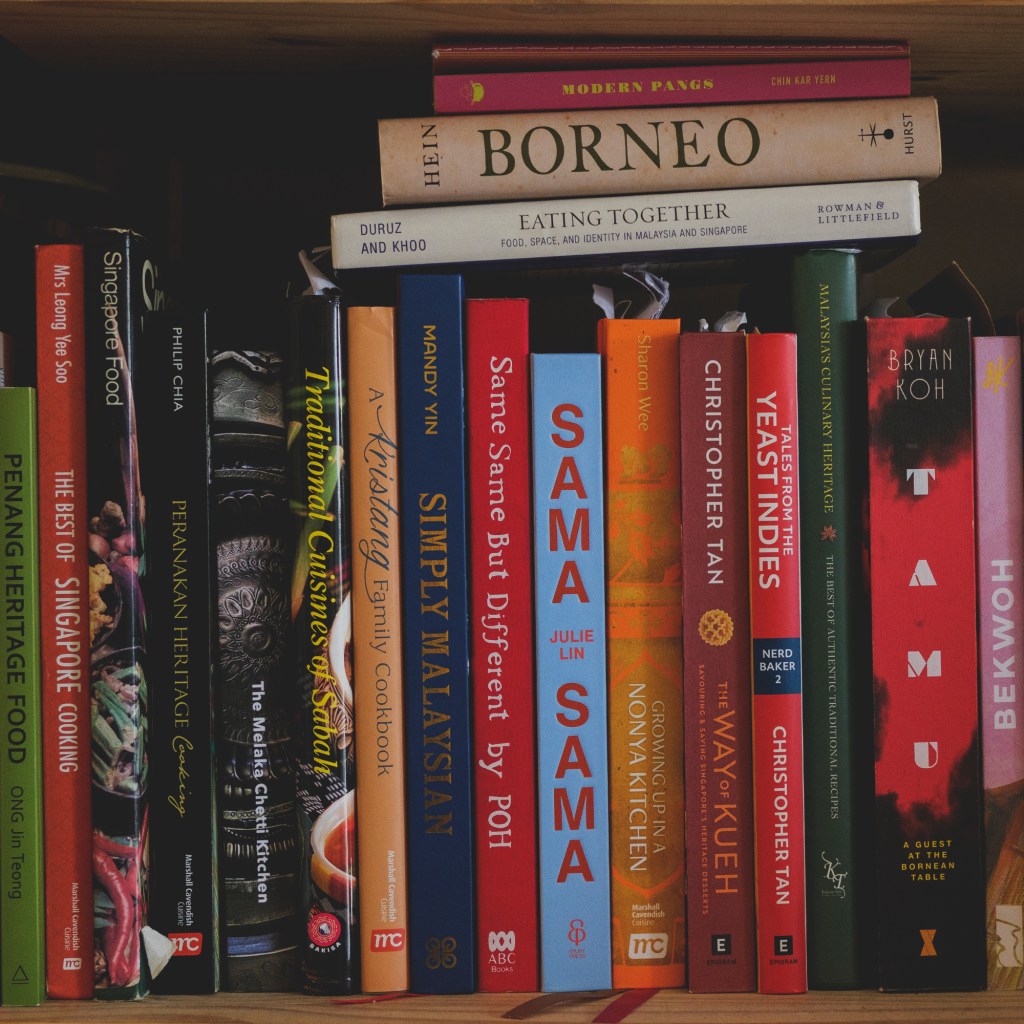
Cookbooks are a guide into another world. They are cultural artefacts that reveal a lot about who we are.
Malaysia entered the 21st Century with relative political stability. The conflict-ridden post-war years are long gone and Malaysians are now able to slow down and reflect on their own identity. For a country that is so new, what does it mean to be Malaysian?
Toffa Abdul Wahed is a researcher and librarian at the National Library of Singapore. She reveals how cookbooks of the past shape our understanding of cuisine and culture, focussing on two forgotten women: Siti Radiah and Haja Asfiah
Meanwhile, cookbook author and friend of the pod, Christopher Tan, shares his take on food social media – the good, the bad and the ugly.
Credits
Hosted by Dr Noby Leong and Philip Gibson
Produced by Dr Noby Leong and Philip Gibson
Sound Design by Jack Barr
Satay? Okay! is produced by Kopi Productions Limited and supported by the Golden Chopsticks Scholarship, by the Oxford Cultural Collective Trust
Resources and References
There are more than 4.6 million food posts on TikTok alone. Why, then, do we still love cookbooks? Garrett C. Van Dyk, The Conversation 25 February 2026 https://theconversation.com/there-are-more-than-4-6-million-food-posts-on-tiktok-alone-why-then-do-we-still-love-cookbooks-276505
The Ancient Mesopotamian Tablet as Cookbook, By Gojko Barjamovic, Patricia Jurado Gonzalez, Chelsea A. Graham, Agnete W. Lassen, Nawal Nasrallah, and Pia M. Sörensen, Latham’s Quarterly 11 June 2019
The world’s oldest-known recipes decoded, Ashley Winchest, BBC, 3 November 2019 https://www.bbc.co.uk/travel/article/20191103-the-worlds-oldest-known-recipes-decoded
The Ancient Babylonians, You’re Dead to Me BBC Radio 4 https://www.bbc.co.uk/sounds/play/p094pxxd
Transcipt
Please note that this transcript may contain errors and typos
Welcome to Satay OK podcast about the foods that
have shaped Malaysia. I’m Dr. Noby Leong, scientist,
food writer and broadcaster. And I’m Philip Gibson,
photographer and test kitchen assistant. And
in this series, we explore the history, cultures
and cuisines of Malaysia, from the ancient lands
of Southeast Asia all the way through to the
creation of a modern day nation. In today’s episode,
we take a look at cookbooks and the shape of
a new nation. So grab your shopping list and
get ready for satay. Okay. Philip, in the last
episode, we talked about the diaspora and the
increase in migrants leaving Malaysia from about
the 1970s. Right, yeah. And in today’s episode,
we’re marching forward in time and we’re basically
now in the 21st century. We’re in now times.
Oh my God. And we have this whole new generation
of Malaysians that are pretty different to the
generation before. And this new generation of
which I am part of have questions. Okay, so why
do you, Noby Leong, of the Malaysian diaspora,
think that you are different to the previous
generations? Well, we will get to that. But before
we do, let’s get into our food symbol of the
day that connects us to the past and our cultures.
And today, well, I guess it’s not really a food,
but it’s a food artifact. Okay. We’re talking
cookbooks. Right. I’m a massive fan of cookbooks.
I kind of collect them. Yep, I know. I think
if I had a lot more money and a lot more space,
I would have many more cookbooks. I’ve got a
few dozen. I mean, the bookshelf is like two
-ply. You can’t even see what’s behind the front
row of books. I mean, I didn’t really have many
growing up. I’m not really sure why I’ve become
obsessed with them now. But there were two cookbooks
in my house growing up. One was about Malaysian
classics and the other was Western cakes. Yeah.
And then I guess when I got into my 20s, I kind
of just went crazy. Do you have any favourites,
Phil? Do I have any favourite cookbooks? This
is going to sound so typically white male of
me, but I remember when I kind of got into making
bread in about 2011, 2012. And I think it…
was one of the bakers from the British Bake Off
who was talking on Twitter about tartine bread.
And I think they’d maybe recently released their
Brook tartine bread, which I think has become
a bit of a staple for bread makers. So that’s
a bakery in San Francisco, is that right? It
is. I’ve been, yeah, I got a croque monsieur
that was the length of my forearm and some other
kind of like pastry, probably a pan of chocolate
that was also probably enormous. And then I went
up to… dolores park i think and sat there and
watched a whole bunch of golden retrievers play
fighting with each other and i thought huh i’m
in san francisco and uh i you know what i actually
got a tote bag as well because i thought i’m
not coming all the way to tartine bread like
you know i think we all go through a sourdough
bread phase i think everyone is interested in
cooking at some point in their life Yeah, COVID
was definitely a big time for a lot of people,
but I’m going to be that arsehole because I’ve
got an arse degree. I’m going to be that arsehole
that’s got an art degree and talk about how,
although I was doing it before everybody, although
I definitely wasn’t, but anyway. I mean, my two
favourite cookbooks, or I should say the two…
Food books that really have influenced me the
most is certainly On Food and Cooking by Howard
McGee. Oh, yeah. So I guess that’s not really
a cookbook per se. That’s strong on your science
background. Yeah, it sort of is a science of
why we cook the way we do. You were talking about
the Maillard reaction before anybody else. And
then the other one is Every Grain of Rice by
Fuchsia Dunlop. Yeah, you have worn that book
out. I know, my copy is destroyed. Fuchsia, if
you’re listening, can we get a new copy? And
of course, I’ve got loads of Malaysian cookbooks
on my shelf. And in this podcast, we’ve had so
many cookbook authors. And you should definitely
get a lot of their cookbooks. They all offer
something different, I think. Definitely. I mean,
as we’ve covered in this podcast, there are so
many different kind of like cultural and ethnic
backgrounds that have all got their own books,
which you slowly started amassing. But it’s not
just that. Like, so what I’ve realized about
cookbooks, and I guess the question I had about
cookbooks is like, why are people still buying
cookbooks? and i say that because recipes are
basically free if you want them to be nowadays
yeah you can go on the internet you can scroll
through social media and you’ll find a dish that
you want to cook but cookbook sales are still
quite strong and there’s new cookbooks published
every year yeah and so i was like doing a bit
of like research and i came across this really
interesting article in the conversation by history
lecturer garrett c van dyke who talks about the
three types of cookbook buyers and what they’re
looking for okay So the first type of buyer,
he says, is an aspirational buyer, I suppose.
Buys it, will never cook from it. More like the
contents of the cookbook is something to aspire
to. So maybe you buy a cookbook by a top chef
and you’re trying to find the secrets of the
Michelin star kitchen or the secrets of being
that top restaurant chef. Or you might aspire
to be like… Nigella Lawson a domestic goddess
you’re aspiring to kind of put on a dinner party
that’s effortless a soiree yeah a supper yes
supper yeah the second type of cookbook buyer
is an everyday buyer right they want that everyday
question of what am I putting on the table inspire
me yeah yeah yeah but inspire me without too
much effort well that’s one aspect of it it could
be a budgetary constraint a time constraint so
jamie oliver books i think are really geared
towards this particularly meals yeah 15 minute
meals five seven meals in 30 seconds um but there’s
also those books like uh an air fryer book or
you know one pan books which is sort of fulfilling
that same question for those everyday cookbook
buyers. Yeah, well, I mean, you’d have brands
like Ninja. By the way, we are not sponsored
by anybody. But if they want to. But if they
want to. Yeah, I imagine that if you’ve bought
one of their new countertop appliances that can
cook a meal, the Thermomix must have had to produce
a recipe book because nothing cooks quite like
a Thermomix, right? And then the third type is
the escapist. And so this type of cookbook reader
kind of wants to be transported to another world.
They want to engage with the food through like
a memoir or a discussion on the history and culture.
And so Otto Lenge does this quite well with Jerusalem.
I would say Fuchsia Dunlop’s books delve a lot
into the history and culture as well. So I think
that is sort of covered by that genre. And certainly
a lot of the Malaysian cookbooks that I love.
teach you something about someone else’s world
right okay but yeah so those are the three that
this author has talked about the aspirational
the everyday and the escapist so what are you
an escapist i’m probably more of an escapist
and maybe every day sometimes but primarily i’m
an escapist i think i’m too practical i think
i just basically want to flick through something
go like that’ll do yeah and just hope that i
have it the ingredients in the cupboard otherwise
i’m going to be grossly inconvenient yeah to
the shops but i mean for me if i cook like five
recipes from a cookbook that that to me is like
wow i must really love that yeah i mean i mean
how much does it cost to eat out these days you’re
talking 20 quid for a meal and how much is the
cookbook 20 30 quid yeah that’s true all right
okay i mean i know you then have to put the labor
in but if you’re going to go out for the food
but then you could also cook it at home What
am I getting at? There’s a point there. If you’re
an escapist cook like me, who’s really need to
escape to another world, 20 pounds for a cookbook
or almost 20 pounds now to go to the movies.
Right, yeah, yeah, yeah. You could put it in
that. And some people do, like yourself, actually
enjoy cooking. They find it is actually quite
a therapeutic process, whereas some people are
like, I need to eat this as fuel. Yeah, yeah,
yeah. But I, if I’m cooking from a cookbook,
I like to set aside an afternoon to do so. And
I don’t like to rush. Yep. And then only until
that recipe is now part of my repertoire will
I do a 30 minute meal out of it kind of thing.
Yeah, I think I try to do the same thing, telling
myself it won’t take me an hour and then I’m
still standing over the stove at nine o ‘clock
at night. Yeah. So, but then I… I’ve also cooked
three times as much of it because I’m lazy. And
so then trying to be economical and batch cook
stuff and then realize there’s no room in the
freezer. But, you know, with all the cookbook
authors that we’ve featured on this podcast before,
they’re all part of those Venn diagram of aspirational
escapists and everyday. But why do we need labels?
It’s not like you have to be one or the other
necessarily. But the reason why we’re talking
about cookbooks today is that cookbooks are more
than just recipe books. Sure. And they are. artifacts
that can reveal who we are as a people and what
our culture is so the oldest cookbook or i guess
set of recipes written is about 4 000 years old
okay they’re called the yale culinary tablets
and they’re from a region in mesopotamia so modern
day iraq syria and turkey so they’re on stone
tablets written in cuneiform which is the ancient
oh sure right okay um three of the tablets are
from 1730 bc and one of the tablets is from about
a thousand years later So the recipes in them
are quite short and very different to what we’re
used to today. So this is the recipe for stew
of lamb. Meat is used. You prepare water. You
add fat. You add fine -grained salt, dried barley,
cakes, onion, Persian shallot, and milk. You
crush and add leek and garlic. So that’s the
recipe. Sometimes when I read this recipe, I’ve
read it a few times now, it almost sounds accusational.
You add the fat. You add the salt. But I don’t
think it was really written with that in mind.
Maybe that says more about you, Noby. Aside
from those short written recipes, there were
also joke menus, which I thought was very, very
interesting. There are parodies written in these
culinary tablets, I believe. And they were perhaps
by Babylonian jesters. So this is one of the
joke menus that is on the tablets. Okay. Month
of Sabatu. What is your food? you shall eat still
hot bread and the buttock of a donkey stallion
stuffed with dog poop and the excrement of dust
flies. Nice. So when I read that, I was like,
this is outrageous. Toilet humour has existed
for 4 ,000 years. Yeah. And I think it gives
you this idea of how important food was even,
you know, 4 ,000 years ago. that people were
writing this on stone tablets, which is a very
labor intensive process. So there’s this idea
that cuisine was really important. They knew
about, you know, banquets, foods for different
occasions, foods that are ours, foods that are
foreign, quote unquote, mock foods. So I found
that to be fascinating, really. Yeah, yeah. And
I think those ideas are still prevalent today
in questioning who we are as Malaysians. Yeah.
No, I think the historical cookbooks are definitely
interesting because I feel like I’ve come across
a couple. And I guess even when we think about
like the recipes that we use from our grandparents
and stuff like that, you know, that’s still within
living memory. But you’re looking at something
that was possibly handwritten 50 years ago. Yeah,
yeah. And, you know, how was that impacted by
their grandparents or the availability of food
at the time? yeah when margarine came on the
scene whoa let’s not stop using butter well yeah
there’s so much information coded within these
within these recipes whether or not you can like
read that code of what was available what was
in vogue yeah you know was was lab available
back in mesopotamian times now we know that it
was yeah um or then you go to my nana’s kitchen
and it’s early microwave cooking um you know
my nana had one of these old sony microwaves
or something like that that was the size of a
caravan it was enormous but she always used to
steam corn on the cob beautifully in it so you
had corn back then that was you know we know
that now i think we’ve had corn for a wee while
back back then what what you know 25 years ago
yeah ah no we had corn so the reason why we’re
so interested in this is because of i guess where
we are in malaysia’s journey yeah so in the last
episode we talked about the emerging malaysian
diaspora and malaysia really was reshaped through
the national economic policy which among many
things helped to modernize the country and bring
a lot of wealth so we’re continuing that journey
today into the 21st century and we now have malaysians
that are wealthier more connected than ever with
the internet. And interestingly, this is the
first generation of Malaysians that have only
ever known Malaysia. Right. I’m part of this
generation that I never grew up under British
Malaya. I wasn’t around during the Japanese occupation.
I didn’t know anything about the independence
movement. I wasn’t around during the independence
movement of the 50s and 60s. I’ve only ever known
a Malaysia that is Malaysia and not part of anything
else. Sure, right, yeah. You know? so i think
i might be projecting a bit here philip but i
think that in the 21st century there’s a huge
desire to maybe navel gaze a little bit i do
this a lot um because you know i’m constantly
having a midlife crisis and an identity crisis
sure but there’s this tendency to really look
at ourselves and ask who who am i who what does
it mean to be malaysian or malaysian australian
or what’s my place in this yeah i feel like i’ve
come across this on social media as well like
where you see people who perhaps are never been
more educated never had more access to travel
and appreciation and have had the luxury of not
having to worry about other things that they
can start to worry about themselves and their
identity and what have you, which, you know,
is a very good exercise, I think. And I think
these questions become particularly important
for people from Malaysia, Singapore and Indonesia
because this is a reminder that these countries
only became independent very, very recently.
Right, yeah. So Malaysia only became independent
in 1957. Before that, it was part of the British
Empire. And before that, it was… i guess part
of nusantara you know that huge collection of
cultures that make up the archipelago right so
malaysia has gone from a borderless state to
one with some pretty hard borders really very
very recently sure so the question of what it
means to be malaysian and what is malaysian culture
becomes um quite challenging to answer i suppose
right because which parts of your culture do
you distill from this arbitrary border that colonialism
has drawn for you right and which parts of your
culture was from the ancient times so if we’re
trying to understand malaysian food culture more
or singaporean or indonesian what better way
than to examine the role of cookbooks and what
that tells us about our culture and who we are
today i see so we have two fabulous guests today
who are ironically both from singapore Christopher
Tan and Toffa Abdul Wahed. So first, let’s chat
to friend of the pod, Christopher Tan, who we
first spoke to in season one, where he lent his
expertise on Kueh. But he’s back today talking
about the importance of food to our culture,
why we’re so obsessed with food here in Malaysia,
Singapore, Southeast Asia in general, and also
the importance of cookbooks. Because he is, of
course, a renowned cookbook author. He’s written
Nerdbaker. The Way of Kueh, and his most recent
book is Tales of the Yeast Indies. Love the pun.
So let’s ask Christopher, why is food so important
to Southeast Asia and Southeast Asian culture?
If you think about it, three meals a day, you
have three opportunities a day, more if you’re
a diehard supper or elevenses or high tea person,
right? Multiple opportunities a day to celebrate
history. to connect with your family, to connect
with your community, to relive something or to
remake something. What other things do you do
multiple times a day that afford you all these
opportunities? Food is a very unique carrier
of culture in that respect. But broadly speaking,
all cultures eat three meals a day. Why are Asians
any different? I think if you come from a culture
where you do your shopping at wet markets, where
you have to be fully invested in selecting your
produce and haggling for it and forging relationships
with the vendors and then you bring it home and
cook it, that all takes time. That consumes a
large part of your day and you are necessarily
more focused on that. I interviewed a Chetti Peranakan
lady for my book and she remembers her grandma
walking, from somewhere in town to Little India,
buying all her groceries and taking a trishaw
back. And that would easily take about three
or four hours every morning. So if you have that
kind of experience, you are necessarily thinking
about food on some level just to get through
the day, historically speaking. This intense
connection to food means that cuisine is important
not just to personal identities, but national
identities too. You know, the act of cooking
together is as an important part of the meal
as actually eating it. We’re definitely losing
that. Also, as families get smaller and as people
seek to, you know, when they grow up, get married
and move away from their immediate family and
families get fragmented like that, it’s hard
to maintain these kinds of traditions. And you
have to prioritise and you have to realise how
important it is for the maintenance of not just
family tradition, but national custom. every
hawker food dish every restaurant dish was a
home dish at one point okay you know i’m sure
some dishes were dreamed up especially for restaurants
i’m not talking about you know uh highly lauded
chefs tasting menus that kind of thing i’m thinking
of things like lasagna which you will find in
a million italian restaurants but also that was
a home dish at some point and so what we think
of as a country’s national cuisine or cuisines
ultimately came from a home kitchen So I like
to warn my students when I teach them, I said,
if you look at what’s cooking in home kitchens
in Singapore today, what will our great -great
-grandchildren think of as Singaporean food?
Because what we cook today will become associated
in their minds with Singaporean food. And that
was Christopher Tan. We’re going to come back
to him later in the episode. But I think talking
to Christopher is always a good reminder of why
food is so important to Malaysians, Singaporeans
and a lot of Southeast Asians, because it is
so prevalent in our lives. It’s much more prevalent
in our lives than I think here in the UK. because
you’ve got wet markets, you’ve got street food
vendors in your face all the time. Yeah, yeah,
yeah. No, totally. It’s something I actually
need to go back and talk to my nana about because
she used to work in a butcher before supermarkets
and things like that. And you think about actually
how much the active convenience of having a supermarket
has kind of obliterated a lot of even like in
the UK and every other country now that has supermarkets.
Yeah. Has… you know completely ruined the experience
of cooking from scratch not okay not totally
but like but like you know if you’ve got all
of these punnets of pre -prepared cuts of meat
or mince or fish or whatever the hell it is you
then cooking becomes mechanical i feel like as
opposed to this and that’s where it comes back
to this is like cooking for convenience and this
is like 20 minute meals as opposed to like yeah
okay you could probably make something delicious
but You’re trying to get through the process
as quickly as possible. You’re not enjoying the
process of cooking if you’re rushing it. I wish
more people understood that cooking itself can
be just as satisfying and rewarding as the meal
itself. I think that’s subjective. I think some
people really do, like yourself, enjoy the process
of cooking, but other people just kind of…
you know I was chatting to somebody and they
were saying about how like I really hate cooking
alone because cooking alone is a functional process
whereas cooking with people and that’s what he’s
saying about family and things like that as well
and I remember when I was at your cousin’s place
in Malacca for Chinese New Year last year and
you know it’s that way where there’s all these
people together and even in my own family like
Christmas dinner is like our one big you know
feast a year right and I think I enjoy being
in the kitchen for four or five hours cooking
the meal because that is where you’re quite communal
and that’s where you’re actually socialising
as much as you’re actually doing something because
Because you can’t actually, I mean, I’m not,
you know, Mediterranean and I don’t have dinner
for four hours. Like, you know, I’m not sitting
around a table chatting while I’m eating. Because
like, you know, when the food’s served, we also
like our food to be piping hot in my family.
And therefore you try to eat it as quickly as
possible. And so you’ve got all of this like
cooking, which is what I really enjoy, but you’re
also on your feet. And then I think as soon as
you sit down at the dinner table, it all just,
like it falls out of you and you’re kind of like,
oh, well, all that’s left to do is eat. I think
it’s a function of how Malaysian society works
as well, that food is a lot more affordable than
it is in the UK. So people can go out to eat
all the time. They can socialize around a meal
all the time. And we talk about food a lot in
Malaysia. Like the level of detail with which
we will dissect a meal in part of just daily
conversation is quite intense. And I think you’ve
been… an observer to some of these conversations
where it’d be like me and a malaysian friend
talking about the specifics of dal for half an
hour and what we like and don’t like yeah not
from a like a scientific point of view or a like
a restauranty kind of view but Just a minutiae
of our personal preferences. Sure. I think if
there was like a World Cup of like people that
call themselves foodies, I think Malaysia and
Singapore are always going to be in the final.
I’ll take that. Yeah. I think that’s the only
Olympic badge that I’ll ever get in life if that
happens. It’s not even Olympic, it’s FIFA, but
yeah. So let’s keep going with this conversation
about the food and let’s bring in now the role
of cookbooks. and what they can teach us about
our history and culture. Because cookbooks written
today are actually very, very different to cookbooks
of the past. I’m not just talking about the 4
,000 -year -old cuneiform tablets, but more recent
history. And they can reveal a lot about who
we are. I obviously know nothing about historical
cookbooks. So we took a trip to the National
Library of Singapore where we met librarian Toffa
Abdul Wahed. So Toffa is a librarian and researcher
who specialises in food stories. So if there
was someone that could teach us about cookbooks
and their role in our culture, it’s Toffa. I
think cookbooks, regardless of when they were
produced, they are a snapshot of what was happening
at that time and place. Hi, I’m Tofa Abdul Wahed.
I’m one of the librarians at the National Library
and I work with the Singapore and Southeast Asia
collections. My area of interest is Malay cookbooks
from the early 20th century to about the 1980s.
So generally cookbooks, they are more than just
practical guides, not just a collection of recipes,
but they also reflect a lot about a certain period
and time, the place, the culture, the people
that you know were from that period and also
from that place. It also tells us, it gives us
a snapshot for instance of the earlier 20th century,
the kinds of ingredients that were available,
the kinds of things that were sold at the markets
for instance. Also the tools that were used which
are different from what we use today and also
culinary techniques and practices. They also
shed light especially about the domestic life,
the not so public life of people and especially
in this case women. This was especially the case
with cookbooks published in the late 19th century
and early 20th century. For instance in the case
of Malaysia and Singapore or maybe even other
cookbooks from other areas of the world in the
early 20th century or even in the late 19th century,
the authors or publishers would specifically
address women in their prefaces or in their notes.
So in the case of Singapore and Malaya, the authors
would address these women as kaum istri, wives,
kaum ibu, mothers, as well as gadis or saudari,
which can mean sisters or girls. And in the context
of the home in Malaya and Singapore, cooking
was seen as an essential skill. And women were
expected to be what they call household managers.
Urusan rumah tangga, household management. So
they were not only doing cooking. A lot of their
day -to -day roles was… like doing laundry,
sewing, stocking the pantry, taking care of the
furniture, the decor of the house. So some of
these cookbooks, I wouldn’t say they were technically
just cookbooks, but they were practical guides
that included other things about the household.
Not only was the audience of cookbooks different
in the past, so too were the cookbook authors.
Cookbooks today are written by chefs, restauranteurs.
In the past, in Malaya and Singapore, they were
written by people who just had this strong desire
to share knowledge, to disseminate information
and knowledge with regards to the culinary. It
was a time where there was not enough books for
women, for instance. And there were authors like
Siti Radiah Mohamad Saleh, an author based in
Singapore, but was from Malaya. she called for
other women in one of her cookbook prefaces she
said that there was a lack of books guide books
practical books for women and there needed to
be more books that would guide women in managing
the household and especially in cooking and um
i think i like today you know like you may want
to document let’s say what your restaurant does
or kind of like the brand of a restaurant, I
don’t think they were very concerned with those
things back then. It was really practical. And
the reason for the advocacy of education, in
this sense, was also a way for them to upgrade
their skills in consideration of the larger context
of Malaya and Singapore, the nationalist struggle
against colonialism. Back then, the Malay women
wanted to be seen as on par with other women
of other races. So cookbooks were a form of resistance
and rebellion. And though the cookbook authors
didn’t know it at the time, they became cultural
custodians. Yes, they were custodians of cuisine.
But I think custodian kind of has that connotation
that it’s… they were working towards preservation
of a certain heritage or a culture or traditions.
But I think the women at that time, especially
in the period right after the war, World War
II ended in 1945, and the period of the 50s,
it wasn’t so much of preservation of heritage.
It was just to help other women and share knowledge
about culinary skills. And these skills were
also… not only just related to cooking of traditional
malay dishes they also incorporate western style
cuisine like cakes puddings custards biscuits
yes so it wasn’t so much of copying the west
but the idea was that using these techniques
which they call modern because western cakes
and biscuits and puddings were classified as
the new style of kuih or snacks and some even
called it modern kuih as compared to more traditional
dishes. It wasn’t so much of copying the rest
but it’s more of incorporating new techniques
into whatever repertoire they already had in
the kitchens and homes. We have to also acknowledged
that it wasn’t just the cookbook author who were
custodians but it was also the practitioners
of cooking the home cook the housewife because
it’s in tandem you know the authors they they
recognize what people desired for what kind of
recipes people wanted to learn but at the same
time the the people who wanted to learn these
recipes they were also shapers of you know the
general food culture Despite the importance of
cookbooks, they don’t often get a lot of recognition,
and sometimes their importance is even dismissed.
Cookbooks, sometimes I believe they are overlooked
as a serious topic of research. When it comes
to, for instance, even Siti Radiah herself, right,
the author of a few cookbooks published in Singapore
from the late 40s to the early 60s. She was very
adamant about expanding Malay literature to encompass
cookbook. And when we think of literature today,
you know, it’s like perhaps literary works, poetry,
non -fiction books related to history, geography,
and things like that. But cookbooks themselves
have a place in the larger literature. She saw
cookbooks as a way for women to progress. So
that was Toffa Abdul Wahed. We’re going to hear
from her again in a second, but I just wanted
to sort of unpack a little bit of what she was
talking about. And, you know, after listening
to her, I can’t help but look at my own cookbook
shelf and look at what all of these modern day
cookbooks are saying about our society today.
You know, there’s so many cookbooks written by
people that are trying to preserve their culture
or talk a lot about the history and culture of.
aspects of Malaysia society, whether it’s like,
you know, Malay life, Malacca Chettis, Chinese
Peranakan, those sorts of things. And that kind
of tells you that today we’re losing a lot of
that culture. Right. Authors feel compelled to
write and preserve about that. Right. Yeah. And
I look at some of my other cookbooks by, you
know, Jamie Oliver, Nigella Lawson, that kind
of, it’s just business. Well, it points to the
role of chefs as celebrities these days. And
so that tells you a lot about how our society
has evolved as well. So it’s so, interesting
to look at these cookbooks with what Topher has
mentioned. Right. Yeah. I mean, that’s more of
a kind of psychoanalytic dive that you could
go down to the motivations between the consumer
and the producer. But like, yeah, I think there’s
a million motivations for people to write these
things. And there’s also a million motivations
for people to consume them. I think what’s important
is that. the documents are being produced yeah
yeah and you know i really love toffer mentioning
that cookbooks are a form of literature right
that they are like poetry or fiction books and
that they should have a lot of value placed onto
them that they should have recognition and they’re
not just sets of recipes that it is literature
and part of our culture yeah I think that goes
for a lot of mediums, though. I take photographs
and I sometimes think that the photographs that
I take aren’t particularly interesting, but I
know as time passes, they become more interesting
because they then all of a sudden become artefacts.
Yeah, yeah. So, yeah. If you’re enjoying this
episode, follow us on social media at SatayOK.
We’ve got more stories and more food to share.
You can also find links to give us a donation
or tip. We’re an independent podcast and every
ringgit, dollar and pound goes directly to supporting
our work. So give us a follow and say hello at
SatayOK. So let’s go back to Toffa now. And she’s
already mentioned one cookbook author who tells
a lot about our own history and culture, and
that was Siti Radia. But she shared with me another
one, someone just as important, that reveals
something about our past. There’s a cookbook
written in 1986 by a Singaporean author, Haja
Asfiah Abdullah. She was also called Cikgu Asfiah.
Cikgu is a respectful term for a teacher. She
was born in Kampong Gelam. which was a very cosmopolitan
hub back in the days in Singapore. And where
it attracted so many people from across the archipelago,
the Javanese, the Balinese, to come and settle,
to work, to live. And also we had Arab traders,
Arab merchants, and also Indian traders there.
She grew up in this, I would say, city or town,
cosmopolitan area in Singapore where she was
exposed to many different cuisines of the larger
Malay world. The cosmopolitan upbringing led
Hajah Asfiah to see the value in culture and
heritage. And throughout her life, she conducted
classes on a range of cultural elements, including
cooking, embroidery and wedding rituals. She
was a cultural advocate. Throughout her life,
she was so serious about this that Towards the
end of her life, she managed to compile a cookbook.
Even though she was very, very old and ill, with
the help of her family, she wrote this cookbook,
which was published just a year before she passed.
And in the cookbook, she wrote a dedication for
her family and also to the larger Malay community,
hoping that these recipes, traditional Malay
recipes, would be cherished for a long time.
yeah so you know she she was she was a very very
important figure who has been largely forgotten
today and i didn’t even know about her until
i came across her cookbook hidangan warisan kita
our heritage station i think at that time because
singapore was undergoing such rapid changes industrialization
after after gaining independence in 65 and people
were being moved out of their traditional ways
of life, like the kampong houses, for instance,
and they were moving to high -rise buildings,
public housing. So I think there was that anxiety
about things disappearing, so they needed to
document it. In some ways, Hajah Asfiah’s fears
have come true, and her books demonstrate the
dishes that are still consumed and those that
have been lost. A section at the end of the book
dedicated to Gubahan. Gubah is to arrange. So
a gubahan is an arrangement. You can also say
lagu gubahan, a gubahan of a song. In this case,
the gubahan referred to elaborately prepared
dishes for either an engagement or a wedding.
So I think there were about six to seven dishes
at the end. I looked through the dishes. I haven’t
seen any of them for the longest time. Maybe
when I was a kid. in the 90s in the 90s I saw
some of them but I think they pretty much died
out in the 2000s and people are more the Malay
community in Singapore especially they kind of
like the minimalist look now the pastels the
very clean looks even when it comes to clothes
you know so in the past it was like this arrangement
almost like a bouquet of food and I recreated
one of them called bunga kobes which translates
to cabbage flower. It’s not a very beautiful
name in English, but in Malay it’s very poetic.
Bunga Kobis. And it was for one of the episodes
of a series produced by the National Library
called From Book to Cook. It basically involves
creating almost a rugby -sized ball of meat and
dough. Fried dough. Yes. I would call it a rugby
ball. It was so hard. It was one of… It was
probably the most technical dish I ever had to
make. You create the dough, and then you put
the minced meat inside. Already prepared, already
fried with some spices. And then you wrap it,
you deep fry it. That first package. And then,
it’s kind of like a Matryoshka doll. Oh yes,
yep. Where you just keep folding and folding.
And you keep frying. Yeah. So you add more meat,
you put the… original one inside and then just
keep folding and wrapping and you just keep frying
yeah and once you have like six seven layers
you cut it open and it will look like a cabbage
yeah and and and it’s it’s it’s a tradition that
has died out today in singapore and um i was
reading online some of the comments to that to
that video um people um remember their mothers
or their community making the dish for weddings
in the 60s. And this book was published in the
80s. So, you know, she’s too bad it has died
out. But I can see why it has died out. It’s
such a laborious thing to make. When we look
at what Cigku Asfiah was trying to document,
I think there is a time and place for a slower
way of cooking, or just to honour that culture
or tradition that our grandmothers, our families
back in the past, would have had a taste of.
These two authors, Siti Radiah and Hajah Asfiah,
really show us the two sides of the culinary
coin. So these two women, they both had very
keen senses of the time. They had their pulse
on what was happening. So for Radia, she had
a pulse on what was growing. what was the shifting
trends within the cuisine at that time in the
late 40s and 50s. On the other hand, Cigku Asfiah,
she had a pulse on what was dying out or
at risk of disappearing and hence wanting to
document. I wouldn’t say they were so much shapers
of cuisine or creators of cuisine, but they enabled
their readers to continue and contribute. You
know, it’s like Like I said, in tandem. It’s
a collaborative effort. It isn’t just the authors
who drive changes within cuisine or culinary
culture or even domestic culture, but it is the
people who practice it. They were very vocal.
We should remember them as very vocal women who
were willing to pretty much be the forerunner
or the forbearer of culture that they were experiencing
at that time. In Siti Radiah’s case, for women’s
education and progress, and also in encouraging
women to upgrade themselves, expand their culinary
skills. And for Cikgu Asfiah, as someone who
was very passionate and in love with the culture
or the heritage that she herself had inherited
from what she would call pusaka ibu. Pusaka is
the word for… inheritance and Ibu is mothers.
So this knowledge, generations of mothers that
she wanted to keep. What a beautiful sentiment
to sort of sum up the work of those two authors,
Siti Rajia and Haja Asfiah of mothers’ inheritance.
And I think, you know, we’ve talked about this
in the podcast before of the role of women in
shaping our culture and passing down the culture.
And also, that’s the reason why we also don’t
talk about food and cookbooks in the same way
that we talk about other aspects of our culture
because it’s women’s work. No, 100%. I think
it was really interesting when we interviewed
Tofa over the course of our trip through Southeast
Asia and we hadn’t really properly done Malaysia
yet, really. Okay, we’d been there for two weeks.
We’d had a week in Penang and a week in Malacca.
i think it was this conversation that then made
me stop and realize hang on a minute this is
all about women and and the role that women play
in like being cultural custodians to keep using
that word then when we went back up to kuala
lumpur and spent a few weeks there and interviewed
a bunch of people like calcium type and the malacca
jetties and a bunch of other people it made me
think like we do not recognise, I think, the
role of women in the arts in general. Do you
know what I mean? And it made me stop and think
about what’s going on over here, of course. I
always compare it back to what’s going on at
home. And that’s invaluable, I think, the contribution
that women have made to culture and society and
just the vibrancy of life that we live. Yeah,
I think that is that’s it is like making life
worth living because you know for me and my family
right food made life Worth living is what we
thought about when we went to bed as we thought
about we would first work up sure It’s what all
our socializing was based around. Yeah, and it
was my mom that made that life. Yeah Not to be
reductive, but I think if it was just left to
men, I think we’d just be eating steak all the
time and it’d be kind of boring. It would be
very, very boring. But yeah, there were so many
interesting points throughout the entire interview.
I want to make this cabbage flour. It sounds
fascinating. I’ve seen the video on YouTube.
Definitely check it out. Go into the National
Library of Singapore’s YouTube channel because
it’s really interesting to see this, I guess,
historical food being brought to life. Yep. No,
it’s a bit Turducken -esque, isn’t it? With all
these kind of like constant layers. Almost, yeah.
But that wasn’t the end of the interview with
Toffa and she had so many interesting things
to share like the evolution of cookbooks. We
ended the interview talking about how cookbooks
have changed over time and how social media is
now a new form of cookbooks. So let’s go back
to Toffa and also let’s bring back in Christopher
Tan who’s going to share his thoughts as well
about the evolution of sharing recipes. One of
the most striking changes for me personally,
when you’re looking through the cookbooks of
the 20th century Singapore and Malaya, is the
visuals. In the earlier part of the century,
a lot of the cookbooks would be purely text.
Very instructional manual. This is the recipe,
how many grams, done. And the instructions are
really, really short. I’m not sure whether the
the the authors were assuming that women kind
of the women who were reading these books already
had a lot of knowledge or perhaps at that time
you know cookbook formats also shifted over time
to have lengthy more lengthy recipes more detailed
recipes and the visuals you had hand -drawn illustrations
coming in around i think from what i’ve seen
about late 40s and I think at that time in the
50s a lot of the illustrations also on the book
covers were very poppy and vibrant the covers
were colored but the illustrations within the
book were not most of the time and the colored
illustrations were very vibrant and they were
very very reminiscent of the comic books that
were being published around the same time and
and some of the comic book the comic book artists
the comic artists also kind of you know they
went into like creating illustration for films
like billboards and i think i believe some of
them also went into illustrating for cookbooks
the industry was very closely knit at that time
the publishing industry and um once you go into
the 60s late 60s and 70s you know you have photographs
beginning to be interwoven into the cookbooks
Apart from the visuals, like I mentioned earlier,
the shift of how women cookbook authors in Singapore
and Malaya were very concerned about women’s
education. But as you come to today, people are
more concerned about preservation of heritage
and traditions. Unlike the earlier cookbooks
that were very instructional, almost like a school
text or home economics text. Cookbooks today,
at least in the past 10 years, you see a lot
of personal stories, family stories being interwoven
and creating this larger narrative of family,
of migration and nostalgia. I don’t think there
was any hint of nostalgia in a lot of the books
in the earlier 20th century. While there are
many cookbooks concerned with preservation today,
there are many cuisines and cultures underrepresented
in the literature. I think in the context of
Malaya, and later Malaysia and Singapore. Of
course, there’s a lot of emphasis about the larger
ethnic groups, but the minority groups like the
Orang Asli and the Orang Laut. The Orang Laut
in Singapore, especially, we can’t talk in confidence
about their cuisine because there’s not much
documented. I don’t think there’s a dedicated
cookbook about the cuisine of the Orang Laut
in Singapore. The Orang Laut are a seafaring
tradition historically. seafaring community.
They are no longer seafaring in Singapore, but
there are still other seafaring communities around
Southeast Asia. And I would like to see, you
know, a cookbook about the cuisine of seafaring
communities throughout Southeast Asia, including
the Bajau Laut in Malaysia, the Mokian, and
of course the Orang Laut in Singapore. Cookbooks,
of course, aren’t the only ways to document or
transmit culture. Social media is now playing
a big role, and libraries now need to consider
posts, likes and stories as cultural artefacts
too. They are artefacts. In fact, the National
Library has this initiative, and also it’s an
initiative that’s also being done in other parts
of the world, this thing called contemporary
collecting. So contemporary collecting basically
looks at collecting materials from contemporary
life of the 21st century. So social media is
one. TikToks, YouTube videos, maybe even tweets.
I don’t know. But for the National Library, we
do collect social media accounts, also websites.
Those are all new forms of media that need to
be collected to basically… serve as a snapshot
of today’s life for researchers in the future.
Social media and the internet provide new opportunities
to preserve and share culture. But it comes with
many challenges too, as Christopher Tan pointed
out. People are relying on social media platforms
to supply them with information. As we know,
the internet is always right, except it’s not.
How do younger folks who grow up online, how
do they choose what to let their attention rest
on? How do they choose what to watch? I think
one of the aspects in which it has changed how
people think about food is that we are much more
visually attuned to food now. So in order to
make it onto Instagram, in order to make it onto
TikTok, something has to look a certain way.
In the past, I think flavour was the main objective.
It probably still is, but I think the look of
a dish is a lot more salient nowadays. Social
media is a tool. It can be used for good, it
can be used for bad. It’s how you use it. But
I think we should never let an algorithm substitute
for our own curiosity. We should follow our own
sense of what is interesting and our own palettes
rather than… having it dictated to us, oh,
this is a trendy thing, this is a top thing,
this is what you must be interested in. We should
follow our own noses more, I think, and on a
practical level by just going out and eating
more things and looking at more things. You know,
where things like Instagram come in very handy
is in bringing to light rare dishes or maybe…
highly endangered dishes that people didn’t know
about before. So it’s really useful in that aspect.
And there are many accounts on Insta using it
to highlight regional vegetables or forgotten
herbs or old folk medicine foods and things like
that. Whether it’s cookbooks, social media or
handwritten notes, Christopher Tan has some advice
for people learning to cook. And actually you
know now that I realize a lot of people now learn
to cook from watching videos rather than reading
cookbook or getting one -to -one instruction
you know and I think while obviously watching
a video and watching someone else do it is better
than reading a dry text it’s still not a perfect
substitute for standing next to someone in the
kitchen and getting it taught to you because
that kind of learning by osmosis and and direct
tasting and seeing is the best way to pass on
a recipe I think you know but but also The thing
is now because algorithms are dictating how people
edit cooking videos online, it gives people a
false sense of security sometimes. They think,
well, that looks easy. And then they try and
it’s not. And then they get scared. And even
just these short videos that dispense nuggets
of information. Sometimes cooking is a lot more
nuanced than it can be summed up in a two -minute
video. And there are many more grace notes and
fine points that are involved that don’t make
it into the edit. With the evolution from written
recipes to video -based recipes, traditional
dishes are being adapted. I asked Christopher
his thoughts on this evolution. As I’ve said
before in some of the books I’ve written, tradition
should not be a straight jacket. It should be
a launch pad. It should be your foundation. And
from there, you can progress. But it shouldn’t
be a constricting force. Because food has always
evolved. It is extremely arbitrary to say, this
is the traditional version. Anything created
or… Any twist added beyond a certain point
is invalid. Like I said, cuisine grows organically
out of a community. At the same time, I think
leaps of logic shouldn’t be utterly confounding.
I wouldn’t want to eat an ondeh -ondeh with a
foie gras filling. Some combinations which are
obviously destined, dreamed up to be clickbait,
I have no time for. So I made it a point, the
last four recipes in my Kueh book, are examples
of what I think is sensible innovation. Okay,
so there’s a Malay Kueh called Kole Kole which
is a very, very… malay kueh which is made with
with mung beans which are roasted um until they’re
sort of a deep golden brown in color that then
they ground up and then into a powder and then
they’re cooked with coconut milk to make almost
like a hawa it’s almost like like like a like
a it sets when it’s cool it’s almost like a fudge
kind of texture um and so in so i had a different
version where i added some cocoa to it because
kakao bean mung bean they’re both beans they
both have that earthiness to them and then i
added some uh cashew nuts instead of coconut
milk because they’re both nuts and they have
they have that fattiness you mean so so to me
i am replicating the same earthy fatty flavor
contrast but with different ingredients and so
to me i thought that was allowable i mean you
know if you live with these ingredients day in
and day out you will know how to use them you
will know how to to get away with experimentation
but innovation is not just acceptable in many
ways it’s crucial a food In order to survive
and to persist in a culture, a food has to be
relevant to every generation that makes it. And
if the younger generations don’t find it relevant,
they’ll stop making it. So the question is, how
can they find it relevant? How can they put their
own stamp on it in a way that it makes sense
to them? And in a non -trivial sense, every generation
has to do this with everything, just because
agriculture has changed, climate has changed,
the kind of blacchan I can get nowadays. is probably
not that much like the belacan my grandma would
have used, just because of changes in fishing
and changes in weather. A lot of kuehs are difficult
to make now because global warming has increased
the humidity, ambient humidity, and it’s harder
to dry things out in the sun now. So I feel if
you misunderstand tradition or if you don’t grasp
what the history of a dish is, you’re not super
well equipped to take it further. But at the
same time, like I said, you cannot feel so constrained
by the history that you don’t adapt it. There’s
a mindset that treats traditional cuisine as
something, as like a museum exhibit. You know,
you can’t change it. You can’t make it any other
way. It must be revered and adored only in this
form. And woe betide you if you do something
different. But that’s the surest way to kill
a dish. Things persist because they can adapt.
They can adapt to a changing world. It’s quite
amazing reading. old historical texts. I have
like a Kueh cookbook from the 1920s. I have one
from the 1800s. Many of the Kuehs are completely
recognisable. You know, they have hardly changed
at all. And you figure that they must be so ingrained
in the culture already in that form in order
to persist that long that no one feels that they
need to fiddle with it. And that was food writer
Christopher Tan and also Toffa Abdul Wahed.
from the National Library of Singapore. So many
things covered in those two interviews, but I
guess it tells you this like story of how cuisine
evolves and how literature and now social media
can tell us about this journey. Right. And I
think it’s so interesting that, you know, Topher
talks so much about these cookbooks from our
past that tell us a lot about who we are, what
our society was like back in the day, what people
were cooking, what people were eating. But then…
Christopher also reminds us that those traditions
have to evolve at some point as well. Or not
that they have to evolve, but it’s okay if they
do. Yes, shouldn’t be a straight jacket, I quite
like that. Yeah, yeah, yeah. So as we sort of
navel gaze, look at our identities, I know I’m
sort of guilty of thinking, oh, to be Malaysian,
or to be Chinese Malaysian, is to be X, Y, and
Z. Right. To tick off a very specific… criteria
of things that make up the food or make up the
culture or make up myself right but i think this
conversation was a good reminder that’s not necessarily
the case well particularly in a country that’s
got such a hybrid identity between so many different
cultures and races and things like that is like
i feel like there’s no one way to be malaysian
and isn’t that kind of the entire point of this
entire project exactly could have said about
myself philip yeah so if we go back to our food
symbol of the day Cookbooks, more than just pretty
pictures, they’re cultural artifacts, they’re
literature in their own right. They tell us a
lot about the things we consume today and…
Will eventually become a record of the things
we ate in the past. Exactly. And if you are going
to Malaysia or going to Singapore, my recommendation
to buy cookbooks is Kinokuniya. which you can
get in Kuala Lumpur and also Singapore really
really big bookstore they’ve got a huge selection
of cookbooks from local writers and that’s what
kind of makes this different they’ve got a lot
of cookbooks that are actually really hard to
get outside of the region right yeah yeah and
so a lot of the cookbook writers that we’ve featured
in this series you can find their books at Kinokuniya
Now, Philip, in the next episode… The penultimate
episode. The penultimate episode, yeah. We’re
going to take an even closer look at Malaysia’s
food culture, examining this whole idea of a
national cuisine. Right, okay. And I think it
was the very, very first episode that I said
that Malaysia doesn’t have a cuisine. Or it doesn’t
have one cuisine, but it has multiple cuisines.
Okay. And so we’re going to explore that idea
further in an episode called Rendang and the
dangers of a national cuisine. Ooft. Very ominous
title, Philip. Yeah, you’re really keeping the
listeners hooked with that. So don’t miss the
next episode of Satay. Okay.

