
19. Char Kuay Teow and the Emerging Diaspora – Satay? Okay!
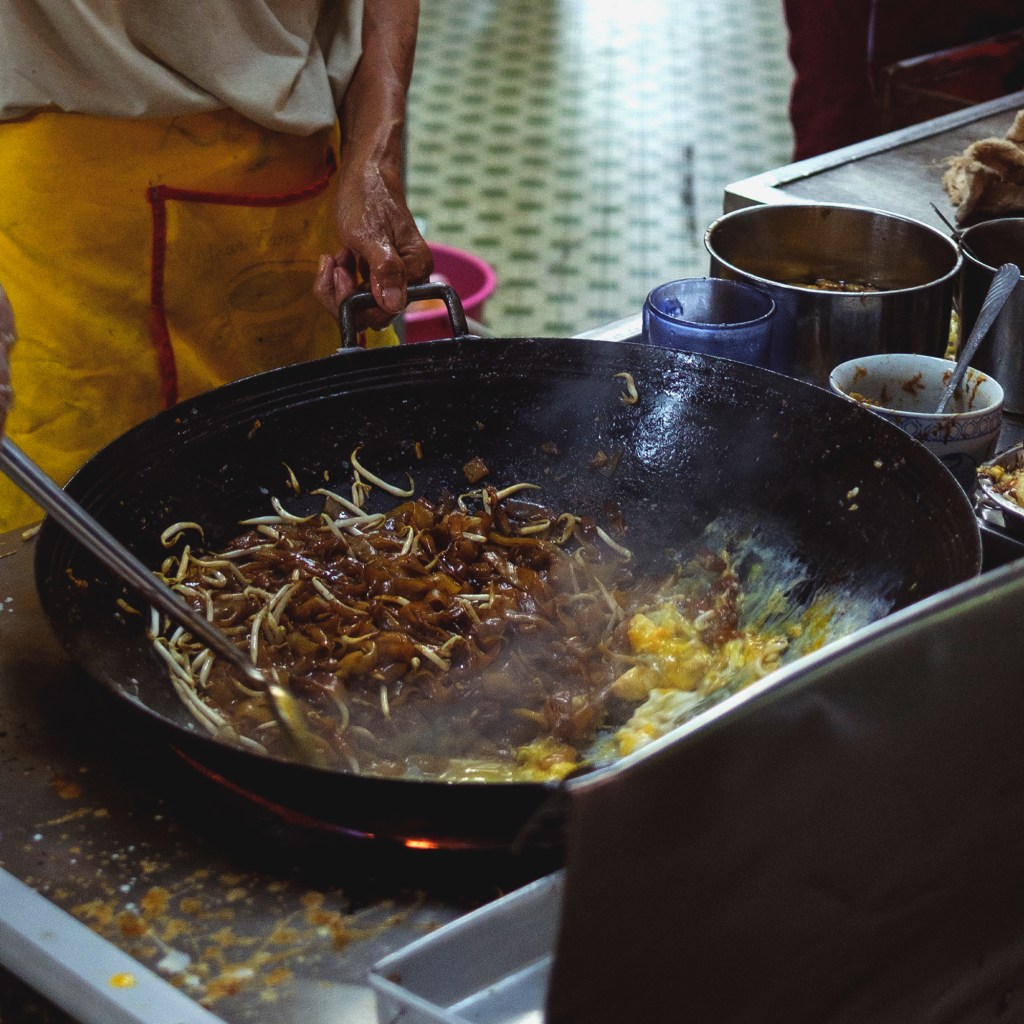
Char kuay teow is a hawker favourite that has become a staple in Malaysian restaurants around the world. The origins of this dish reveal a lot about who emigrated from Malaysia and why.
The post-independence years in Malaysia were tense and race riots would trigger another State of Emergency in 1969. To quell civil unrest and alleviate poverty, the Government announced the New Economic Policy. Not everyone was happy with this new political trajectory and many left to build lives elsewhere.
Celebrity chef Julie Lin and her mum Lang MacLeod share family tales on life in a Scottish-Malaysian household.
Credits
Hosted by Dr Noby Leong and Philip Gibson
Produced by Dr Noby Leong and Philip Gibson
Sound Design by Jack Barr
Satay? Okay! is produced by Kopi Productions Limited and supported by the Golden Chopsticks Scholarship, by the Oxford Cultural Collective Trust
Resources and References
A History of Malaysia (2016), Barbara Watson Andaya, Leonard Y. Andaya
Borneo: The History of an Enigma (2026), Olivier Hein
Embedded Myths of Malaysia’s New Economic Policy, Christopher Choong Weng Tai, London School of Economics blog, 4 April 2022 https://blogs.lse.ac.uk/seac/2022/04/04/embedded-myths-of-malaysias-new-economic-policy/
Putting the Malaysian diaspora into perspective https://cs.stanford.edu/people/eroberts/cs181/projects/2010-11/BrainDrain/Malaysia.html
Transcipt
Please note that this transcript may contain errors and typos
Welcome to Satay. Okay. A podcast about the foods
that have shaped Malaysia. I’m Dr. Noby Leong,
a scientist, food writer, and broadcaster. And
I’m Philip Gibson, photographer and travel agent.
And in this series, we explore the history, cultures,
and cuisines of Malaysia, from the ancient lands
of Southeast Asia, all the way through to the
creation of a modern day nation. In today’s episode,
we take a look at Char kuay Teow and the emerging
diaspora. So catch in those frequent flyer miles
and get ready for satay. Okay. So in the last
episode, Philip, we talked about the emergency.
And so this was in the aftermath of World War
II. There was all this civil unrest. There were
these rebel guerrilla groups. And Britain wanted
to kind of get all the money from Malaya, which
had become their most profitable colony. They
were rapidly running out of them. That is very
true. And so they did a whole bunch of things,
including war crimes and concentration camps.
And amidst all of that, Malaysia became independent.
So in today’s episode, we’re going to take a
look. at the events after this leading into the
late 20th century okay so from what 1965 onwards
yeah okay perfect but before we do that let’s
take a look at our food of the day the symbol
that connects us to the history and the culture
of malaysia and that is char kway teow my possibly
my favorite malaysian dish ever i remember taking
you to eat char kway teow for the first time
and i think going through my head i was like
I know Philip is going to love this, but I don’t
know why. But I had this like sense inside of
me that you were really going to love this dish.
Yeah, I think I also felt like there was a ray
of light came through the window as I lay in
bed one morning and this dish came to me. And
I was like, no, is there a dish that exists that’s
like, I don’t know, wide vermicelli noodles with,
it’s probably wok fried. I don’t know, maybe
it’s got like lap cheong or… prawns or something
like that through it maybe some like crispy bits
or something now i don’t know how i knew this
maybe i’d actually eaten it before at this point
and subconscious eating maybe you’ve seen it
in a documentary no maybe i had had it before
and i just didn’t really remember at the time
but then i woke up one saturday morning and my
mouth was all shaped for it and then we went
to the central markets in adelaide and uh went
to Ricky’s Chicken Rice, who, not only selling
Hainanese Chicken Rice, also sold Char kuay teow,
and sat down and ate it and was like, yes, this
is exactly what my mouth is shaped for. So I
don’t know what it was about it. It is a… Like
immaculate conception, but for food. This is
suddenly… I didn’t give birth to it. But suddenly
this thing arrives to you that was everything
you ever wanted. Yeah. maybe I’d had a few drinks
the night before and it is probably quite good
hangover food, but I, yeah, no, I remember just
sitting there. I can’t explain to you what it
is about char kway teow that’s so good. I mean,
it’s a very, it is quite rich, right? It’s got
like, sometimes like crispy lard through it and
things like that. So it is quite a fatty dish,
but it’s also, because it’s crispy, it’s crunchy,
it’s meaty through the prawns, salty from the
lap cheong. Well, before we get any further,
let’s just tell people, in case you don’t know
what char kway teow is. I’m describing it flawlessly.
Char kway teow. Char Kway Teow is a fried noodle
dish and it’s always made, or typically always
made, with a wide, flat rice noodle, at least
one centimeter wide, I would say. Okay. Along
with the noodle, you’ve got thin slices of lak
cheong, which is Chinese sausage. You’ve also
got egg, prawn, and cockles often are there.
Oh yeah. And then you’ve also got bean sprouts
and chives that are stirred through. And a really
good Char Kway Teow will have those crispy pork
lardons, but that’s not always the case. That’s
like a… That to me is a semi -fancy version.
Yeah, okay. Second wave chocolate. Maybe it’s
just because they wouldn’t add that in Australia
because it’s just another expense. But in Malaysia,
perhaps it’s more common. Okay, right, okay.
It’s a bit of a kitchen sink kind of meal, isn’t
it? Is that rude? I would not call it that. There
are certainly things that I would not put in
a char kway teow. I wouldn’t put chicken in char
kway teow, for instance. I think that would be
weird. But I think I have had it when people
have put chicken. Yes, and they are wrong. So
I certainly have an idea of what should and shouldn’t
be in char kway teow. You can, of course, add
whatever you like, but I have a personal reference
and I would… There’s things that I would and
would not put in it. All right. Yeah. Well, to
all the restaurants in the world selling char
kway teow with chicken in it, Nabi Leong has
out to get you. Well, the flavor of char kway
teow is pretty incredible. It really captures
the essence of wok hei. So wok hei is that smoky,
charred aroma. And so historically, many people
would have used charcoal to make char kway teow.
And that would impart even more of that wok hei.
flavour and that’s why char kway teow is so desired
I think by so many people and perhaps what attracted
you to that? I don’t know I think when now that
I’m quite familiar with the dish when I can hear
them cooking it and I can hear the afterburner
of the wok the jet fuel yeah yeah yeah it’s like
a foot long flame coming out of this thing but
yeah that and the kind of like the rapid sizzling
as like they’re frying off the kind of shallots
and stuff like that to begin with and then firing
everything else into it i’m like salivating as
i can start yeah to see all the smoke come off
of them i’d say it’s a dish that most malaysians
don’t actually cook at home certainly not because
you can’t cook it properly it’s very it’s very
difficult to make and i think i know one person
that makes it in the diaspora like you know a
malaysian migrant um when we were in malaysia
i remember we spoke to a hawker stall chef who
specializes in char kway teow who took over the
store from his mum and he said it took him four
years to make char kway teow that the public
actually liked oh this is a guy in penang yeah
yeah so it goes to show you how much skill is
involved and then when you think about transferring
those hawker skills to the home kitchen it’s
very it’s almost impossible because a home kitchen
is not set up like a professional chef’s stall.
Yeah, you need all your mise en place done and
stuff like that as well. Yeah, it’s that, but
you know, we don’t have really strong wok burners,
for instance. And so the change in heat source
really does make a huge difference. I think the
other reason why people don’t make it at home
is because you really only can make one portion
at a time. Ah, yeah, yeah. And so if you’ve got
a big family, like my family’s family of six,
my mum wasn’t going to do kind of… Spend their
45 minutes just like serving up portions because
person one would be finished before person three
even started. I will say she did do that with
some dishes, but on the whole was not something
that was an everyday occurrence. Fair enough.
Am I right in thinking that its origin sort of
started on the docks? Like, because it is a lot
of quite fishy bits in it. Yeah, so it’s a southern
Chinese dish, probably Teochew origin. Oh.
There are Malayan Indonesian versions of this
dish too. but it’s very much because it’s noodles,
you know, very, very Chinese. And there are stories
that it started off as sort of dock worker labourer
food. So made specifically for those people at
the end of the day when you’ve got cockles left
over, prawns left over maybe, and so you make
this high calorie dish because they’re labourers.
Because you’re working such a physical trade,
yeah. So that’s a general story that most people
agree with. And so now all of these people are
eating this quite high -calorie dish but not
necessarily working as laborers anymore. Yeah,
that is the danger. That possibly might be contributing
to the obesity epidemic in Southeast Asia. I
will say that in Malaysia, the portions for the
char kway teow are quite small. But that’s probably
enough. Not at Ricky’s Chicken, right? I was just
going through some of my photographs there from
when I used to live in Australia. I had this
mountain of charcoal tea and I was kind of like,
that’s the right amount of charcoal tea. I mean,
Char Kuay Teow is massive in the diaspora. It’s
massive, particularly in Australia. It’s part
of that suite of dishes that every Malaysian
restaurant in Australia or in a lot of Western
countries has. Like there’s always Char Kuay Teow
on the menu. There’s always laksa. There’s always
chicken rice, satay and nasi lemak. And that’s
like your starter pack. And it’s so popular in
Australia that Char Kuay Teow, people just call
it CKT. Because, you know, it’s not just Malaysians
that eat it. It’s like everyone wants CKT. But
then you also get BKT for Bak Kut Teh. Yeah,
we love an acronym. Malaysia does love an acronym,
actually. So to me, I think Char Kuay Teow really
encapsulates that Malaysian diaspora. A group
that, you know, I’m part of and that really emerged
from the 70s onwards. And these Malaysians came
to be part of many Western countries, namely
Australia, UK, US and Canada. Loads of famous
Malaysians in these Western countries. And the
vast majority of them have something in common
with Char Kway Teow. Oh. They all have Chinese
heritage. Oh. A lot of them have Chinese heritage.
So I’m just going to read out a list of super
prominent Malaysians in the West. Michelle Yeoh.
Yeah. Oscar winning actress. Yeah. Icon. She
is of Hokkien and Cantonese descent. Jimmy Choo,
the shoemaker. Which I did not realise. Neither.
Every time watching Sex and the City and, you
know. Talking about Jimmy Choo’s, you didn’t
think, here’s this guy from Malaysia. Yeah, yeah.
So, Hakka, Hakka descent. Ronnie Chieng, actor
and comedian. Oh, yeah. So, Crazy Rich Asians
and The Daily Show in America, I believe. So,
also Chinese descent. And James Wan, he’s the
director of Saw, Aquaman, lots of horror films.
Right, okay. But horror’s quite big in Southeast
Asia. Indonesian, I think, horror is, like, particularly
gruesome, right? Yeah, I don’t know if he made
them there, though. I don’t know. In Australia,
two of the most prominent Malaysian chefs, Poh
Ling Yeoh and Adam Liaw, are also of Chinese heritage.
And Penny Wong is also of Chinese heritage. Who’s
a politician. Yep. Phil Wong in the UK, British
comedian. Oh, yeah. Hakka, Uncle Roger. Oh, yeah.
Hokkien. Not to say that all famous Malaysians
in the West are Chinese. You certainly have some
prominent Malay, Indonesian Malaysians too. But
I would say that in the West, there’s a disproportionately
large number of Chinese Malaysians in general.
And so this trend is also reflected in the food
scene of the diaspora. And when I was growing
up in Adelaide, going to Malaysian restaurants,
Almost all of the restaurants we went to were
run by Chinese Malaysian people, one or two by
Indian Malaysians. Oh, yeah. I don’t think I
went to a single Malay run restaurant in Adelaide
up until like five years ago. Oh. Yeah. And so
the reason for this, I think, has nothing to
do with pushy stereotype of Chinese people working
hard or whatever. It really does go back to who
migrated from Malaysia in the 70s and 80s. and
why they did so so let’s hit the history books
okay so what so 1965 singapore is out and malaysia
as we know it today has kind of been formally
formalized yeah so we’ve just come out from that
emergency which we talked about in the last episode
where you had the malayan communist party guerrilla
fighters right launching attacks against the
government and the civilian population okay and
remember these guerrilla fighters these rebels
are mostly chinese because they originated during
world war ii when they were fighting against
japan right and japan hated all Chinese people
at the time. So during this emergency, Britain
responded intense violence. They constructed
new villages, which went on to house about 500
,000 people, also mainly Chinese people. And
then in the years after the emergency, things
did kind of settle down slightly. Malaysia got
independence and new government formed. The challenge
for this government now, as we move on from this
emergency period, is to build a new nation in
the aftermath of all of this conflict. because
everyone kind of hated each other. Yeah, I could
see that. I think particularly if there’s so
much suspicion between, like, you know, suspicion
of Chinese people in Malaysia at that point.
And both ways, though, you know, I think all
races had some kind of preconceived notion of
what the other races were feeling and how the
other races were maybe better than them. Yeah.
And I think perhaps even from the Chinese perspective
and the other kind of races as well, it might
be looked at like it was Malaysia for Malays
and things like that. Yeah. And so, you know,
I think that would probably strike fear into
you as well. Kind of going like, wait a minute,
we’ve been here for generations. Like we’re just
as part of Malaysia as anybody else is. And just
a reminder, this ethnic tension had been going
on for quite some time. It wasn’t just through
World War II or the emergency. Because prior
to all that, when Britain was still ruling prior
to World War II, they enacted a huge range of
race -based policies. So things like only Malay
people could work in administrative and government
roles and the police force. um chinese people
couldn’t and chinese people could set up certain
businesses in industries but they they had nothing
to do with government right you also had like
a big divide of where malay and chinese people
were living and there were large large populations
of malay people in rural areas being very very
poor you had a lot of chinese people that were
living in urban areas and then later in these
new villages so coming into the 60s what you
have are malay people and chinese people living
very very different lives they’ve got very different
jobs in different industries they live largely
in different areas urban, rural, and you have
different wealth perceptions too. So it’s a race
divide, a wealth divide, an urban -rural divide,
all wrapped in one, and it’s also a constitutional
divide. So when Malaysia became independent and
the constitution was drawn up, it gave special
privileges to Malay and other indigenous people,
which are collectively categorized by the term
Bumi Putra. So these… Constitutional special
privileges mean that there are quotas for Bumi
Putra people in positions in the civil service,
for scholarships, for education and training.
There’s quotas for permits and licenses for trade
and certain businesses, and also quotas for places
at schools and universities. And so this constitutional
divide further kind of creates division. particularly
around Malay and Chinese people. And these tensions
come to a head in the elections taking place
in 1969. You’ve got a whole bunch of political
parties that are also largely race -based, arguing
for many different things, and they’re kind of
riling up their individual constituents. And
it kind of comes to a head in Kuala Lumpur in
May 1969. So you’ve got hundreds of young men
coming to the capital. There are Malay, Chinese
and Indian men. And they’ve all got different
perspectives on the situation. All of them are
feeling disadvantaged in some way. And they’re
all feeling discriminated against in some way.
And I’m sure, you know, the political conversation
at the time helped to stoke their prejudices
or realities one way or the other. This huge
gathering of men culminated in a Chinese man
being shot dead by a police officer. And instantly
he became a martyr and his funeral became a big
demonstration with 10 ,000 people attending.
What followed basically was protests, counter
protests, lots of violence. There was like arson,
there were looting. So officially 196 people
died. And 409 people were injured. But this is
probably like an underestimate. Most victims
were Chinese, though, of course, not all of them.
At least 6 ,000 homes and property destroyed.
Wow. So in response, the government announced
a state of emergency again. So this is the second
emergency now that the country has gone through.
The constitution was suspended. Parliament was
dissolved. The elections for Borneo were postponed.
All administrative powers were centralized. There
was a curfew. Newspapers were suspended. Massive,
massive, you know, civil changes happening. Lots
of arrests, lots of detention of, you know, the
suspects. And this lasted for about two years,
ending in January 1971. That’s quite a prolonged
period to be existing in that kind of like, yeah.
I mean, a pretty pivotal moment in the history
of Malaysia in general, and it really did mark
a new era for the country. And I think the government,
I mean, they had such a big challenge ahead of
them. To build a country. To build a country,
to kind of quell these race riots, to kind of
build harmony, I suppose. They’ve essentially
inherited a very colonial system of governance
based on community division in some way. So this
becomes their focus. They’re trying to quell
tensions. They’re trying to alleviate poverty.
They’re trying to boost education. They want
to boost the economy and restore peace. So in
1970, during the emergency, they announced a
20 -year -long policy called the New Economic
Policy. Okay. So this NEP has two broad objectives.
The first is to reduce and eradicate poverty,
irrespective of race. And the second is to restructure
society so that identification of race with economic
function would be reduced and eliminated. So
this is how they plan to kind of uplift the country.
Sounds positive. So they would achieve these
goals by getting people access to land, to physical
capital, but also boost training and education
by increasing ownership in the corporate sector
and lots of other things. The government ends
up targeting largely poor people for this policy.
And in 1970, 49 .3 % of all households on the
peninsula were below the poverty line. But 74
% of these are Malay. So even though the new
economic policy is trying to do things irrespective
of race, what ends up happening is that Malay
people are getting a lot of support. And so this
kind of becomes an affirmative action policy.
Okay. Yes, there was some support offered to
other races, but by and large, you had quotas
for Malay people, business licenses for Malay
people, education system that favored the Malay
language. Things like that. So the policy lasted
for 20 years, but then it continued under a new
name called the National Development Policy.
And I guess as we look at this policy and how
it impacted Malaysia, you kind of have to wonder,
did it work? Did it not work? What was the collateral
damage? So in 1970, only 40 accountants, 79 doctors
and 33 engineers were in Malay. By 1997, 27 years
later. there were 1 ,766 accountants, 4 ,508
doctors, and 11 ,481 engineers that were Malay.
So a massive shift in the professions and the
demographics of who was, you know… Are these
people registered with professional bodies? Because
11 ,000 engineers in a country the size of Malaysia
doesn’t actually seem like that big a number.
But I guess it’s about the jump. Okay, sure,
right, okay. From 1969 to 1990, Malay equity
ownership… in various different businesses
went from 1 .5 % to 19 .2%. So massive jump in
there. And that came at the expense of foreign
ownership. So foreign ownership decreased while
Malay ownership increased. Was there not still
a lot of legacy plantations that were still run
by European organizations? Yeah, so in 1970,
foreign ownership of various different companies
went from 73 % to about 25%. Wow, okay. So massive,
massive drop. Poverty rates also massively slashed.
So in 1970, poverty rates in the peninsula were
49 .3%. And then by the end of the 20th century,
it dropped to 5 .5%. It’s pretty radical. Yeah.
So you do have a country that’s economically
kind of booming. They were averaging six to 7
% growth. every year it’s pretty pretty good
which is kind of amazing and i think you know
partly because they discovered oil and gas fields
in in certain parts of the country right but
also because they now had ownership of their
own country and didn’t have to give everything
to britain right yeah yeah but yeah it’s one
of those policies that because it was enacted
in relatively recent history it’s only now being
dissected and there are lots of scholars both
within malaysia and internationally that are
trying to reflect to see what this means and
opinions range from like yes, this policy was
a success, look at the results, to, yeah, it
succeeded, but look, it divided the nation. And
then there’s other opinions like this policy
was basically a continuation of the colonial
system that didn’t actually remove systemic advantages
or disadvantages. So I think, you know, with
this new economic policy, whatever people thought
about it, I think it does become this push factor
for non -Malays. to migrate right they feel that
maybe they can have better opportunities elsewhere
yeah and this is particularly the case with chinese
malaysians and i do think because chinese malaysians
lived in more urban settings they were more able
to migrate versus for instance indian malaysians
who faced a lot more hardships because the history
of indentured labor some living in agricultural
areas that made it less likely that they could
on that large scale that Chinese Malaysians did.
And certainly you have some Chinese Malaysians
that are quite wealthy and do have certain privileges,
which again allows them to migrate. And the Chinese
Malaysian diaspora starts to really grow from
the 70s when this policy was enacted. I see.
When I was growing up, my parents always were
like, oh, we moved because we wanted better opportunities.
That was kind of all they said. So I didn’t really
know what that meant. Yeah, okay. And I kind
of have to just piece together information about
what their life was like to find out, you know,
how big was this policy for them. Yeah, because
a lot of your parents’ generation, they did stay
in Malaysia. It was really just your parents
and your aunt that moved here. Yeah, yeah, yeah,
indeed. But the biggest diaspora is definitely
Singapore. That’s where most Malaysians throughout,
you know. Just move to. Either move permanently
to or work there and still live in Malaysia.
Oh, yeah. Right. That’s even happening today.
So many of my cousins live in Malaysia but work
in Singapore. Yeah, yeah. But as I mentioned
before, massive diaspora is also in Australia,
the UK, New Zealand, which are all Commonwealth
countries. to some degree also the US, Canada
and Brunei. So I think connecting this with the
early observation about Malaysian celebrities,
this is why I think that so many Malaysian celebrities
in the West are Chinese Malaysians. This is why
so many Malaysian restaurants in the diaspora
are run by Chinese Malaysians. And also why so
many of the iconic dishes that we know of in
the West are Chinese. Char Kway Teow, laksa,
chicken rice. So to some degree, the Western
world’s perception of Malaysia… has been pre
-filtered by the Chinese Malaysian perspective.
And I was chatting to a Malay friend recently,
and he was saying that when he goes around London
to all the Malaysian restaurants, there’s not
much Malay food. Right, yeah, yeah. And this
is kind of why. Do you think it’s also because
a lot of the ingredients that are used in Chinese
Malaysian cooking are globally more available
because of the mainland Chinese diaspora? And
so you can get a lot of those ingredients. that
way whereas like you know i feel like perhaps
in a lot of malay dishes it’s harder to get certain
ingredients that i mean i think what migrants
have always done is adapt their local cuisine
to the ingredients available sure there’s always
a way if you can’t find what you want to kind
of change change it up if you’re enjoying this
episode follow us on social media at satay okay
we’ve got more stories and more food to share
you can also find links to give us a donation
or tip We’re an independent podcast and every
ringgit, dollar and pound goes directly to supporting
our work. So give us a follow and say hello at
Sate OK. So I want to delve more into the migrant
life, I suppose. Hashtag. Yeah. Because, you
know, as a migrant, I mean, like, yes, my family
migrated when I was one. So technically I grew
up as a migrant, but it’s different. when I migrated
to the UK and was an adult migrant and I start
to understand what my parents kind of went through
in order to uproot their entire life from one
country to another. Yeah. Lots of push and pull
factors to consider, lots of sacrifices, but
also potential opportunities. Yeah. You know,
this podcast could be one of them. So to delve
in a bit more, we interviewed a renowned Scottish
Malaysian chef, Julie Lin, and her mother, Lang
MacLeod. So Lang was born and raised in Malaysia,
but she moved to the UK in the 1970s. So she
was part of that growing diaspora and, you know,
that first generation of Malaysians to actually
move. I spoke to Lang and Julie about the decision
to move, the opportunities and challenges this
presented, and an identity shaped by mixed upbringing.
All right. I’m Lang MacLeod, obviously married
to Scott. I’ve been in Scotland for over 50,
I have been away from Malaysia for over 50 years.
And 40 of it probably spent in Scotland, especially
in Glasgow. Yeah. And I trained as a nurse midwife
and latterly worked as a health visitor in Glasgow.
And I retired at the start of COVID, which was
in 2020. In the 70s, Britain had an active role
in recruiting nurses. So for me, you’re going
to somewhere different and you are getting the
support so you were not let loose as such as
you would do if you were a university student.
So we were in a nurses’ home. And you had accommodation
and then your career was mapped in a way because
you had to pass your three years. And then I
did midwifery and whatever else that comes after.
Yeah. Yeah. So and I suppose in the 70s, that
was what a lot of girls do. Boys as well, because
you do see Malaysian boys who are nurses. in
the health service and in fact if you look most
of them are probably based down in england yeah
was it mostly like chinese malaysians chinese
malaysians or indian yeah yeah but never never
malay but i know there were some malays who were
sponsored to uh paisley and stuff like that yeah
yeah yeah the provision of nursing education
was a big pull factor for lang but there were
also push factors the malaysian government was
using Bahasa Malaysia as the main subject to
push people along. And I think indirectly it
was to try and get the Malay race to the forefront,
which I think they have eventually done. And
a lot of people who, a lot of people that I know
who have failed in Malay, but I got fantastic
other results. They failed the whole exam. So
they were learning English as well. English was
our main subject. We learned a lot of subjects.
In fact, I learned Shakespeare. In Malacca? In
Malacca. And I can still quote you quite a lot
of Shakespeare. I always think of Macbeth. See
when I go up north? So yeah, I did English Literature
as an O -Level subject. Yeah, so that would give
you a rough idea how we had to switch and our
teachers who taught in English also had to take
exams to pass the Malay language and they were
given a few years to do it or they were out of
a job. yeah it was as bad as that but i think
um as a result of that you felt that you were
being discriminated against and singapore took
a lot of these students in who didn’t pass because
they feel them only yeah yeah so yeah that was
how i came to be here yeah it’s that new economic
policy absolutely it started from then yeah yeah
lang wasn’t always intending to stay in the uk
permanently But then she met Evan, got married
and had Julie. Hi, I’m Julie and I am a Scottish
Malaysian chef and presenter. I think that’s
all I’m doing right now. That’s the two that
I’ll give right now. With mother and daughter
in front of me, I asked Lang how conscious she
was when it came to passing down her Malaysian
culture to Julie. Not really. It was very mixed,
isn’t it, Julie? Yeah, I think it was definitely
very mixed. but I think there’s always been something
in my name that I’ve always thought really shows
your kind of I guess your will to show my Malaysian
-ness because obviously it’s a very like mixed
name it’s Julie Swee Lin McLeod so I always thought
that about from the beginning I felt like that
was the first moment that maybe a culture from
Malaysia was put into my periphery and I think
Part of it, too, is probably your food. And I
used to speak to Julie in Teochew. Oh, yes. Yeah,
yeah. Can you pick anything up? Chet Pabwa. Have
you eaten yet? Very important. Yeah. So, yeah,
yeah. But it was hard because, really, Mandarin
would have been the language that I could teach
Julie. But I don’t have enough Mandarin because
in our household, We would speak in three languages,
as you know, all in one sentence. So we never
really developed a full knowledge of one language.
While Julie’s name pointed to a Malaysian heritage,
it took her a while to realise what this heritage
actually was. I do remember, Mum, a conversation
with you where I didn’t realise that I was Asian.
Do you remember that? Where mum had to tell me
when I was younger, she was like, you’re Asian.
And I was like, what? How old were you when that
revelation came? I don’t understand. When was
it? It was last year. No, I’m kidding. I can’t
remember what age. Possibly before you hit 10.
Wow, that’s quite old. No, no. Possibly about
five. I think five, six, seven. That sort of
time. Yeah, yeah. And then like… How did that
realisation come about that maybe you weren’t,
that you were Asian? Good question. I don’t know.
I just do remember a moment where you were like,
hey, I’ve got something to tell you. You’re Asian.
And I was like, really? Okay, got it. That like
very childish little notion of being like, oh,
that’s cool. I didn’t know that. I think that
was also compounded by Lloyd’s friend. Remember,
his mother was from Taiwan, Chinese Taiwanese.
Father was Scottish. And he came up to you and
said. You look like me. I know. I was quite sad
too, wasn’t it? Like two lost souls that were
like, hold on, we both look a little bit different.
And yeah, it was really nice. So we have such
a big family here of the adopted family, I call
them. So there was my childminders. And so with
Carol and Jim, who became like a second mum and
dad. And then their children, Gillian and Susan,
so almost like sisters. So I would go to theirs
every single day. So in the morning, but then
also after school. And I think there was little
moments of realising, and it was always food
that made me realise these things. The girls
would constantly have, this is an exclusive,
I’m giving this to you, salad cream and rice.
So I used to as well. and like I loved it so
much so then when I came home I think mum was
like horrified because she was like what is this
little gremlin I’ve brought up in the world why
does she want salad cream with her chicken curry
so there was like all these little nuances that
used to happen and then I would say to kind of
shoot through school you know people would sometimes
ask you like oh you look like a little bit different
like what’s your So you get those questions coming
in, maybe more so in high school, and people
maybe also assuming where you’re from as well.
And I think quite a lot of mixed people will
get that too. It was only later that Julie wanted
to learn more about her Malaysian heritage. That
kind of came in my, I guess, like 18, 19, 20
kind of years. And then it’s when you feel like
such a connection to Malaysia. And, you know,
like… There’s so many childhood memories. And
I think because, you know, I was working quite
a lot for that time and you don’t go for a couple
of years. It was like this unknown feeling of
what now I recognise as being homesick. Because
you don’t… I think it was quite a later on
feeling that I had rather than realising it straight
away. And that feeling of connecting to somewhere
and you’ve not been back there in a while. I
remember just wanting to see the red stone of
Malacca. and go to the river and go and walk
around. And it was all those feelings of being
like, oh, I feel like I’m really from this place
as well. My identity doesn’t just feel like it’s
here in Glasgow in Scotland. There’s also another
part of me that is there too. So it was actually
maybe the lack of being in Malaysia that made
me realise that I was like, oh, this is really
important to who I am and what you’ve kind of
taught me growing up on. So, yeah. And it was
a gradual, perhaps unconscious process to connect
with Malaysian traditions. I guess we took quite
a lot of trips to Malaysia. I started to ask
you about more and just learn a bit more. And
then sit and watch you cook on the little stool
in the kitchen and learn like what all these
spices were and how to make that chicken curry
that we always did. So it was like a very kind
of gradual process, which wasn’t ever… I never
realised that this was going to be something
that would end up being my everyday career. It
was more just that kind of innocence of just
trying to figure out who you are as a human being
rather than going, do you know what, I’m going
to study this by this point. It was a very natural
and organic way of just trying to figure out
who you are. While Julie was able to go to Malaysia,
learn about her culture and enjoy time with her
family, there were barriers, the main one being
language. Like, oh, actually maybe to communicate
with Ama, which is grandmother, maybe I should
speak or learn to speak Teochew. But then actually
that’s also a language that is kind of like,
it’s not being used quite as much. It’s a dialect.
Sorry, a dialect that’s not being used quite
as much anymore. So that was always like, I mean,
it’s a bit sad sometimes because you feel like
you want to say more. But there is also a lot
of room for the communication that you have with
your family members. when you can’t speak the
same language. So Ama and I will always, we’ll
always manage to have a conversation. I don’t
quite know how we get through it, but with like
certain like, you know, even hand gestures or
like we manage to have this communication that
has no language and it’s really lovely. So you
still manage to form a bond in that way. I think
what you forget, my mother is conversing in,
a lot of dialects and a lot of languages. She
refuses to learn English, right? Which languages
does she speak? She speaks Mandarin, she speaks
Malay, she speaks all the dialects, yeah, and
she understands English because one day we were
talking about… And she turned round and she
said, you think I don’t understand English? Really?
No, but that’s her, that’s our mum. But you know
what, fair play to her. She shouldn’t have to
learn English. It should be me that has to learn
the other way. There were more challenges beyond
just language. Families don’t always pass down
stories from one generation to the next, so it
can be hard to connect with one’s own family
history. And even in this interview, Julie was
learning stories from her mother for the first
time. We do talk. We do have tales to tell. But
I think it’s my father, unfortunately, became
an orphan quite young, just around the Second
World War. Yeah, his father used to run. mental
hospital Tampoi in Johor and when the Japanese
came the whole thing got disintegrated and obviously
that the country went into chaos for a good few
years and I think because of that he’s not had
that parental guidance. His mother died shortly
after the father died so you’ve got a whole group
of kids who were orphaned and farmed up to various
people. Was that from the…? Japanese invasion?
It’s from during the Japanese invasion. I also
didn’t know this. Wow. So I think Asians don’t
talk about Japanese invasion at all. They want
to forget it because it’s been such a cruel part
of the history. My mum very rarely talks about
it and my dad never talks about it because it’s
possibly a period that caused chaos in his life
and they want to forget. from having a settled
home of parents and everything else, then they
end up being with his grandmother and some of
the kids were farmed out and adopted. Yeah, yeah.
So it was quite a confused time and traumatic
time for him. Yeah. Shota, what’s going through
your head when you think about, you know, your
grandparents through World War II and learning
some of these stories for the first time? Yeah,
it’s quite like, it’s quite shocking. I never
knew that about Kong Kong’s parents. I mean but
also if that’s something he’s not speaking about
a lot then it’s almost that way where I think
that there’s so much history and I do think that
with Malaysia it’s a place that is so abundant
in history and change and so much to learn about
that it inherently kind of comes into everybody’s
families in a way that there is just these endless
amounts of tales to learn about. And it makes
you want to preserve that knowledge, like write
it down somewhere and know where to put it and
know at what point. Because, you know, obviously
with Malaysia being colonised so many times,
there’s so much change. There’s so much change
within family, place. So, yeah, it makes me want
to get a notepad out. There is something about
your podcast that makes me feel that I’m like,
oh, this is this media source that will manage
to hold all of these stories. forever in time
which is maybe in a way that it’s never been
recorded before it’s quite lovely it’s history
very personal history and very like family kind
of family stories and history and it yeah I think
it’s a very important thing so that was Lang
MacLeod and Julie Lin we’re going to go back
to them in a second but I just wanted to kind
of like reflect on some of that conversation
so far because that sounds so familiar to kind
of you know my family you know lang moved to
the uk to study nursing yeah my auntie also did
that and i’ve got like five other non -blood
related aunties at least five yeah that also
did that but then ended up moving to australia
yeah and it’s always a good reminder that like
migrants contribute so much to their new country.
Yeah. And like, I think of my parents who kind
of went to Australia to fill a skills gap in
the healthcare sector. Right. How many like thousands
of patients had seen over the course of their
career that they’ve helped to, you know, improve
the lives of and save the lives of. Yeah. We
need to do more to remember that migrants actually
do contribute to society. Yeah. Yeah. You know,
when I consider what my life was like growing
up, it sounds so similar to Julie’s in terms
of like, how you build your identity how you
kind of understand your place in the world like
there was many points that i was at when i was
like five or six and my parents telling me that
i was like chinese but wait i’m malaysian how
can i be both but wait am i australian but i
also think my parents went through the same identity
crisis over the years because i remember distinctly
growing up they would say you are malaysian this
is who you are yeah yeah but then when i was
in my early 20s they would they stopped calling
themselves Malaysian and they only referred to
themselves as Australian. Right, okay. I always
think it’s such a funny thing for parents as
well, raising children in a new country, is that
their children will sound different to them.
Yeah. I think that’s quite a funny one. I do
wonder what my… parents thought of my accent
what with all these Aussie babies yeah yeah yeah
the other thing that Lang said that also resonated
me and something that I’m thinking about more
and more is how previous generations have gone
through so much trauma in Malaysia that they
actually just don’t want to talk about anymore
or it’s too difficult to talk about and they
don’t have a mechanism to talk about it if she’s
saying that you know people didn’t necessarily
have those parental figures that explored those
emotions how are you supposed to yourself explore
those emotions yeah um because my parents never
talk about their childhood and my grandparents
i mean i didn’t really have a strong relationship
with my grandparents because you know grow up
different countries yep but i can’t imagine they
were forthcoming with what life was like under
japanese occupation yeah or during the emergency
and things like that Yeah, I’m trying to think
if there’s anything like that in my own family.
I mean, being in Scotland, we weren’t directly
impacted by the Second World War very much. I
think the Luftwaffe did bomb the Clydeside. And
I remember my papa telling me a story one night
where his father took him out the house and said,
look, on the horizon, bear in mind, my family
grew up about 30 miles away from Glasgow, but
the fires that were happening in Glasgow could
be seen from the orange in the sky anyway. I
remember my papa talking to me about that and
also, there was various like searchlights like
stations based all the way along the coastline
because we were still very much a mass manufacturing
that’s because my papa was born in the early
30s and so it was actually like old enough to
remember this yeah but like i think because we
were like the victors of the war but also because
my family were rural and not actually having
their houses blowing up My papa, I think, was
more happy to talk about it because I think he
saw that as a piece of national pride that we
beat the Nazis. Whereas for your family, being
absolutely just chewed through the machine of
war and empire and colonialism. Successive conflicts
as well, not just the one. And then all of a
sudden you’ve had 40 years that the dust has
settled and you’re a bit kind of like, oh, that
was in the past. Yeah, yeah. It does seem like
people in Britain and also Australia talk about
those moments in history a lot more than Malaysians
do. at all and so because we see ourselves as
the victors and it reinforces national pride
i will say it’s not just migrants that do find
new opportunities in in the uk or in their new
home country i think you know we also have to
recognize that the home country this new country
welcoming these migrants has a lot to gain as
well so yes like from people that work directly
in in places like the healthcare sector yeah
but i think including perspectives of how to
run society from a Malaysian perspective or whatever,
also can benefit the country. I think it’s funny,
I saw an article recently where the Glasgow Chamber
of Commerce have actually solicited Singaporean
experts to come over recently to give instruction
and direction to the Glasgow economy to see how…
Singapore, you’ve done such a fabulous job of
building a country in the last 60 years. What
could Glasgow do? And I just think that’s so
funny that you’ve got all of these Glaswegians
going like, hi, Singapore, can you help us, please?
And, you know, that’s, you know, the beauty of
what migrants bring. And so this is something
that Julie talked about with her life as a professional
chef and working in professional kitchens. So
Julie has, you know, opened several restaurants.
She opened Julie’s Kopitiam, which was in Glasgow
Southside. She also opened Gaga and also has
now a… a Malaysian Mexican restaurant or food
stall in Edinburgh called Tacos Lah. She’s also
the author of Sama Sama, which explores her Malaysian
Scottish kitchen. And I love she uses the term
authentically in between to describe it. I asked
her about her life in those professional kitchens
and specifically the lesson she took away from
her first restaurant, Julie’s Kopitiam. We put
so much… so much importance into cooking and
measurements, so much, especially within the
professional chef world, where you get people
saying, you know, well, consistency is key. And
I do agree with that. But isn’t better than consistency
somebody cooking something from scratch that
maybe it’s not been the classic recipe -trained
way of doing things and flambéing a fish in the
same way? So in that place, we really practised.
cooking from your heart so it would be like you
would have to taste everything you have to taste
every single nasi goreng because you know you’re
you would just do it by feel so i then then started
to work with chefs in a different way where it
felt like a bit more reflective of how you do
cook in asia but in a professional environment
in the uk so there was all these different things
that i started learning from that place and there
was also hardships there’s also like that’s probably
where That’s probably where I became a bit feisty,
I think, because you get people coming in and
not understanding the cuisine. And there was
often quite a lot of people that would decide
that I was not Asian enough or too Asian. So
it was just like you never sat in the perfect
bracket. But I kind of love it because now I
do feel a bit more fiery and a bit more ready
to explain now. So as much as it was hard. I
think that place was like the real gem for me
and I really figured out a lot in that little
restaurant. These early kitchen experiences led
to the realisation that professional kitchens
also bear the mark of colonialism. Kitchens themselves
are so colonial. They’re built on that army brigade
basis of having a head chef, a sous chef, a chef
de partie. That is such a very masculine male
ranking system. I don’t actually think it provides
the best food, I have to say. So I would much
rather have a team of people who could all do
the same thing and respect each other and not
one person doing sauces and the other person
doing the cold salad -y bits. That to me is insane
because then nobody can learn the same. So I
would much rather have a place where… We all
do the same job. Like, you know, in that space,
I would be washing the pots as well. We all,
like, just took a turn on the dishwasher because
what’s the point in having a kitchen porter when
you could just bring in someone in and train
them how to cook food? So, yeah, it’s been a
bit of a mission of decolonising kitchens. And
so kitchens are more than just a place to explore
new flavours. They’re a place to explore new
ways of doing things. Yeah, like, I’m so fascinated
by… takeaway kitchens because often you know
I think in a kind of very generalized way the
first imprint of immigrants that we see in the
UK generally will come from takeaways because
that’s people will get a takeaway you know it’s
not as expensive to have people sit in etc etc
and that’s where you start to see Indian food
you start to see Chinese food and but the way
that people cook in those kitchens There is some
of the biggest Chinese takeaway menus I have
ever seen and one uncle smoking a fag in the
back. And not that that’s the way, but I’m like,
well, there is something to say against these
really snobby ways of learning how to be a professional
chef where you need to go to the Cordon Bleu
and learn all of these things. But there’s also
these amazing takeaways with, you know, people
who have emigrated here that have really got…
their skills down, like really to a fine tee
that I would argue in some ways is a higher level.
I’m going to upset some people, but yeah, I think
I’m really fascinated by how they work. So I
love this concept of decolonizing kitchens. And
it’s something that has popped up in this podcast
before. If you remember, we talked to Raphael
Jay Peter Lee. of Oitom in Sabah, which is a
fine dining restaurant. And he was saying that
when he first started, he kind of was, he yelled
a lot, he shouted a lot in the kitchen. Yeah,
sucked into the system of these hierarchical
kitchens. And people would just quit. And so
he had to kind of create a totally different
space, which was a lot more, I guess, community
driven. Democratic. Yes, yeah. To stop people
from leaving. And that created a more cohesive
kitchen for him. So I love this idea that different
cultures can impact us really, really positively
by just showing us a different way. So let’s
continue and go to the final segment with Lang
and Julie talking more about how their identity
has evolved and their reflection on that. I consider
myself a Scottish with a Malaysian heritage.
When do you think you became that person? I think…
It’s probably a gradual transition and you don’t
notice it until after it happens. But this new
identity, forged over 50 years living in another
country, has come with sacrifices. It would be
family. Family. I think what you miss out is
the high days and the holidays, right? And I
can remember… being really, really sad and
tearful, I think, when I was walking past one
of the public buildings in Leeds, and it was
miserable, it was cold, and you kind of felt,
you know, you wish you were with your family.
And then when you go back for that short period,
in those days, we would go back for three, four
weeks. you just you you link in immediately but
then they talk about things and think god i do
miss all that yeah yeah i suppose it’s something
that you have to accept that when you become
and when you emigrate somewhere you’re bound
to miss out on something we can’t have them both
both worlds really and that’s something you have
to accept it or be emotionally crippled by it.
I think so, yeah. Do you ever think about what
would have been like if you stayed in Malaysia
or if you did go back as you intended? Is that
ever a scenario that plays out in your head?
You don’t. Because it’s a bridge that you haven’t
crossed. Yeah, yeah. So you don’t and you can’t
because what you have, your memory of Malaysia
and Malacca, It’s honestly different from what
is there just now. So you can’t… Yeah, yeah,
yeah. And that’s something I’ve accepted. Yeah,
yeah. I think a lot of people who have emigrated
to whatever country, their memory of food is
based on what it was when they left. Whereas
a lot of… You find in a lot of… Malaysian
families in Britain, a lot of their food is based
on their mother’s memory of what the food was
like. But in actual fact, if they went to Malaysia
now, they’ll see huge changes. Whether you’re
an immigrant, a local or somewhere in between,
Julie and Lang want everyone to understand that
our identities aren’t fixed and they can change
over time. The time that we take into understanding
people who are also mixed who you know because
there’s so much movement in this world now I
think has like it has such a bigger meaning because
we I think to look at people and not just to
say that you’re so defined by one place or another
or it could somebody could be from more than
two or three places I think that understanding
of a mixed identity is within all of us because
I think we are all mixed essentially in some
way we’ve come from different strains historically
and I think that’ll be a huge part into accepting
all of us as a society together. That change
happens and I think being accepting, not being
judgmental. I think being accepting because I
think there is so much judgment today when you
think of all the various things that are happening.
And I think we’ve forgotten how to love life,
live life and be kind. And that was Lang MacLeod
and Julie Lin. And I think I really need to take
a leaf out of Lang’s book. And, you know, she
talks about… not dwelling too much in the past
or you’ll be emotionally crippled yeah I’m definitely
constantly emotionally crippled because I think
I keep looking back and thinking about a life
I could have had in Australia when I moved to
the UK yeah um but then also it happened at such
a traumatic time in your life with your mum literally
passing away days before you left the country
yeah there’s a version of a life that I think
you kind of would have assumed that you would
have had if your mum had still been around but
she wasn’t You’ve got to be there. So there’s
almost like a few lives that I’m grieving at
the same time. Yeah. You’ll always go back to
the family home and it will never quite feel
like home. Yeah. for a lot of reasons, which
is quite devastating. Yeah. And I think that,
you know, she is right that at some point you
do have to move on because it’s a bridge that
you haven’t crossed before. A bridge you can
never cross and you can never go back to that
point in time. Yeah, you can’t live in two states.
Yeah. Very deep. Yeah, yeah. But, you know, it’s
refreshing to hear someone like Lange talk about
it. in the tone that she delivers it. Because
sometimes you just need someone to tell you that
it’s going to be okay. You kind of have to move
on. Yeah, she’s got 40 years on you. Do you know
what I mean? Like, she’ll have gone through the
cycles of grief and crises and things like that.
And you’ll be a bit kind of like, ah, okay, right.
Yeah, yeah. And, you know, like Julia was saying
at the end as well, we all have a mixed identity
in some ways. You know, my identity is very much
rooted with my parents being Malaysian, but it’s
also undeniably Australian too. Right. And, you
know, I’m sure there’s a lot of things that I’m
going to reflect on in 10 years time that are
like, oh, that’s a very Scottish part of my identity
now. I say I a lot now. Do you? Well, like in
Australia, I never said it. Of course. Not in
the Australian vernacular. Uh -huh. I love the
word shuggle. That’s probably my favorite Scottish
word. Shuggle. Yeah. Which for those that don’t
know means to shake. Yeah. Yeah. And so, you
know, I think my identity will definitely change
over time and sit back and enjoy it maybe. I
don’t know. Don’t get emotionally crippled. Yeah.
Yeah. It’s not that deep. It’s like both though,
isn’t it? Yeah, of course it is. In some ways
it’s so deep, but also in other ways it’s not
that deep. I think you just have to let it wash
over you. I think you just have to kind of like
drop the tension over your shoulders and just
go, well. Anyway, let’s go back to our food symbol
of the day, char kway teow or CKT. So this very,
I guess, you know, Chinese Malaysian dish that
has now become so popular in the diaspora. you
know it’s one of those dishes that you can just
eat and enjoy it but as you look into it further
realize why so many people in the diaspora do
enjoy it you start to kind of see patterns of
migration and you know the economic forces and
social forces that were happening behind it You
think all of the symbolism is wrapped up in that
one dish? Yes, I do. Okay, sorry for being cynical.
The whole thesis of this podcast film is to look
at the stories behind food. No, I know that,
but specifically char kway teow, interesting.
Yeah, that’s how I see the dish, yeah. Yeah.
Lots of things coming together in the heat of
the wok and then coming out and being delicious.
So yes, I think that the next time anyone has
char kway teow, it’s a good opportunity to reflect
on the push and pull factors of migration. culture,
and how food arrives at our table. So, Philip,
it’s kind of a minor miracle that Malaysia has
survived, to be honest. Like, as a nation, if
you think about what’s happened to this country…
It’s been tested. It’s experienced traumatic
event after traumatic event for most of the 20th
century. Yeah. And 16th, and 17th, and 18th,
and 19th. Yeah, yeah. You had a lot of European
colonialism. Then you’ve had the Japanese invasion.
which saw 100 ,000 people die, you had the emergency,
you had these British new villages, you had race
riots, you had a lot of poverty and hunger, that
the country has managed to stay intact amidst
all of that is kind of astounding. And not just
survive, but the country has thrived in a lot
of ways too. We talked about, you know, how many
people were lifted out of poverty in just the
last few decades. Well, you talk about the tiger
economies of Southeast Asia in the 80s and 90s,
and Malaysia was firmly one of them. Yeah, yeah,
exactly. So, you know, it’s amazing. And I think
the country as a whole should really reflect
on how it’s managed to come through out of all
of that. Yeah, to where it is now. But now as
we continue on in our historical journey, we
are now in the 21st century. Okay. So you have
this whole generation that’s only really known
Malaysia in this, you know, semi -stable form.
Post -patronus towers. Yeah, post -patronus towers,
you know, one of the tallest buildings in the
world. Generation like me, you just didn’t grow
up with the race riots. There’s no memory of
anything pre -independence. Right. Or this really
intense conflicts have happened. Yeah. And so
I think this stability has allowed us to consider
what it really means to be Malaysian, whether
or not you’re a Malaysian national or in the
diaspora. And so how do we go about creating
a unified Malaysian culture if that’s the way
to go? So we’re going to explore all of that
in the next episode entitled Cookbooks and the
Shape of a New Nation. Interesting. Yeah. So
I hope you join us for the next episode of Satay.
Okay.

