
17. Nasi Lemak and the Dawn of Malaysia – Satay? Okay!
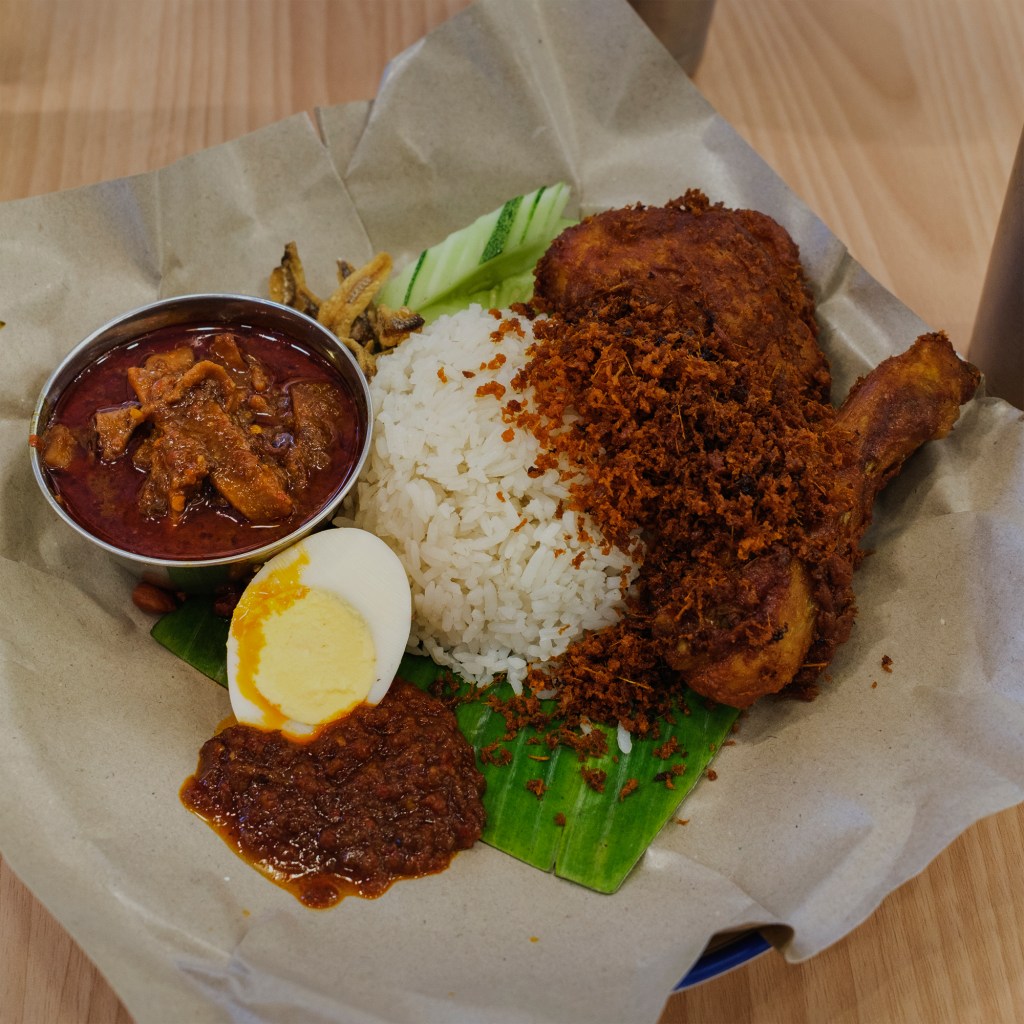
Nasi lemak is the national dish of Malaysia. But does this humble rice dish really encapsulate the story of Malaysia?
The early 20th Century saw all parts of Malaya and north Borneo under some form of colonial control. But with the advent of World War II, the invasion by Japan would upend the lives of locals once again.
Cookbook author Kalsom Taib is older than the country of Malaysia. She was born during the occupation and shares what it was like in the years before, during and after the war. She also recounts how food has transformed over the decades, for better or worse.
Credits
Hosted by Dr Noby Leong and Philip Gibson
Produced by Dr Noby Leong and Philip Gibson
Sound Design by Jack Barr
Satay? Okay! is produced by Kopi Productions Limited and supported by the Golden Chopsticks Scholarship, by the Oxford Cultural Collective Trust
Resources and References
A History of Malaysia (2016), Barbara Watson Andaya, Leonard Y. Andaya
Borneo: The History of an Enigma (2026), Olivier Hein
Druce, Stephen C and Nani Suryani Haji Abu Bakar. 2023. Brunei and the World Since 1984. Routledge Handbook of Contemporary Brunei, pp. 100-117. eds. Ooi Keat Gin and Victor T. King. London: Routledge.
“Scorched Earth” Policy Hansard Volume 377: debated on Thursday 8 January 1942 https://hansard.parliament.uk/commons/1942-01-08/debates/06602dd3-6929-4a8a-b4da-0c30b4427c9d/ScorchedEarthPolicy
SCORCHED EARTH POLICY IN MALAYA, The Canberra Times, 16 Jan 1942
Page 1 https://trove.nla.gov.au/newspaper/article/2585976
Operation Sook Ching by Stephanie Ho, National Library of Singapore https://www.nlb.gov.sg/main/article-detail?cmsuuid=cc4da337-3bcd-4f96-bdc6-5210646bdd90
Transcipt
Please note that this transcript may contain errors and typos
Welcome to Satay. Okay. A podcast about the foods
that have shaped Malaysia. I’m Dr. Noby Leong,
scientist, food writer and broadcaster. And I’m
Philip Gibson, photographer and advocate for
independence. And in this series, we explore
the history, cultures and cuisines of Malaysia
from the ancient lands of Southeast Asia all
the way through to the creation of a modern day
nation. In today’s episode, we take a look at
Nasi Lemak and the dawn of Malaysia. So iron
those flags and get ready for satay. Okay. So
Philip. In the last few episodes, we’ve looked
at the history of Borneo. We talked about how
Sarawak came to be ruled by the White Rajas.
Yep. And then how North Borneo came to be governed
by the North Borneo Company. Yes. And then in
season one, we talked a lot about the Malay Peninsula
and how the British Empire came to kind of overrun
that whole area. Are we bringing it all together,
Noby? We’re bringing it all together. These
large regions, Borneo and the Malay Peninsula,
they’ve both been colonized in some form by Britain.
But everything’s about to change with the advent
of World War II. Pray tell. Well, before we get
to that, let’s get on to the food of the day,
that symbol that connects us with the past, and
that is nasi lemak. Which must be one of the
national dishes. Is it the national dish? It’s
the national dish of Malaysia. I mean, I don’t
really know how we come to decide these things.
I think it’s quite arbitrary, but everyone just
seems to say nasi lemak is the national dish.
Yeah, I would say that people in Malaysia probably
eat nasi lemak more than we eat haggis. Yeah,
that would be, you know, nasi lemak for a lot
of people is an everyday thing. It’s like as
common as toast. Yeah, I was about to say toast.
Yeah. Whereas if you like haggis, if it’s not
burnt night, then I don’t know. I feel like haggis
is having a renaissance. I don’t know. Yeah.
We haggis panini. We haggis on pizza. Haggis
bonbons. Haggis bonbons. Haggis pakora. Yeah.
But we’re not here to talk about haggis. It’s
Scotland’s national dish. Thank you. Pardon.
Nasi lemak. Do you have a first time that you
remember eating nasi lemak? Well, it would. Probably
been in Australia. I don’t know where. Probably
somewhere in the central markets in Chinatown.
I don’t know. I think I didn’t really understand
it. I was like, why is there so many dry bits?
What’s going on with these fried anchovies and
peanuts? That doesn’t mix in with… my bits
and pieces. I don’t know. I come from a country
of stodge loving and nasi lemak is not a stodgy
dish. Well, so for those that don’t know, so
nasi lemak comes in many different forms, but
basically it’s coconut rice served with sambal.
fried anchovies, peanuts and a boiled egg and
maybe some sliced cucumber too. And I think those
are sort of the minimum requirements for nasi
lemak. Historically you would wrap this in banana
leaf and that’s probably how it evolved as this
packed lunch kind of thing that you would take
in the morning and then go out to the fields
and that’s how you’d bring it with you. But these
days you’d also have, you know, fried chicken
with it, full curries on the side, sambal squid
and many others. And in Malaysia it’s typically
a breakfast dish. But in Australia, I almost
always had it for dinner because my mum was not
going to wake up at 5 a .m. in the morning to
make nasi lemak for breakfast. Yeah. I remember
when we were staying in Kuala Lumpur on our recent
trip, there was like a roadside stand at the
end of the street that we were staying on. Yeah,
and these guys are up at, what, 4 or 5am? Yeah.
Is this for the morning prayer? Is that why,
like, I feel like people start their day so early
in Malaysia, and I assume it’s religion -based.
Not necessarily, like, schools start earlier.
Ah, yeah, yeah, yeah. And so some people have
a long commute to work as well, especially if
you’re in KL. Sure, and I guess, like, I remember
your dad was telling us as well, it’s kind of
like, yeah, these guys will be, like, packed
up by, like, 9, 10am. Yeah. And I’m like, what?
I’m barely out of bed. Uh -huh. Well, you would
kind of just roll out of bed in the morning.
Get your flip -flops on and slap down the street
and go and get… and Nasi Lemak. Yeah. But I
guess to your point about the fact that it’s
not like stodgy. I even remember when I ate Nasi
Lemak when I was a kid, it had these like shards
of fried anchovies with the soft rice. And I
remember that being a bit jarring in my mouth.
Yeah. It’s like they’re hydrophobic. They don’t
want to be pals. They don’t want to touch and
gel with each other. It’s like they’re both just,
I don’t know. Texturally quite contrasted, I
suppose. But it’s, you know, those anchovies,
they can really… tear up your mouth if you
don’t chew them. Do you know what I mean? Yeah,
yeah. And they’ll continue tearing you up if
you don’t chew them. Yeah. So, yeah. No, I don’t
know. I mean, like, okay, I know you get your
little bit of, like, a sandball with it, but,
yeah, I don’t know. I’m very pro -sauce. Like,
I like… The wetter, the better. Well, when
I was a kid, I would just eat the anchovies by
themselves. I would kind of eat them like chips,
and then I… Yeah, I could see that. I dread
to think of the… And that breaking into the
Western markets like high protein snack and it’s
just like dried anchovies. Pure fish. I mean,
it’s probably full of like good and beneficial
oils and stuff like that as well. Your joints
would be nice and loose. Yeah, they’ll probably
be clogged up. You know, you’ll find them in
vegetable oil. Oh, so it’s not really omega -3,
right? Okay. I mean, I’m sure you get a little
bit. Okay, let us know in the comments. Yeah,
yeah. But the secret to a good fried anchovy,
fried ikan bilis, that’s what you’d call them
in Malaysia, is to make sure you get the dried
version with its head still attached. Because
that’s where all the flavor is. Oh, I feel like
I’ve never seen them without their heads. is
that because you just don’t buy them that’s because
i just don’t buy them maybe at some point in
australia’s history you couldn’t buy them with
the heads on there could have been some quarantine
also what a tedious process of removing the heads
off of a tiny anchovy you’d be there forever
like nail clippers trying to get them off that’d
be horrible it is very tedious yeah um i think
i think i mean going back to this idea of nasi
lemak as the national dish I do think it sort
of represents the many different constituents
of Malaysia’s foodscape, regardless of your race
or culture. So nasi lemak for most people would
be considered a Malay dish, though there are
many indigenous groups that could also claim
it. There’s many other cultures across Southeast
Asia that also have a version of nasi lemak.
So by no means is nasi lemak unique to Malaysia.
And everyone eats it. It doesn’t matter who you
are, you know, Chinese people, Indian people.
I think the rice is pretty central to all cultures
of Malaysia. So having that coconut rice, is
representative of everyone. Antrophes, those
icumbiles, they, I guess, connect us to the importance
of fishing. and fishing maritime trade yes seafaring
culture is so embedded within the history the
banana leaf that’s wrapped in that’s you know
that’s your jungle constituent which is you know
where all food comes from in malaysia is the
jungle you’re really finding the symbolism in
this one yeah i i mean i’ve obviously thought
about this a lot and then you know the sambal
and the peanuts chili comes from south america
so there’s peanuts so that speaks to the colonial
history of the region too so i think there is
a nice story to be told with nice little mark
about people and the history there yeah well
that is the coming together of all of these people
yeah but how did this country come to be exactly
how did we go from this british colony to an
independent nation let me guess were the people
living under british rule not very happy about
it i don’t think anyone was happy about it so
since colonization there’s always been parts
of the community that have wanted to be free
from the british empire and They were pretty
upset about how Britain came to occupy Malaya
and the tactics in colonization. I guess they
were pretty deceptive. 12 men for an island.
Yeah, in their role, they were pretty exploitative.
They disregard local customs and culture and
really extractive as well. They took a lot of
resources, a lot of wealth from Malaya. Tin and
rubber. And they didn’t really give anything
back. Yeah. So a lot of people didn’t like this.
A lot of people wanted independence for such
a long time. But what would turn the tide in
favor of independence was World War II. Okay.
So Malaya was a target in this arena because
of Japan. And Japan was attempting to conquer
the whole world, I guess. Yeah, what I read was
that the the Japanese I think had started kind
of like seeding the kind of anti -colonial rhetoric
and a bit kind of like Asia for Asians and therefore
well they were still being quite colonial about
it in their own way. Yeah, yeah. And it was kind
of like, well, don’t be run by white people,
we’ll run you instead. So yeah, that was the
propaganda that they were sort of pushing to
try and get sympathies from the local populations
to get rid of the Dutch and the French and the
Brits. Yeah, and well, you know, Malaya was the
target because it’s one of those Pacific nations
that Japan was targeting. It was also a major
rubber and tin producing country. So those are
vital resources for any country’s military efforts.
And as was, historical before and this is very
current just now the strait of malacca no doubt
being a highly significant trading route that
they would have definitely wanted control over
yeah britain would have known that malaya was
a target during world war ii because once the
war accelerated resources and soldiers were spread
pretty thin yeah and it was important to protect
britain in britain and not malaya right so they
began plans to kind of like shore up Malaya without
really being there. Yeah and also we have to
remember that the war in Europe started before
the war in Asia. Yes yeah yeah. So the first
thing that Britain did was enact the scorched
earth policy. All right. So this was a policy
that meant the destruction of any resources that
could be used by Japan with the exception of
adequate amounts of food and water for the local
population. And with the exception of anything
that would require a lot of bombs and a lot of
explosions, which would draw too much attention.
Is this after the Japanese have landed? So, you
know, this is before Japan’s even arrived. They’re
trying to preempt what might Japan want to steal
and use for their own military efforts. So Britain
destroyed lots of rubber, lots of petroleum products,
coal factories, railway communications. bridges,
roads, and other infrastructure. So they were
trying to slow down any sort of Japanese invasion
that was going to occur. The other thing that
they did defense -wise, I suppose, was kind of
protect what they valued most, which was Singapore.
Singapore being that main port. Yeah, right at
the tip of the strait. Yeah, yeah. Other than
that, they kind of abandoned Malaya. Yeah, I
read in a book that they basically sent two warships
to kind of defend. Singapore, and then there
was all this kind of basically British propaganda
for the Malay civil service, which was mostly
Brits going over there to run the administrative
side of Malaysia. You know, telling them it was
Fortress Singapore and Singapore will never fall
and Winston Churchill will never let Singapore
fall, etc. And I think very quickly after the
Japanese invaded… Well, they went through Malaysia
at a rate that I think astonished even the Brits
on the ground. Yeah. And sank, I think, at least
one, if not both of the ships. I’m not sure.
I’m not sure. But yeah, I think Britain did underestimate
the efficacy of the Japanese military and how
swift they would work their way through Malaya.
Yeah. So Japan invaded around the same time as
the Pearl Harbour attack. So early December 1940.
one one yeah so this was the start of the pacific
war and so by this stage japan already invaded
vietnam cambodia and laos okay and then they
had arrived at penang so that was their first
um port of call they worked their way through
penang down south through ipo allostar and they
kept moving at rapid speed and they took over
the entire malay peninsula in just one month
and part of the reason why they were so effective
is because they had already been there for a
while. Yeah, there was a lot of Japanese interest
in the region, right? Yeah, yeah. They knew where
they were going. They had maps. Yeah, yeah. And
so I think they were able to move pretty swiftly.
And, like, local intelligence. Like, they had,
like, you know, shopkeepers and rubber plantation
owners and stuff like that that were run by Japanese
organisations. And a similar story was playing
out in Borneo. So the Battle of Borneo began
in December 1941 as well. Prior to this, again,
the British interests there, they knew that Japan
was coming. Weiner Brook, who was the Raja of
Sarawak at the time, he was burning oil fields
and destroying refineries. And then he fled to
Sydney. Wow. And, you know, he didn’t return.
And so within a month as well, Japan had captured
Brunei and they also captured Jesselton, which
is modern day Kota Kinabalu in Sabah. So, you
know, in just one month, a local person to have
your entire life changed in the blink of an eye
really yeah i think a lot of people who were
working in the malay civil service from some
reading that i’ve been doing seemed to think
that they they paint me this i don’t know slightly
patronizing kind of view of this happy little
colony because nobody really touched malaysia
and it was you know they described it i don’t
know it was being kind of sleepy and everybody
was just having a nice time and they had the
nice little routines of waking up in the morning
and going to play tennis and then coming back
up and having a siesta all the rest then all
of a sudden the bombs start falling from the
sky yeah i think what also surprised them is
just how in these like um extracts that the people
were saying That they were astonished by how
quickly Malaya fell to the Japanese and then
all of a sudden they’re stuck in these kind of
boat holes in Singapore that they’ve been able
to get to as they’ve crossed the causeway as
the Japanese are entirely around them over the
Strait of Johor. Yeah, I think they were completely
astonished by it and just trying to get women
and children onto boats to either get them to
Australia or get them to… I think possibly
India, because I don’t think India was occupied
by the Japanese or Sri Lanka even. But you know,
those memoirs, I guess, are from British people
who could actually do that. But for most of the
population, they kind of now had to live under
Japanese occupation. Right. And I think there
were some very interesting choices that everyone
had to make. Right. You kind of had just spent
your previous generation under British occupation,
essentially. Yep. An invader from the West, if
you like. Sure. Now you have an invader from
the East out of a different occupation, but still
an occupation nonetheless. Different language.
So I think you’ve got choices to make of how
you want to survive this period because you don’t
know how long it’s going to last for. Sure. Are
you going to play with this new enemy? Are you
going to try and make friends? Are you going
to fight back? So these are all things that the
local population has to deal with. Japan in general
needed this society to function. without resistance
yeah so you know they didn’t want to constantly
quell rebellions so local rulers largely retained
their posts but with the obvious influence of
japanese overlords right so in borneo the interiors
generally weren’t governed because the jungle
is just too dense sure but the coastal areas
were and the bornean people generally had a lot
of independence And it seems that Japanese authorities
wanted to cultivate those relationships in a
more friendly way. In the Malay Peninsula, though,
it was quite different. And how you were treated
depended if you were Malay, Chinese or Indian.
So if you were Malay, you were generally treated
more favorably and you were generally okay to
hold administrative and more senior positions.
You could be in the police force. if you didn’t
resist okay so you know that’s a decision that
malay people would have had to make right chinese
people though were treated with intense suspicion
because japan and china were at war at the time
there’s this communist sort of struggle that
japan is working against so anyone that is chinese
is treated with intense suspicion they were often
brutalized and often targeted by japanese soldiers
indians were treated worse than malays but better
than the Chinese. Some were conscripted to the
death railways in Siam, which is obviously terrible,
but otherwise they weren’t brutalized and targeted
in the same way as Chinese people. Right. There’s
no way suggesting that life was rosy for anyone,
regardless of who you are. So there’s lots of
instances of mass starvation, Japan destroying
crops and livestock. There was forced labor conscription
and still those racial tensions between Malay
and Chinese communities because… If you’ve
got a police force that’s now largely Malay,
you’ve got Japan targeting Chinese people. And
so you can see how this tension is being stoked
between these two cultures. Prior to the Japanese
coming, what was the ethnic breakdown of the
police force in Malaysia? Pretty similar to what
it was under Japan. Mostly Malay people in the
police force, mostly Malay people in administrative.
So that wasn’t a cultural shift then? No. In
really many ways, Japan kind of just continued
the race -based policies that Britain had started.
Right, okay. So Britain preferred to run its
colonies along racial lines. So Malay people
could be in the civil service and administrative
positions. Chinese people were allowed to kind
of run some types of… agricultural or tin businesses.
Indian people could only really be workers in
plantations. And so this was a… Japan just
continued this. I see. So the occupation lasted
for about three years. And as you can imagine,
a lot of brutality, a lot of war crimes, I guess,
were happening at this time. And I think it’s
important to mention some of them because I don’t
think we talk a lot about… Southeast Asia’s
role in World War II and what was happening there
and just how difficult it was for people that
were living there. So one of the most infamous
cases of war crimes in the region was the Sandakan
Death Marches. So Sandakan is a coastal town
in Sabah and Allied prisoners of war were sent
there by Japan to build an airport. This itself
was quite a harsh situation for the POWs. Long
hours. the harsh climate, if you’re not used
to, you know, the Borneo tropical heat, it’s
intense, and they weren’t really fed a lot. But
things got a lot worse when the prisoners of
war had to flee Sandakan. So in 1945, when the
tide of the war was changing and Japan was sensing
its defeat, they were kind of relocating some
of their well -known bases, one of them being
Sandakan. So their plan was to move all the Japanese
troops and the prisoners of war into the jungle
to walk to another town called Renao, which was
inland. And so they’d be more hidden in this
location. And these treks to Renao became called
the Sandakan Death Marches. So these occurred
three times. The distance between Sandakan and
Renau was about 260 kilometers through dense
jungle. The Japanese soldiers used the prisoners
of war as porters and they got them to carry
all their heavy equipment and their luggage.
These prisoners of war were already pretty weak.
They were injured from building this airport.
They were very malnourished. and they weren’t
given adequate rations through the trip so often
they had to forage for their own food while they
were kind of trekking through the jungle disease
was rife and so many succumbed to illness in
the first march 470 prisoners of war were sent
and only six survived wow six out of 470. in
the second march 536 prisoners marched and 183
reached the end and on the third march None of
the 75 men survived. Wow. Aside from those, many
prisoners of war were also left in Sandakan and
they died from starvation. The only reason why
we know about these Sandakan death marches is
because on the second march, six Australian prisoners
of war escaped. They fled into the jungle where
they were met by a Dayak community. Those Dayaks
nursed them back to health. And then four of
these Australians would go on to testify against
these war crimes. Wow. So the fact that… you
know i didn’t get taught any of this as an australian
it’s kind of wild to me yeah and the fact that
we don’t talk about you know this this event
yeah i’m fairly certain that we don’t get taught
about it over here is because it’s probably a
bit of a national embarrassment that we didn’t
actually look after our colonies we don’t really
talk about the demise of the british empire at
all really yeah um because it’s not a happy subject
no yeah well it’s not a subject that instills
pride yeah um yeah yeah Unfortunately, that’s
not even the worst of it. The worst of Japanese
war crimes occurred during the Japanese occupation
in Singapore. It was a war crime that was called
Operation Suk Ching. So Suk Ching is a Chinese
term meaning purging through cleansing. So again,
we’ve got these Japanese imperialists who are
suspicious of anyone Chinese because they’re
associated with communism. Right. So in this
operation, Japan was trying to root out these
Chinese men who were suspected of working against
Japan. And from 21st of February to the 4th of
March in 1942, Chinese men between the ages of
18 and 50 were summoned and then sent to mass
screening centers. There they were questioned
and depending on the whims of the inspecting
officer, they were either released or killed.
Wow. So officers would basically base their decision
on… any sort of personal opinion that they
might have had at the time. So this could be
maybe the Chinese person had a certain occupation
that was more suspicious. Maybe they had tattoos.
Maybe someone dobbed them in. Or maybe they were
just feeling particularly cruel that day and
decided to kill someone. The men that were suspected
of being anti -Japanese were rounded up in lorries
and executed. Sometimes their bodies were thrown
at sea. Other times they were buried and their
graves were dug by other prisoners of war. We
don’t exactly know how many men were killed through
Operation Suk Ching. We don’t know who they were
because records weren’t being kept. We don’t
have the bodies because some of them were thrown
at sea. But anywhere between 4 ,000 to 5 ,000,
up to 40 ,000 to 50 ,000 were thought to have
been killed at this time. Some call this a massacre,
others call it a genocide, but it was certainly
the most heinous war crime ever committed. So
the Japanese occupation total would last for
three years. And then during this time, there
were many resistance movements across Malaya,
across Borneo with varying degrees of success
and failure. By 1945, Allied forces would return
and they would coordinate with local militia
to launch more aggressive resistance and Japan
would eventually surrender. Right. So the overall
impact of the Japanese occupation was brutal
and an estimated 100 ,000 people across Malaya
lost their lives through either death in combat,
execution through Operation Suk Ching, starvation
or other causes. I’m not sure how many people
in Borneo. And I think this is the time in history
that even Malaysians don’t really talk about.
Again, it’ll be like, you know, intergenerational
trauma. They just won’t want to talk about it.
Yeah, yeah. Because they were up that coalface
for such a long time. Yeah. How do you even begin
to unpack all of that? Yeah. I suppose perhaps
in the initial years after the war, which I imagine
you’ll get to, a lot of the local sentiment will
have just been a bit kind of like, we’ve had
the West, we’ve had the East, why don’t we just
do it ourselves? And then they’ll have just probably
put all of their energy and motivation into building
what has become Malaysia. Just sort of let’s,
we can’t dwell on this trauma. We need to move
forward. Yeah. Yeah. Yeah. But I think a lot
of, I think there’s a lot of missing stories
in a lot of families in Malaysia. Everyone is
going to have a story about World War II. You
can’t not, you know, and there’s a lot of gaps
in my family history that people have told me
over the years that. Either don’t make sense
or we don’t have enough information. So one of
them is like my grandma on my mom’s side, Amma.
She was born in Singapore. She became an orphan
at five. Both her parents died. I don’t think
that they died from war -related things. I think
the mom died in childbirth, but I’m not sure
about how the father died. Anyway, my grandma,
she had a younger sister and they were sent to
Malacca to live with an auntie. However, she
had two… twin brothers that were left behind
in Singapore we believe and my grandma never
had contact with them ever again she tried to
find them she would put like things in the newspaper
to try and find them but she never found contact
with them again would they have been too young
to maybe remember and know well one possibility
is that they were caught up in operation Seokjin
they were too Young Chinese boys living in Singapore.
Do you know when was your grandma born? I don’t
know. I reckon she would have born in the 30s.
So whether or not the twin brothers were younger
or older, I’m not sure. Right, okay. And so,
you know, this is one of the gaps in my family’s
history. Even if they were too young, maybe,
you know, still something could happen in the
war so easily. Yeah. Yeah, challenging things
to uncover because… being an orphan in those
days was not really unusual. True, yeah. You
know, so many people were orphans at that time.
Yeah, I feel like a couple of people that we’ve
spoken to during the interviews for the podcast
have talked about how they talk about their parents’
and grandparents’ generation just having adopted
siblings. Yeah, yeah. Some people couldn’t afford
to raise that child, and so they got passed over
to a slightly better -off family or whatever.
Obviously, nobody wanted to see anybody starve,
and so there was that kind of, I don’t know.
Child -sharing almost. Yeah, I mean, I don’t
know what it was. I have an auntie that was adopted,
probably in the mid to late 40s. Right. So I’m
not sure the circumstances of how that happened.
I think this is one of the reasons why it’s so
important to talk about this history, especially
for Malaysians in the diaspora, who we get even
less of these stories than what you might get
if you actually grew up in Malaysia. Yeah, and
you just went over to your auntie’s place for
tea, and she just starts talking one day. Yeah,
and you kind of have to try and piece together
what that auntie is talking about, but if you
don’t have the historical background of what
Malaysia was doing at this time, it’s hard to
think about what she’s trying to tell you. Yeah,
yeah, yeah. And again, you know, Australia, I
don’t know why Australia doesn’t talk about their
role in the Pacific War much at all, really.
We sort of talk more about World War I, Gallipoli.
Oh, sure, right. Those are stories that I was
taught in school. We didn’t actually learn much
about World War II at all because Australia did
have a role in taking over Borneo from Japan.
Oh, right, okay. Yeah, no, there you go. So hopefully
if you’re living in the diaspora, Malaysian,
your curiosity has been piqued. I hope this has
helped. And I don’t know, I found it very difficult
to research this part of history, but also it
was very important and it filled in a lot of
gaps. The end of World War II became a catalyst
for independence, which would happen in 1957.
So a good 12 years actually. There’s a lot that
happened from the end of World War II and independence.
And so the next episode is going to talk about
that 12 -year period. But for now, our guest
of the episode, Kalsum Tabe. We first spoke to
Kalsum Tabe in episode one of this podcast. And
she was kind of talking about her thoughts on
Malaysian cuisine, what it is, what it isn’t.
But there was so much more to her story. So she
was actually around during the Japanese occupation.
She remembers what it was like. and also what
happened in the years after World War II ended.
I think what’s quite remarkable, given how little
literature you’ve had to kind of like draw upon,
to kind of learn about this, is that we are still
lucky enough that there are people alive today
who lived through the Japanese occupation, and
we were lucky enough to speak to one of them.
And so let’s go to an interview with Kalsum Tabe
to hear what it was like growing up at that time,
what it was like for her family, and the events
shortly after the war as well. I was born in
August. December 1941, the Japanese came. So
by the time I was born, Japanese were already.
I remember my mother telling me that they came
early, you know, they came. There were some were
my father’s friends, you know. They came as dentists,
some jobs that they did, shopkeeper. But they
were actually Japanese soldiers, you know. They
were already like spies. And my mother said we
had to run. I had an elder brother, but he died
just before I was born because they had to run
and go into the jungle, flee, you know. So there
was not much water, dirty water. He died. He
was eight months old in April. I was born in
August. born in my grandfather’s house. But because
my father had some Japanese friends like that,
so he was not really suffering. We had rations
for food. So we had food. My grandfather had
food. We were safe. We didn’t have to run after
that. But it was food which was homegrown. Rice
was rationed. little bit of rice, ration, and
my father had a job by the Japanese, so we didn’t
really suffer that much. But after the Japanese
occupation, two of my uncles were shot by the
communists because by the time the British came
and the Japanese left, the communists, the MACPJ,
the army came, they were hiding in the jungles.
So my two uncles, my father’s brother and brother
shot at the tire of the car. They were going
to buy food. So they went out. They were shot.
So that’s how we suffered. My grandmother lost
a son and a son -in -law by the communists. They
were the communists, the Kuomintang, you know.
But it was only a short while. By 1945, The British,
they surrendered. Japanese surrendered. The British
took over. So it was easy. My father, because
he had a diploma from Raffles College, had a
job. But he left soon after. 1946, he got the
government scholarship to go to London to do
law. He was there. Then my mother subsequently
followed and left all of us with my grandfather.
I was born in my grandfather’s house. I lived
with my grandfather. until I was seven, when
my father came back in 1949. So I had good food
at my grandfather’s house, you know? So we didn’t
really suffer, I have to be honest with you.
So that was Kalsom Taib just talking about her
childhood, and we’ll go back to her a little
later in the episode. But I think what struck
me is, she seems to talk quite casually about
what this time was like, but I think even for
someone like her, that was relatively… privileged
i supposed in being safe um you can sense still
the decisions that her family had to make in
order to keep that safety self -preservation
isn’t it yeah yeah you know her father had some
japanese friends and and so if you wanted to
ensure that your daughter was safe and your family
was safe you know this is what you kind of had
to do yeah but it’s also interesting that her
idea of safety is just having enough food to
eat yeah was it not right that the japanese were
kind of taking a lot of the food that was available
and obviously prioritizing the japanese soldiers
nutrition over the locals nutrition and so i
think this is probably again reinforces why food
is so important to to so many people in southeast
asia because you have these relatives where starvation
was common hunger was very common And you had
to spend a lot of time thinking about food because
it wasn’t really available. And so when food
became more available in the following decades
and you could spend money on food and be luxurious
with your food, that of course you would just
talk about it all the time. But after World War
II ended, that I guess became a catalyst for
independence. Sure. Independence was gained in
1957, so a whole 12 years after the war ended.
A lot happened in that 12 -year period that we’re
going to talk about in the next episode. But
in 1957, independence was announced at what’s
now called Medeka Stadium in Kuala Lumpur, and
Medeka meaning independence in Malay. Kalsom
Taib was also there at the stadium witnessing
the declaration of independence. So here’s Kalsom
Taib describing what that moment was like. Do
you know I was at the Merdeka Stadium? I was
15 in 1957, August 31st. I followed my father.
He was district officer. He was on duty, so I
wanted to go with him. I told you I have always
been interested in history. I wanted to be there.
I was there! On the 30th night, when the flags
came down, and I was there at Merdeka Stadium
31st. You see, I was fortunate. I had a teacher,
Miss Ting Weng Vian, Form 3 at that time, who
told me about Merdeka, independence, what would
it mean to us. That now, the British… have
done a lot we have inherited a lot of their legacies
but we will have more money to spend for the
country because they are leaving they will not
take the tin money and the rubber money back
to uk so we will have the money to develop our
country so i was already i knew about what medeka
means so i was schooling in jb i came back for
the holidays because my father moved earlier
So when Merdeka came, I told him I wanted to
follow. So he took me to the 30th place at the
Selangor Club, Padang, where they hurled back
the Union Jack and pushed up, hurled up the Merdeka
flag with the stripes. So I witnessed that because
my father, being in the committee, put me in
a strategic place. Tunku Abdul Rahman shouted,
he said, with one stroke of the pen, you know
what, we have achieved Merdeka. When the flag
came down, the sound of the Negaraku filled the
air and he shouted, Merdeka! I also followed
in my squeaky voice, Merdeka! And I was overwhelmed
because this is what it feels to be independent.
independent you know independent from the yoke
of colonialism so it was a good feeling at young
I suppose that witnessing it it really make you
make you aware you know that Now the country
is different. That’s why I was very interested
in history. That’s why I majored in history at
the University of Malaya. I wanted to know because
it is the past that determines the present and
the future. You know, Philip, next year, 2027,
will be the 70th anniversary of independence.
Oh, yeah. And what is… so interesting is that
when I hear Kalsum Tabe retell that story, it’s
like that memory is so fresh in her head. She’s
telling it with such enthusiasm and you can hear
the excitement and the hope that must have been
occurring at that point of time. Yeah. We had
a referendum in 2014 in Scotland and in George
Square in Glasgow there was a big independence
camp which I had to walk through every day to
get to college. In the run -up to the referendum
in September 2014, there was genuine palpable
enthusiasm and excitement for finally Scotland
being able to do its own thing, which I understand
that our colonialism is very different to what
anywhere else in the world has gone through,
given that we were part of the union that were
the oppressors. Just the idea that we would finally
be able to do it our way. And then I cannot explain
the atmosphere that hung over Glasgow on the
Friday after the vote when the results came through
to say that we were to remain in the UK. It was
as if nobody was talking on the street. It was
like the entire city went through a funeral.
Listening to her talk and listening to her enthusiasm,
and the enthusiasm that she said was free from
the yoke of colonialism or something like that,
which I think is such a poetic way of describing
this chokehold or whatever. I’m just, I was envious.
Because I kind of know what that hope feels like,
actually, and I know what that combined hope
feels like. And that’s such an incredible thing
to feel. And so, yeah, no, it was so… utterly
amazing to sit in an audience with her and listen
to her talk about this. I felt very privileged
to be in her company. We were welcomed into her
home. We did the interview in her back garden,
so you could hear the gardener kind of going
in the background of that interview. But, you
know, as soon as we got there, you know, she
fed us breakfast and then we had the interview,
but she fed us lunch and she was very generous.
And I think just so willing to share her story,
which I was also very grateful for. Yeah. She
was able to overcome whatever difficulties in
remembering those. times in history. If you’re
enjoying this episode, follow us on social media
at SatayOK. We’ve got more stories and more food
to share. You can also find links to give us
a donation or tip. We’re an independent podcast
and every ringgit, dollar and pound goes directly
to supporting our work. So give us a follow and
say hello at SatayOK. So in many ways, the country
that Kalsom Taib grew up with is very different
to Malaysia of today. Like if you go to KL today,
Kuala Lumpur, the capital, It kind of looks like
any other big metropolis in a way. It’s got a
monorail. It’s got a monorail. It’s got skyscrapers
galore. You know, you’ve got the Petronas Towers.
Yeah. It’s got Merdeka 118, which is currently
the second tallest building in the world. So
that’s the one that Florence Pugh jumped off
in one of those Marvel movies. And that’s how
you really put your city on the map. It’s by
getting Florence Pugh to jump off a notable building.
We’ve made it. there’s also lots of highways
it’s basically a concrete jungle yeah yeah i
definitely think the concrete lobby in malaysia
and kuala lumpur particularly like is getting
a lot of bank off of the government like it’s
quite a hilly city don’t get me wrong and so
like we you see where they’ve built like the
metro railway and you’re like why is this 30
meters off of the ground anyway i feel it’s very
passionate about infrastructure and public public
yeah town planning of which i’m not sure there’s
any in kuala lumpur and i think the locals would
agree so malaysia has undergone rapid growth
and transformation in just one lifetime as well.
And that extends to its culinary landscape too.
So the ways of eating in the past, the types
of food available, that’s all radically changed
over the years. And of course, the person who
has seen that change is calcium tape. So I was
really curious to understand what food was like
under Japanese occupation and how that’s changed
over the decades. When we were growing up during
the Japanese occupation, it was just tapioca
they made a lot of food from tapioca so we became
my parents my grandparents became skilled in
making different kinds of food from tapioca you
know you can just not only boil you can mash
form into cutlets and fry you can cut into slices
and fry you can make bubble using that so they
became innovative you know and you use the leaves
to make ulam or you cook with coconut milk innovative
very short of it with a bit of flour things can
happen so we didn’t starve actually because they
grow tapioca at the back of the garden the kampung
houses you know then after that the British cake
so by then my father studied in London so then
my mother left the children and went and followed
him And that’s where she learned all her cakes
and the puddings and the pies and all that. I
know when my mother came back from London, you
know. And it was the first taste. I mean, she
brought a waffle, literally brought back a waffle
baker. And we used to have waffles for breakfast
every weekday, once a week, with butter, honey,
imported butter, not local butter, not margarine,
and kipas because they were sold in the supermarket.
So we were introduced that very early. She came
back in 1949. But it was easier because then
rice, you know, during that there was stability.
and then more food then with the british the
supermarket so there was food but we were still
eating at home no fast food no nothing so we
grew up on good wholesome food simple but cook
home cooked food rice as the main staple with
dishes it must have a gravy a vegetable either
fried or cooked with coconut milk something fried
hardly chicken we were poor you see My father
was a struggling civil servant. More fish, you
know, and eggs, omelette or something like that.
But it’s nourishment. It’s good food. That’s
why you don’t grow plump, you know, those times,
you know. No fast food. I remember the fast food
was introduced when I was at the university.
1962, 63, 64, 65. A &W came in. Oh, really? The
first… fast food joint. We had burgers and
hot dogs and root beer. It was a craze and I
was at the university so my boyfriend my husband
now took me there to have burger you know and
then we have pancakes and waffles. Then they
built the car hog type where you can eat from
the car you know. Then after that they had the
fast food KFC and slowly slowly our food habits
changed. The arrival of fast food joints proved
to be a pivotal change to Malaysia, altering
how people cooked and shared food. And people
stopped, I think, eating together. I grew up
eating together. You must be at home at least
for dinner, you know. It’s cooked food, so we
get the family together. But once you start having
this, they go out with friends, they eat their
own. Family also starts to disintegrate, you
know. It wasn’t as good as home -cooked. Fast
food, however, wouldn’t be the only major change
to Malaysia’s culinary landscape. And I don’t
blame because people were now working. My mother’s
generation don’t work. I work, but I cook. I
had to cook. But as the years go by, people don’t
cook because it’s getting expensive. I’m guilty
now also of not using original, cooked from scratch.
I mean, I can use now coconut milk from Saji.
They have all the sauces. They have a lot of
paste. You want sambal tumis? You want curry?
You want kuzi? You buy the paste and just add
the fresh ingredients. It’s simple now. Times
have changed over the years. I’ve seen it happening
even to me. So I buy the ready -made because
it won’t last. The fresh, I’m not going to market
every day. So I keep the saji coconut milk in
my pantry so that when I want to make vegetables
in coconut milk, I just take that. So simple.
And now you can buy freshly cut vegetables from
the supermarket or packed nicely. Unlike before.
So times have indeed changed. Now you go to the
big supermarkets. All the big supermarkets. You
just go to the shelves. Everything all packed
nicely. Peeled prawns, peeled fish, peeled everything.
It has changed unlike the past. It’s good in
one way. Easy for the career woman just to pick
up. and now also with the street food the waros
ready -made food you just buy in fact for the
fasting month i tell you my secret sahur is the
dawn food where we have to eat in the morning
for the nourishment where you do not eat the
whole day i have ordered packets of gravy sauce
from balkis can you make for me 10 packets of
the gravy sauce I have the frozen roti canai.
I don’t have to make my roti canai. You know
how hassle it is to make. So I just fry for sahur.
I heat that gravy. I open a tin of ayam sardine,
throw out the gravy, fry a bit and put inside
the sauce. I dip it with the roti canai or with
toast. makes life simple for me you know in the
morning you want to cook fresh tired you are
tired because of fasting whole day but this is
a good nourishment it’s home cooked because bakis
that does it for me so from eating tapioca dulu
all the different forms of tapioca to now the
modern generation and the fast food that is growing
And the food delivery now, people don’t have
to cook, just ring up, grab. I’m guilty too,
when I’m too lazy, grab food. You can just grab,
pay online, and then the Lalamove will bring
the food for you, which is another innovation,
I think. Before, you have to buy, you have to
wait. Now you pay, what? You pay by no cash,
cashless. You just pay online. I will order like
yesterday because I have to prepare. I told my
husband, don’t want to eat rice today. I will
order. So I ordered flavours. Aunty Chom here,
I want mushroom soup and aglio spaghetti. So
how much is it? So these are innovations I see.
The changes that I see. And I’m glad. I’m going
to be 83 this year. So I am blessed that I have
seen the changes before my eyes. Though Kalsum
Tabe is thankful for these changes, she offers
a reminder about tradition. So times have changed,
maybe for better in the long run, but yet don’t
forget your roots. Don’t forget your heritage,
who you are. Once in a while, maybe you have
time, take out my book, choose a simple recipe
and cook. one of the dishes from there for your
family, for your grandchildren. I have 14 grandchildren.
They come and eat in my house every Friday. Yes,
that’s why my house is like a restaurant. You
notice or not? It is like a restaurant, yeah.
Like a restaurant because I have them every Friday.
Once a month, I have the whole lot. There are
30 of them, my immediate family. So we have brunch,
we have breakfast brunch, we have dinner. we
grill we have barbecue so the chairs are always
people come to my house and said are you going
to are you entertaining no it’s there all the
time because i don’t have men i’m lazy to put
the table in and out they’re there all the time
once a month i have and every friday my 14 grandchildren
will come to eat some i order i’ll make maybe
omelette or fried vegetables to unify my family
So that the cousins will know each other. So
it keeps the family unity. I have to practice
what I preach. You know, I have to practice.
Cannot. So it comes from the home. It comes from
me to unify. Because I said when I’m gone, all
of you must know and you know your heritage.
You know, so that this will keep going. The family
who eats together. Stays together. Family who
eats together, stays together. And it is through
food that unifies all of us. And that was calcium
tape. What a chronology of the last 80 years
in food in Malaysia. It really is incredible
when someone lays it out. like that yeah yeah
in such a kind of meticulous order of like how
things changed from the introduction introduction
of waffles and butter uh -huh how prevalent tapioca
used to be yeah yeah part of me is almost like
surprised because I didn’t grow up with much
tapioca at all maybe that’s because I was grew
up in Australia and there wasn’t a lot of tapioca
but then i’m like maybe that generation doesn’t
actually want to eat tapioca anymore because
it’s like a collective trauma of a bad period
i feel like we have a lot of like wartime food
that we don’t eat anymore in this country because
it was phased out again with supermarkets coming
into the uk yeah yeah it’s it’s so interesting
how food has become so convenient now you know
calcium tape talks about first she cooked everything
from scratch right then she cooked some components
from scratch and bought others pre -made then
she didn’t cook anything and you could just go
out and buy pre -made food. Now it’s just getting
food delivered to your house and you don’t have
to leave the house. Yeah, I like the way she’s
kind of like, Auntie Chom here, I’ll take some
whatever. Yeah, so for better or worse, that
is an astounding change in how people consume
food nowadays. And like she says, I think it’s
important that with these changes we don’t forget.
our food heritage. No, I think it’s probably
something that a lot of countries and cultures
are probably trying to reconcile with as mass
manufactured food becomes just so… normalized
and what the trade -offs are you know as you
were saying as well it’s like people have stopped
eating together as much there’s you lose that
community feel when everything is just done for
you yeah you see these styles of restaurants
where it’s like literally like catered for single
people coming to just have dinner by themselves
yeah yeah but then like she makes a really good
point about how her mother didn’t have to work
but she was a working woman and and therefore
like you know what are the expectations on the
family unit and like how much money comes in
so you know it’s not just as like romantic as
It’s kind of like, oh, I’m just going to just
order food because I’m lazy. It’s actually because,
you know, fundamentally the world has changed.
I think it’s one of those interviews that I’ll
dwell upon for a long time. It was a long interview.
We were at her house for like five hours. But,
you know, hearing her descriptions and reflecting
on what she must have seen, I think… For me,
I need to reflect on that quite a lot and what
that means for our food and our culture today.
I think what’s also really reassuring from how
Carlsman -Tabe talks about things is that she
never really comes across as pessimistic or cynical.
Yeah. Like, everything’s delivered in quite a…
matter of fact or or light even like you know
yeah yeah it’d be quite easy to have listened
to all of that come at you from a very different
tone of voice yeah and and she delivered it in
quite a refreshing way i thought that’s true
and i think that it speaks to her abilities like
a communicator and also her her own like philosophy
and like you know how she sees the world which
i think it was just such a joy to be in her presence
and listen to her i can grow up to become like
calisthen tape i would be very happy you’re far
too cynical nobby i know she’s had such a calmness
about her which I really envy. Maybe it will
come with age. Maybe. Anyway, back to our food
of the day which is nasi lemak. Malaysia’s national
dish. And sometimes I think when we think about
national dishes, they’re supposed to instill
a lot of pride in us and who the country is.
But I think it’s also important that these foods
recognize where we’ve come from as a country
as well, who this food represents and what we’ve
all collectively been through. Because in the
case of Malaysia, we’ve been through quite a
lot, Philip. Definitely. No, I would agree. Now,
Philip, the end of the Japanese occupation meant
the dawn of independence, as Kalsom Taib described.
But the end of the war didn’t necessarily mean
the end of conflict. Right. The Japanese occupation
ended up exacerbating underlying racial tensions,
particularly between Malay and Chinese communities.
Right. Which led to some very drastic responses
from the British authorities who eventually returned
to Malaya when Japan retreated. Right. So it’s
really quite a devastating set of events that
happened post -World War II where you think the
worst is over. But really, it’s kind of just
a beginning of something different. Right, yeah.
So we’ll be exploring all of that in the next
episode entitled Hawkers and the Aftermath of
War. And we’re going to look at the period between
1945 into the early 1960s. All right. So it’s
going to be another tough episode, but a really
important one as we delve into that history.
So I hope you’ll join us for the next episode
of Satay. Okay.

