
12. Ginger and the Empires of Borneo – Satay? Okay!
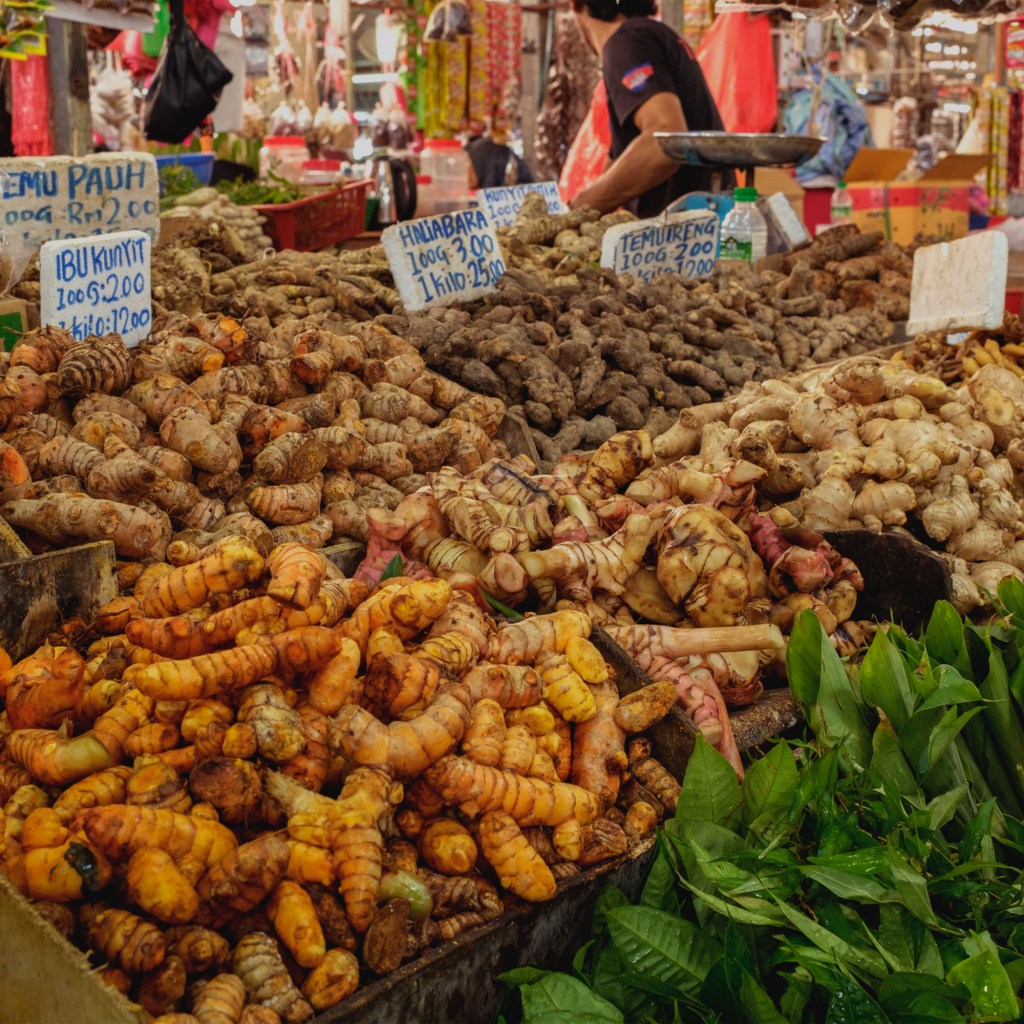
Ginger root isn’t the only ginger out there. Malaysia boasts dozens of different gingers, some that are only found in Borneo.
Much of Malaysian Borneo’s early history concerns Brunei, an ancient kingdom that sprung up in the 10th century. Like other coastal sultanates, Brunei was a maritime trade empire, specialising in jungle products found no where else. Critical to this trade system was Borneo’s indigenous communities, which are still thriving today.
Pison Jaujip is one of Sabah’s most famous content creators. He runs Ropuhan Di Tanak Wagu, or Bachelor’s Kitchen, where he teaches people to cook traditional Sabahan foods. His efforts are helping to document a cuisine that is fast-changing.
Vicky Chong, meanwhile, runs Walai Dahai Corner in Kota Kinabalu, where she runs classes on traditional Dusun foods. She sits down with us to share the stories behind classic heritage foods, many of which are rooted in survival.
Credits
Hosted by Dr Noby Leong and Philip Gibson
Produced by Dr Noby Leong and Philip Gibson
Sound Design by Jack Barr
Satay? Okay! is produced by Kopi Productions Limited and supported by the Golden Chopsticks Scholarship, by the Oxford Cultural Collective Trust
Resources and References
A History of Malaysia (2016), Barbara Watson Andaya, Leonard Y. Andaya
Borneo: The History of an Enigma (2026), Olivier Hein
Druce, Stephen C and Nani Suryani Haji Abu Bakar. 2023. Brunei and the World Since 1984. Routledge Handbook of Contemporary Brunei, pp. 100-117. eds. Ooi Keat Gin and Victor T. King. London: Routledge.
Ji, F. (2018). The Chinese Kongsis in West Borneo: the Rise of the Chinese in Global Trade in the Early and Mid-19th Century [Brandeis University]. https://doi.org/10.48617/etd.853
Charles Spence, Ginger: The pungent spice, International Journal of Gastronomy and Food Science, Volume 33,2023, 100793, ISSN 1878-450X, https://doi.org/10.1016/j.ijgfs.2023.100793.
Transcipt
Please note that this transcript may contain errors and typos
Welcome to Satay. Okay. A podcast about the foods
that have shaped Malaysia. I’m Dr. Noby Leong,
scientist, food writer and broadcaster. And I’m
Philip Gibson, photographer. And you can’t catch
me. I’ve outrun an old woman, a cow, a pig and
others before ultimately being caught by a fox,
the gingerbread man. And in this series, we explore
the history, cultures and cuisines of Malaysia
from the ancient lands of Southeast Asia all
the way through to the creation of a modern day
nation. And in today’s episode, we take a look
at ginger. And the empires of Borneo. So get
out your roasting pans and get ready for satay.
Okay. Run, run, run. Run, run, run. So last week,
we looked at the ancient history of Borneo. We
talked about how the Ice Age meant that Borneo
wasn’t actually an island, but part of a much
larger exposed continental shelf called Sundaland.
Okay. And whenever I think of Sunderland, I think
of Shondaland for some reason. production company
that made Bridgerton. And other things. Yeah,
okay. Shonda Rhimes ever been to Borneo? Maybe
she has. Maybe her next Bridgerton should be
set in Borneo. Oh yeah, okay. Well, we could
maybe see where that story might fit in. The
Bridgertons become the White Rogers of Borneo.
Oh, you’re giving it away, Noby. Oh, I know.
Spoiler alert. We talked about humans migrating
to that land before the ice caps melted, making
Borneo an island. And we also talked about how
Austronesian expansion about 4 ,000 years ago
saw more people migrate to Borneo as well. It’s
the place to be. Today, we’re going to accelerate
into the history, looking at the more recent
past of Borneo. But before we do that, let’s
look at our food of the day, that symbol that
connects us with the past and to the culture.
And that food is ginger. Oh, yeah. We’ve had
so many ginger spice jokes in the past that I
think we need to move past that. Yeah. Well,
I’m ready. Are you? Well, I think any opportunity
to talk about the Spice Girls is a good opportunity.
Sure. A little hanging fruit, though. I know.
That’s very true. Do you have many memories of
ginger growing up? So I don’t think we cooked
with it in a way that I feel like people in Asia
use it and probably other parts of the world.
And that would be that my mum tend to kind of
bake with it. But ginger to me also was like
a dried powder. We didn’t really, like occasionally
we had like fresh ginger in the house, but don’t.
really remember sorry mom if you’re listening
uh my mom cooking with it all that much not not
in the way that you would have it julienne and
stir fries and stuff so my mom’s like gingerbread
loaf is legendary uh shout out to Jeanette Gibson
it’s very tasty I can attest yeah yeah yeah um
but that’s like really dark and like molassesy
and like the ginger kind of adds a kind of heat
to it I suppose yeah um this kind of goes back
into like the the warming fruits of Asia uh which
or heaty, as you described it in one reel. Which,
yeah, I don’t think I realised that as a concept
until it was explained to me by somebody who
has got an Asian background, I guess. But yeah,
anyway. So yeah, gingerbreads. So when I say
gingerbread as well, I think a ginger loaf is
more what I’m thinking of. It’s not like the
biscuit that a gingerbread house would be made
of. So that’s what we would have. My mum would
often make the loaf and slice it up. and then
like toast it and then put butter on it, which
sounds insane, but it is actually the correct
way to eat it. It’s not a million miles away
from sticky toffee pudding. because it’s got
like sugar molasses in it, it’s always a bit
trickly, like quite sticky. Right. Yeah. Like
a dense cake. So if you kind of, because you
can then toast that up rather nicely, you just
get a bit more of a textural crunch on the outside
and it’s still soft and gooey on the inside.
We experienced ginger in very different ways.
There was never ginger powder in my family’s
kitchen, I don’t think. Right. Okay. It was always
like the whole ginger root, as it were. Yeah.
So I was using like stir fry shoes and that sort
of thing. But my core memory is just biting into
huge chunks of ginger once every few weeks. So
my mum would use it in stews a lot, but I would
always mistake it for a potato because she would
use such large chunks. Oh, you know about it
when you bite into it. Exactly, yeah. But it
has helped me as an adult because now I can remember
the ingredients of some of her dishes based on
the trauma that I had when I was five. How many
times did I need to spit something out my mouth?
So ginger is the name for both the ingredient
of ginger root and also the broader botanical
ginger family, which is Zingiberaceae. And again,
I’m not sure if I’m pronouncing that correctly
because my Latin isn’t so good. And once again,
I’m going to remind all of our listeners that
nobody used to work for a botanic garden. And
that broader ginger family also includes things
like turmeric, cardamom, galangal. It is a huge
family though. There’s like hundreds of subspecies
of types of gingers. I think there’s like 1600
species. Yeah, okay. they’re quite beautiful
as well like they flower and they’re quite ornamental
yeah like the ginger that we’re all familiar
with it’s a really tall plant it can go like
two meters i think yeah okay um so it is spectacular
like canna canna lilies those are sort of part
of a similar gingerish sort of family uh but
yeah so we’re talking about ginger and the rhizome
part of it yes so when we say ginger root we’re
not actually referring to the roots of the plant
we’re talking about the rhizome of the plant
and this is where it stores a lot of its energy
okay and And the name ginger comes from a Sanskrit
term meaning shaped like a deer’s antlers. Okay,
I can see that. I think it’s so nice. It’s a
bit of a chunky antler. Yeah. Maybe they were
really prosperous deer back in the day. That’s
how it works. Do you know what kind of blew my
mind actually was realizing that cardamom comes
from the ginger family. But of course, that’s
the seed pods at the other end of the plant.
So yeah, very versatile family. And turmeric
and everybody else, right? You’ve mentioned this
already. The origin is kind of, I don’t think
there’s any accepted… theory of where ginger
originated from some say it was southeast asia
some say it was southern asia central asia others
say it was native southeast asia but then domesticated
in south asia for the first time okay it’s a
really really ancient spice though and records
go as far back as the fourth millennium bc showing
ginger used in food but also as a medicine and
it was almost definitely one of the first spices
that were introduced from asia to northern europe
Okay, along the Silk Road or whatever. Yeah.
Right. So it was really actually quite popular
in Britain and wider Europe from the 9th century
to about the 17th century. That’s early. Yes,
yeah. And it was used in medicine, but also a
lot of sauces. So some old medieval recipes refer
to, say, yellow sauce, which was made from ginger
and peppercorns, and also green sauce made from
ginger, cardamom cloves, and some green herbs.
And they were used to flavor certain meats. It’s
sounding a bit Thai here. A little bit. Yeah.
Okay. So it’s quite fascinating how much Britain
and Europe did embrace ginger back in the day.
Second most popular spice only to pepper. Okay.
Yeah. However, by the 17th century, ginger totally
fell out of favor, along with actually a lot
of other spices, possibly due to like purification
of the kitchen by the church. Okay. This was
during a time of, I think, Puritanism, the Reformation
of the Church of England. Protestantarianism,
right. Yeah, because people… well, they always
thought the Catholic church was a bit gaudy and
a bit over the top and they were a bit kind of
like, no, we should be more restrained. Our architecture
shouldn’t be gold leafed and all the rest of
it. So I guess that extended to fashion and diet
and things like that as well. That’s very funny.
God, the Protestant church. Better not get into
this as a Scot. Anyway. But I think that’s a
topic of another podcast in itself and a very
fascinating to kind of learn how much Britain
and Europe embraced spices back in the day and
how all of that is kind of lost now. And it certainly
was, uh decimated even further in the aftermath
of world war ii when people obviously couldn’t
afford spices so whatever spices were left over
after that purification you know they definitely
fell out of favor after the war yeah god i don’t
really i didn’t quite think about the implication
of the reformation of the church as like having
a dietary consequence as well as a social one
But it’s really interesting to compare how ginger
is used in the West compared to how it’s used
in Southeast Asia. So you were saying that ginger
was, you know, in your mother’s cake. There’s
also ginger bread. There’s also like crystallized
ginger, ginger marmalade. So in the West, ginger
is very much used almost exclusively in sweet
foods, sweet drinks, syrups and that sort of
thing. Yes. Whereas in Southeast Asia, almost…
exclusively in savory. So there is some stuff
that is sweet. So I grew up eating Tang Yuan,
which is this kind of Chinese glutinous rice
balls in a ginger syrup, and also Taofu Fa, which
is a silken tofu also with a sweet ginger syrup.
But there are far more uses of it in savory dishes.
So it’s in spice pastes, which I use, of course,
in curries and dals. It’s finely julienned or
cut into chunks for stir -fries and also a component
of stews. So you’re much more likely to find
that heaty quality, the spicy pungency of ginger
applied to savory dishes rather than sweet dishes.
Do you think that’s got anything to do with the
freshness and availability of it? Because I’m
aware that if some of these things were getting
quite impactful when you cook with it, whereas
it might have dried out a wee bit by the time
it gets to Europe. So a lot of… asian cultures
actually do distinguish between what you would
call young ginger and old ginger okay so Young
ginger is that which is freshly harvested, but
old ginger is that which has been aged. Oh, right.
And so it kind of still retains its shape, its
overall structural integrity, because it is kind
of shelf -stable. Right, but it must have lost
a bit of moisture content or whatever. Uh -huh.
Right, okay. And so you’d get maybe less of those
fruity floral flavors as you get a young ginger,
and I think you’d probably get more heaty pungency
in the older ginger. Yeah, yeah, yeah. And so
historically, I think if ginger was transported
to Europe… even if it did take several months,
it’s not decayed in any way. No, yeah, yeah,
yeah, yeah, yeah. All right, well, that makes
sense. But aside from sort of young ginger and
old ginger, Southeast Asians do have lots of
other types of ginger that are available to them
that aren’t actually known about that much in
Western culture. Right, yeah, yeah. So there
is the king of gingers in Malaysia, which is
bentong ginger, which comes from the north. Okay.
We also have types of native ginger, which are
related to ginger rhizome or ginger root. So
there’s the torch ginger, which is a flower that’s
native to Southeast Asia. And you would like
julienne the flower buds. Yeah. They’re called
bunga kantan. And you use it in luxes and things
like that. Yeah, yeah, yeah. It’s really pretty.
It’s like a huge kind of bulb. Oh, it’s beautiful.
Yeah, yeah, yeah. You’ll see them in market stores
just sort of sold in… bundles. Yeah, it kind
of does make you want to just use it ornamentally.
Because it’s like before the flower has like
opened, it’s just like a closed bulb, right?
Yeah. You also have tuhao, which is a ginger
that’s native to Sabah in Borneo. Oh, yeah. And
you can’t, I don’t even think it’s easy to find
on the Malay Peninsula. It’s a Sabahan special.
It’s a Sabahan special. And even I think when
I was traveling across Sarawak, it’s not, I don’t
think it was super common there either. Couldn’t
say. I wasn’t looking for it. Yes. So when we
talk about ginger and we reflect on its use in
cuisine, we do have to remind ourselves that
it is such a big family and there is so much
more ginger offerings available to people. Yeah.
Again, I think it’s just like what is readily
available in the markets there, isn’t it? What
can grow in the climate? We’re not going to get
that over in our local supermarkets in the UK.
Yeah. And I guess, you know, I kind of wanted
to talk about ginger today and its connection
because we do forget that there are things like
torch ginger and things like tu hal that exist.
And we also forget that Borneo, Malaysia is a
big part of the Malaysian story. Yeah. Well,
huge. Yeah, one half of it, one might say. Well,
the Borneo half of Malaysia is probably larger
in landmass than the peninsula, right? Yeah,
yeah. And of course, today we’re continuing our
history of Borneo. And we’re going to look today
at how the people of Borneo began to interact
with the world around it. Because there’s a lot
of fascinating evidence of how the people of
Borneo began to engage in maritime trade. Okay.
So in the last season… we talked a lot about
the history of the malay peninsula and we were
talking about how that region was wedged between
india and china these two giant economies yep
and how malacca became this nexus point to facilitate
a lot of trade you can’t get there from china
unless you go through the south china sea exactly
which is exactly what sarawak and saba face and
so we are pro map in this podcast so get your
maps out get your maps out just to see where
borneo is in relation to india and china and
also the malay peninsula so from at least the
fourth century we know that traders from india
were arriving in borneo and the best evidence
for this are what are called Yupa, which can
be found on the eastern side of Borneo. So Yupa
are pillars used for rituals and religious reasons.
And they speak to the idea that parts of Borneo
were part of a Hindu kingdom at some point. Oh,
okay. Because there’s inscriptions on these pillars
that are written in Sanskrit. From the 10th century,
we have records in China referring to a place
called Bo Ni. which is actually where we get
the name Borneo from. So these records are from
977 AD or CE, and it’s from Borne that we get
the English name Borneo, but also Brunei. So
this really speaks to how important Brunei is
to the whole history of Borneo as a whole. As
like a sultanate or an empire within itself.
Exactly. So the origin of Brunei, is a bit of
a mystery. So even though we have our first records
coming from China from the 10th century, there
would have been things written by Bruneians in
the past, but they tended to write things on
bark. So whatever existed back then has… Has
rotted away. Exactly. One story of how Brunei
as a sultanate or as an empire started is that
it’s connected to another empire called Funan.
on mainland Southeast Asia. And this is where
modern day Vietnam, Cambodia and parts of Thailand
are today. Okay. So there are some stories about,
you know, some ancient royal family leaving Funan
for whatever reason and then starting up a new
royal dynasty in Brunei. Well, this kind of happened
with like Palembang and even Malacca was founded
by a guy fleeing Sumatra. Yeah. So there was
a lot of… People falling out and moving across
bodies of water. And I guess that is the Nusantaran
spirit as well. This constant cross -oceanic,
cross -sea voyages that happened all the time.
Yeah, expert sailors. So whatever the exact origin
of Brunei, from about 1000 AD, we see trade between
Brunei and China becoming particularly significant.
So Chinese merchants came to Brunei. And to the
wider Borneo because they really wanted a lot
of the products that could only be found in Borneo.
Camphor was one of them. So this is a resin that’s
used to burn it and you get a nice smell. So
it would have been used in lots of, I guess,
rituals and medicines and things like that. Kind
of like an incense. Yeah. So there’s records
of a place called the Mountain of Camphor. And
that’s probably referring to Mount Kinabalu in
Sabah. which is the highest peak of Malaysia.
Household, 4 ,000 meters or something. It’s huge.
I don’t know. I’ve contemplated climbing it on
various occasions, but always talked myself out
of it. It’s a long way up. Yeah, I’m just so
tired. Tired just thinking about it. Yeah. But
there’s lots of other products that Chinese merchants
wanted. Rhino horns were apparently used to make
sex potions for men. Cool. You had porcupines.
Is that where we get horny from? Oh, maybe. I
hadn’t really thought about that. Perhaps, yeah.
Porcupines as well. People wanted bezoar stones,
which is, I guess, the mass of hair and other
bits and pieces in the animal’s tract. They certainly
were resourceful back in the day, weren’t they?
Yeah, it’s again used for medicinal purposes
in other parts of the world. And apparently,
beazel stones were used as talismans in ancient
Bornean culture as well. Okay, I can’t quite
imagine what this looks like. Yeah, neither.
Yeah. I don’t know if I want to look it up, to
be honest. Pepper was also traded, though I think
pepper in Borneo at the time was a secondary
source compared to Sumatra’s pepper, which might
have been more popular at the time. Okay. And
then you have resources like iron, which was
also traded with China. So this is sometimes
referred to as the golden age of Brunei. And
it’s at this time that some of those country
borders that are familiar with today start to
emerge in history. So as we mentioned before,
Borneo is an island and it’s governed by three
separate nations. Brunei, a really, really small
part of land at the top. Malaysia takes up the
top northern third. And then… Indonesia is
the southern two -thirds. And so there’s that
big north -south divide. Brunei at this time
is occupying all that north part, not the southern
part, because there’s a giant mountain range
in the middle of Borneo, which is preventing
them from kind of… Oh yeah, taking over. Going
any further, really. Like, why would you need
to? Yeah, just a natural barrier. Yeah. There
are other trading ports and empires springing
up on the south, where we now have Indonesia.
but they’re separate to Brunei and they’re probably
competitors in some ways and they’re getting
absorbed into different empires. Yeah. So it
was a really diverse tapestry of communities
that existed during this golden age of Brunei
because you’ve got your merchants of Brunei and
they’re going to be living in the coast. They’re
also going to be living… in the capital of
Brunei, maybe living a more cosmopolitan lifestyle.
You’ve also got your river communities, because
they’re going to be getting the jungle products
from the river. You’ve got inland communities.
And so lots and lots of different disparate groups
of people with their own cultures and way of
life. Yep. And those communities are still around
today. Right. So as we mentioned in the last
episode, Malaysian Borneo is really culturally
diverse. So there are a lot of indigenous communities
in Sarawak, which we collectively call Dayak.
Also lots of different indigenous communities
on the Sabah side, like Karasandesun, Murut.
and Bajau. But I think not a lot of people actually
know much about these communities. Do you think
I knew? So we wanted to rectify our ignorance.
And so we took a trip to Sabah. It was there
that we met a couple of cooks, Pison Jaujip and
Vicky Chong, who specialize in their respective
cuisines. And we’re really, really grateful that
they’ve shared their personal stories with us
about their lives and their cuisines. So first,
we’re going to hear from Pison. He’s a super
knowledgeable cook. a really renowned content
creator in Sabah. Everyone I talked to in Sabah,
they just knew who he was. It doesn’t matter
if they were like a journalist or a top chef,
they all knew who Pisan was because of his work
in promoting traditional cuisine to other Sabahans.
Yeah, yeah. And he’s quite a character, which
makes him quite entertaining to watch. Very,
very enthusiastic, very passionate. Very much
so. Pison shared his knowledge on just what Sabahan
cuisine is and what are the unique ingredients
and dishes of the region. But the first thing
that we talked about was the fact that not only
do tourists and foreigners not know much about
Sabah, West Malaysians don’t know much either.
I don’t know, but then people from that side,
they always thought like we still live in the
jungle, we don’t have all this modern stuff.
And then we said like we live on the trees. That’s
their perspective, right? So let them be like
that. If I go to that side, and then when they
hear my accent, they say, are you from Indonesia?
And then when I said, I’m from Sabah, oh, welcome
to Malaysia. Welcome to Malaysia. I said, Sabah
is part of Malaysia. And yet they still said,
welcome to Malaysia. I said, oh, thank you. Thank
you, yeah. Like I said, for me, I don’t care.
If they said, like, we’re from Indonesia, I said,
yeah. It’s your problem because you don’t know.
Because it’s… It’s tiring to teach people,
you know? So it’s better to let them be like
that. So the main point is Sabahan local food
are not well advertised. Foreigners don’t know
about it. Tourists don’t know about it. This
underappreciation of Sabah has perhaps inspired
Pison’s path to become one of the state’s most
prominent food content creators. But for Pison,
food is more than just food. I believe that food
that we eat is just not food. It brings our history,
our traditions, our memory. So that’s what makes
me interested in food. I am a content creator
for an online platform which I call as Ropuhan
di Tanak Wagu. Ropuhan di Tanak Wagu is in
my mother tongue, which is in Kadazan Dusun,
which means Bachelor’s Kitchen in English. Through
this platform… I try to upload video how to
cook traditional Sabahan food especially for
my community that is Kadazan Dusun and my goal
is you know to preserve to share to revive the
food so that other people or maybe maybe not
from here from outside and then the younger generations
they can still access it Sabah cuisine is how
do I describe it It’s vast because you know what,
here in Sabah there are around 42 etnics and
around 200 sub -etnics. So imagine all those
food intermingling, they combine and that’s what
Sabahan foods are. It’s a melting pot of flavour
but basically Sabahan foods are fresh. We use
fresh ingredients from the ocean, from the rainforest,
from the river and we combine it and then…
That’s what Sabahan is. Basically, we depend
on fresh ingredients. Most of our food, we use
less spices, less oil. We prefer steaming, grilling.
Actually, there are six methods. Let me just
list them down if I can remember. Boiling. We
prefer soup. Clear soup. Like Chinese food, right?
We prefer light soup. And we prefer boiling our
food. and then steaming after that we like to
dry and then ferment smoking and grilling so
there’s six right so this is the traditional
food traditional method and then when the chinese
the indian came here and then frying was introduced
so now it becomes seven so here in sabah we like
our food to be sour salty spicy less sweet That’s
what differentiates our food from other Malaysian
states. Over there, they use more spices. It’s
very greasy sometimes. It’s very rich in flavour.
But over here, it’s very mild. It’s the unique
biodiversity of Sabah that gives rise to its
distinct culinary identity. And Pison shared
with me some of Sabah’s most distinct ingredients.
Here in Sabah, we do have a few ingredients that
you don’t have in other places. For example,
like in Peninsular Malaysia, here we have bambangan.
Have you guys heard about bembangan fruit? It’s
a wild mango. If you say mango, people over here
will get angry. So you have to say bambangan.
So bambangan is endemic to Borneo. Bambangan
is especially very popular here in Sabah because
we eat everything from the bembangan. So we eat
the skin, the flesh the kernel in our culture
we’ve been eating bambangan pickled bambangan
grated with this kernel since long long long
long long time back ago right so now people have
started knowing this and everybody is interested
to eat this bambangan fruit so another one is
this this is we call it rosok yeah it’s a bark
of a tree we call it rosok but i don’t know the
scientific name for this but we call it rosok
so this we mix it with coconut sap to make alcoholic
drink you know it’s not yeast it just helps to
give red color and bitter flavor you know what
uh the coconut sap if you just let it ferment
like that it will eventually turn into alcohol
either alcohol or turn into coconut vinegar so
when you add this it helps to prevent the coconut
sap turning into vinegar right and we also have
taco taco taco taco is another it’s from the
mango stream family it’s sour and we dry it and
then we use it to cook fish because it gives
that sour flavor so here inside we have this
dish called pinarasakan sada or in english
it’s sour fish okay uh one of the ingredients
that we use is tako akob that give this
sour taste to the dish all right and then again
this one this is pangi here we call it pangi
and kalimantan they call it keluak yes and in
sarawak yeah but then the different thing is
here in south we don’t boil it we don’t soak
it in running water to remove the poison here
we just mix it with fish with rice salt vegetable
or meat and then we let it ferment for a week
that’s it and then the poison disappear yeah
but then in other states in other places they
boil it and then after that in in what’s that
in kalimantan they buried underground for 40
days to remove the poison this is what they use
in pinarasakan dishes here there in semenanjung
right and in sarawak they boil this they break
it open they scoop out the flesh and then they
soak it under running water for a night to remove
the poison that’s a lot of work yeah but then
in sabah we just break it open mix with fish
and then let it ferment for a week then we can
eat it yeah so this one or tuhao the wild ginger
tuhao it smells like insects yeah it’s it’s it’s
very smelly You know, when we plant rice, there’s
one particular insect which will attack the rice
and suck the rice milk. And that’s the insect.
It smells like that. It’s black in color and
it smells really bad. But that’s what our people
like, the smell of it. And the texture is like
lemongrass, but then the smell is very unique.
So not everybody can eat it. Even the local people,
some of them, they cannot stand the smell. Amongst
the plant -based ingredients are also various
animals, though traditional sources of animal
protein aren’t really eaten anymore. Those wild
meat, like wild boar, monkeys, snakes, whatever,
all those protected wild animals. But now, we
don’t eat that anymore. First… because it’s
a protected animal, right? We don’t eat it. Now
we have different forms of protein. We have chicken,
we have beef, so we prefer eating that. While
the ingredients are unique, the typical meal
is similar to many other Southeast Asian cultures.
We love rice. Anything is with rice. So it’s
always, there will be vegetable and proteins
like this, just like that. Or soup, and soup.
We love soup too. It will be, and of course pickle.
We love our pickles. So basically our food makes
you eat more rice. So that’s why it’s sour, salty,
spicy. Pison’s food journey started when he
was young. He comes from a farming family, and
his parents still run a rice paddy field. While
they were working, his grandma showed him the
very fundamentals of not just cooking, but fishing,
foraging and hunting too. I grew up with my grandma.
My grandma raised me because my parents were
both of them busy working. So I lived with her
and then she’s the one who taught me how to cook
traditional food. I remember when I was a kid
right, I was alone at home and then what my parents
see like we are farmers, my parents go to paddy
fields and then when you’re hungry and you’re
kids you don’t know how to cook so they taught
me this. Go to the pond, catch fish, take a pot.
put boiling water put the fish inside add salt
live fish okay just add salt cover it and then
put stone so that the fish will not will not
be able to jump out and switch on the fire And
yeah, that’s what I learned how to cook. So from
a pretty young age, you learned how to like fish,
cook, forage, all of that. That just become a
natural skill for you. Exactly, yeah. Is that
quite common for people around Sabah? That’s
how they learn to cook? Yeah, it’s common if
you stay in the rural area. But I’m not sure
about here though. But in rural area, it’s common.
Because if you’re hungry, you have to eat something,
right? So you just, yeah, you have to cook. and
after all all the vegetables are available around
the house so you just pluck and we just cook
and that’s how you learn do many people still
today cook forage in that same way in the rural
areas of course that’s nice to have that cultural
tradition still so alive that must be nice when
so many countries around the world have maybe
lost that aspect of their culture really yeah
absolutely but then here it’s still there we
still and but then during my time right i remember
we used to you know what was that what forage
all right we go to the jungle and if we see nests
bird nests we take it we take the eggs and we
eat it raw and then if we see animals bird especially
we just catch it and we just barbecue it and
eat it and then fish like i said catch it and
just grill it or barbecue it so that’s how we
survived and then the only problem was they’ll
be like worm. So when we shit, we shed, right?
Like big, big worms coming out from our ass.
So that’s the only thing we’re like… It’s the
downside. Yeah, downside. But it’s good. It’s
cool. While traditional food, knowledge and skills
are still widely practised, Peasonic acknowledge
that this is changing, especially amongst the
younger generation. For my nephew, right, he
will not eat vegetable. He just wants to eat
hot dog, nugget. burger all this fast food so
when you force him to eat fried egg or real food
he will not eat it i’m sure it’s not only with
my nephew i’m sure with other people kids too
this is what’s happening and i think the main
reason why this happening is for convenience
see their parents busy working right so just
go to the uh where’s that go to the mall just
buy all this pre -packed food just fry it give
it your kids It’s easier. And then if you have
to cook vegetables, you have to chop it, you
have to clean it. It takes a lot of time, it
takes a lot of effort to make it. And then again,
you have to force your kid to eat it. So who
has time now? The change in Sabah food culture,
the shift to busier lives, has made it difficult
to keep up traditions. Combine that with the
lack of resources around traditional culture,
and that just compounds the problem. Pison’s
using social media to reverse this trend, and
it’s something he’s been doing for almost 10
years. Let me just tell how this Ropuhan Di Tanak
Wagu came to existence. So back at 2016, I realised
that video for Sabahan traditional food, especially
for Kadazan Dusun, it’s very rare, it’s very
difficult to find. And then… Back then, I wanted
to learn something about, you know, how to cook
our traditional food, but I couldn’t find any
information. Well, I went to library. We do have
a recipe book, but again, it’s limited. And then,
I can ask those elderly people, I can ask people
around, but then again, it’s difficult. You know,
I can only find them if I go to weekly tamu.
You know tamu, right? Market. Pisan’s channel
has become incredibly popular and when you go
to Kota Kinabalu everyone knows who he is and
what he does. But because he’s been doing this
for so long finding the motivation to continue
can be difficult. See, as a content creator,
right, sometimes you get bored. You don’t have
ideas like, oh, I don’t want to do this anymore.
Like, it gets, you know, it’s the same thing
every time. It’s the same food. But then there’s
one thing that happened that really touched me.
And I said, okay, I have to continue no matter
what. There’s one lady, she came up to me, she
held my hand like this, and she looked at my
eyes, and then… I started tearing up. She held
my hand tightly and said, You have no idea what
your video did to me. For these past few months,
my mom was sick. She was very sick. She was not
eating any food. Whatever food that I cook, I
feed her. She doesn’t want to eat at all. Then
I googled and I stumbled upon your video. and
then I cook your recipe I follow your recipe
and my mom ate and then till my mom died I always
referred to your video and then she said thank
you very much for doing what you’re doing and
don’t stop and yeah and then that’s really like
wow I cried with her because you know what like
I’m happy that my video actually helped someone
and that too to her sick mom you know her mom
is very old and then her food her taste bud is
like those you know very traditional food so
maybe she cooked something which is more than
maybe more than vegetable more than taste it’s
not sour it’s not salty enough maybe and then
she stumbled upon my video and then she followed
all the recipe and then turned out her mom likes
it and then that’s the food that her mom ate
throughout you know, when she was still alive
until she died. And that was Pisan Jaujip, all
about Sabahan cuisine. So Philip, just a recap,
I guess, of everything that we talked about,
because there’s a lot of new dishes, lots of
new ingredients that I’m not familiar with and
perhaps our listeners aren’t familiar with. Some
of those local iconic ingredients include tuhao,
the ginger, bambangan, a wild mango, rossock,
a type of tree bark. Takob akob, which is a really
small sour fruit. But there are also sago worms,
pangi, which is the same as buah keluak, which
is very popular on the Malay Peninsula. Okay.
Those are just a handful of the unique ingredients
to saba. And then in terms of the dishes, he
mentioned ambuyat. And this is a really starchy,
gloopy dish. It’s a really viscous. It’s not
even like a liquid or a solid. It’s just more
like porridge, congee. Yeah, yeah. Made using
a starch. And it’s actually quite physically
challenging to eat because you have to twirl
it with these chopsticks in order to lift it
up to eat it. You also have linapot set, which
is rice with a whole range of accompaniments
like fried fish and pickles and things like that.
You’ve got your pickled mango, pickled tuhao.
Hinava, which is a lime cured fish. Bosou, which
is a fish that’s been fermented. You also have
a whole bunch of different fish, deer, wild boar.
dishes as well. So really, really rich cuisine
over in Sabah and so different to what I was
used to in the Malay Peninsula. Yeah, gastronomically
it seems totally independent of the rest of Malaysia.
was not what i think i expected in terms of like
what i just assumed malaysian food was necessarily
which was so refreshing yeah well it’s probably
the right word to use because so much of it is
fresh like it’s it’s quite fragrant and aromatic
and vinegary and things like that like it is
incredibly good for you yeah it’s so fresh well
he did say that deep frying was not a technique
that is traditional up until you know migration
from other cultural groups yeah i was listening
to him rattling off all of the cooking techniques
and like his first one was like boiling i was
a bit kind of like i don’t want to hear people
come from europeans boiling stuff anymore it’s
like the first thing he’s talking about is like
clear soup i’m like aha like yeah i’m gonna put
a big piece of ham and some water and boil the
living daylights out well we had a smoked deer
soup i believe and that was such an interesting
fiery but also like a clear broth soup which
i thought was so fascinating to enjoy really
interesting i think that There’s not that much
spices in the traditional food. And, you know,
he didn’t really talk about the use of rempahs,
which are a spice paste. Right, okay. So that,
for me, is one of the biggest contrasts between
East and West Malaysia. Well, I guess that comes
back down to what he’s saying about stuff being
fried. Like, you know, if they’re not frying
stuff all the time, then rempah has to get fried
in oil and what have you, right? And I think
they’re getting so much flavour out of the freshness
of what they’re using as ingredients, whether
it’s… spices and herbs and aromatics and things
like that. But also the pickling as well is going
to add so much complexity to the things that
you would get, you know, frying something. I
think those sour flavors are much more prominent
in Saba. than on the Malay Peninsula. The other
thing I was sort of surprised by was that Pisan
seemed himself surprised to learn that foraging,
hunting and those other traditional food practices
are actually really rare in other parts of the
world. Yeah, I think there are some pockets of
people certainly, again I’m speaking to Scotland
here, but like, you know, we as kids, my mum
would drag us out on the bikes and we would…
go for cycles along country lanes and go bramble
picking and stuff like that and I think actually
using what limited native ingredients we have
I’m being so disparaging about Scotland’s botanic
offerings but anyway I was walking along one
of the rivers here and there’s all this wild
garlic because it’s while we’re recording this
it’s springtime or coming into spring and there’s
just banks and banks of wild garlic growing which
people I think traditionally make into soup and
things like that and I think you start to see
people going along with little shopping bags
and some like scissors and just like chopping
all up to take homage I think I think there are
more people who are starting to look back back
to like old kind of traditional Scottish ways
of using these ingredients, which is nice to
see and is encouraging. Yeah. But I think that
ignorance within the greater community does.
Well, maybe it’s people trying to connect with
their heritage because they’re realizing that
they’ve lost it. And, you know, Pisa was talking
about that. when he talks to his nephew he’s
the younger generation that he’s getting introduced
to all of this convenience food this fast food
that is kind of taking over his diet and displacing
traditional foods yeah so it’s like where he
is it’s in the earlier stages of where western
countries are at which where we’ve had so much
of that convenience food for such a long time
and now that’s just a normal diet if you’re enjoying
this episode follow us on social media at satay
okay We’ve got more stories and more food to
share. You can also find links to give us a donation
or tip. We’re an independent podcast and every
ringgit, dollar and pound goes directly to supporting
our work. So give us a follow and say hello at
Satay Oaay. Next up, we have Vicky Chong. And so
we were introduced to her when we visited her
cafe called Walai Dahai Corner. And she only
actually opens a few days a week and only really
by booking. So she’s sort of living the life
that I aspired to, just working when you actually
want to and cooking when you feel like it. Yeah,
and a beautiful veranda just to kind of sit out
and just like a kind of open plan kitchen, kind
of open kitchen sort of set up. And yeah, I definitely
felt like you inherited another auntie during
this interview. I’m quite obsessed with collecting
aunties and uncles. Yeah, I know. It was a productive
trip, I think. Yeah, because you did like a cooking
demo with her. Yeah, so we sampled all of her
food. We cooked alongside her. And we really
have to thank the Sabah Tourism Board for connecting
us with Vicky Chong. They were a massive support
in researching this episode in general. Yeah,
big shout out to Elsie from the Sabah Tourism
Board. So we’re going to hear from Vicky who
shared the stories behind the dishes that she
cooks and how they’ve evolved and what they tell
us about the culture today. So here’s Vicky.
My name is Vicky. I’m a mixed blood Chinese and
Dusun. I live in KK. I love my heritage food.
This is one of the reasons I’m serving this.
I try to enjoy this, even if it’s small, small,
but never mind. I believe that as long as you
are doing, you won’t forget it. The most important.
Vicky’s father was Chinese and her mother was
Dusun. Growing up, Vicky learned to cook mainly
Chinese food. It was only later when she was
living with other Dusun families that she learned
to cook traditional Dusun food. Vicky shared
the story behind some of these dishes. Linapot,
there’s two types. One linapot is only rice you
wrap with leaf. Like the authentic Dusun we call
linangatan. Linangatan means you mix something
in the rice. Normally we use yam because yam,
we want the starchy. but we don’t want the rice
become sweet. Why we have a wrapping rice, right?
Like the day I mentioned, they do planting. they
need to go to the farm and then the farm is very
far so they won’t come back on the lunch time
just to cook for it is very tiring so early in
the morning they will cook the rice and maybe
some anchovies or sotafis it’s just some dish
and then they wrap it they bring together bring
the water you know they put in the wakit oh yeah
okay so they will bring to the farm so they will
start walking and when they feel hungry then
they just open up then you have no need to use
fork and spoon you know they just clean their
hand and then they eat like this because there’s
a leaf environment free so they just wrap it
this is throw away this food is similar to other
rice dishes like nasi lemak however the addition
of yam was new to me so i asked vicky why add
yam to rice maybe some people say why you have
to add in the game. There’s a history behind
Doosan rice. In the old days, Doosan people,
we do plantation, we paddy, we plant paddy. But
we have to imagine nowadays there’s a lot of
technology, right? We know that okay now how
to improve this and that. But in the old days,
we don’t know this. So when they harvest, sometimes
the harvest is not that good. so I only have
maybe let’s say I only have 50 kg okay then my
50 kg penny need to last for 12 months and you
know in the old days we have a lot of people
in the house a lot of children not only now one
children two children you know in the old days
maybe they have eight children ten children okay
12 in the house 50 kg how to last for one year
so they find out they need to save the paddy,
the paddy, the rice. So whatever they cook, they
add in some yam. Or if they don’t have the yam,
they put in the tapioca. So when they add in
this, it makes it feel full. But the rice they
use only little. That’s why do in an old day.
It’s a good trick. Yes. Survival is at the heart
of much of the cuisine, and Vicky shared with
me the story of Bosol, a much -loved fermented
fish condiment made by adding cooked rice and
salt to fresh fish. And then for Dusun people
who live up here, it’s very hard to get fresh
fish because over there we don’t have a sea,
only have river. So we ferment it so we can keep
the fish because it’s hard to get. This is one
of it, we fermented it, we make it salted fish.
These stories of survival extend beyond just
what foods are eaten, but how these foods are
eaten. It’s these stories that were one of the
motivating factors for Vicky to start Walai Dahai
Corner, where she offers cooking classes. If
you eat at the restaurant, no one will tell you
this kind of story. You just look at the picture,
you say this, this, this, and then the food comes,
then you eat. You just eat because you’re hungry.
You don’t know why, why, why this food. Why?
Why are we still serving this food? The restaurant
people won’t tell you this yet. But I love to
do this because all my clients come. I love to
chit -chat with them. I like to interview where
you come from and how you find the food. I will
introduce them, okay, this is what, this is what,
this is what, this is what, and how our local
people are doing that. Her love of sharing these
stories is part of something deeper, the need
to value and preserve things that are special
to you. When we are growing older and older and
older, something belongs to your culture. some
people is only we lost it totally lost it you
no way to find it then you feel like ah why why
i didn’t learn it why i didn’t keep it you know
there is a lot of happen like this so for me
like uh now i i still can do it okay i still
have an opportunity to do it to keep my um food
you know okay so why not i do even The new generation
Dusun, they might don’t know how to eat the original,
authentic Dusun food. But the problem is, like
I say, when we totally lost it and we have no
way to find, because the elderly people will
go on. We don’t have 1 ,000 years. Only now some
of our local youth, when they have a project,
They have a project, talk about the traditional
food and local food. They find me at TikTok.
So yeah, they just like, they will come here
and then yeah, they will do their project. So
I always encourage them, learn it while you still
have an opportunity to learn. And that was Vicky
Chong from Walaidahai Corner. So lots of interesting
conversations there, Philip. I love hearing the
stories behind the food that she makes and that
those stories are still alive. Like they’re not
sort of locked away in some sort of 18th century
book that you have to try and read, but it’s
still getting passed down in person. Yeah. And
I think it… just reminds you sort of how food
evolves and why it evolves you know the idea
that you know that you wrap these this rice in
leaves in order for farmers to take it to the
fields we see that with nasi lemak too oh yeah
which are more popular in the malay peninsula
and so um i love that she’s dedicated her life
to this yeah no and um really really fun like
tutor i guess as well like you know like you
had so much fun learning to cook with her and
she’s she’s quite good fun like she’s a bit sassy
and a bit cheeky and so you always uh -huh you
you learn a lot but very charismatic and just
good fun uh -huh yeah i mean i really want to
do like a cooking tv show with her one day because
i had so much fun yeah cooking alongside of her
just learning from her learning a cuisine as
well that most people don’t know anything about.
For example, if I go to another country in Europe
that I’ve never visited before, I usually know
something about that. cuisine right like going
to italy for the first time i obviously knew
what pasta and pizza were for instance if i go
to france i know about patisserie culture that’s
true but when i went to saba i was like i know
nothing about this cuisine and so it was so refreshing
and lovely to meet someone like vicky who could
teach me about it from a point of total ignorance
yeah yeah yeah yeah fascinating conversations
with both pison and vicky But let’s now go back
to the food of the day that ties us to the past,
ginger. And I guess for me, ginger is one of
those ubiquitous foods that I use so often and
you see it used so often in other cuisines. It’s
easy to forget though that there are other gingers
and it’s easy to forget that Malaysia has two
parts and we must always remember the Borneo
side of things. It’s just crazy that I have to
kind of keep saying this. Yeah. But when Pison
is saying himself, that west malaysians think
they still live in trees it just reinforces that
i kind of have to do this on occasion yeah yeah
and having to kind of explain who they are is
insane and it must be exhausting yeah i guess
as well for one not only is it separated by a
channel of sea but like to fly from kota kinabalu
to kuala lumpur is at least three hours yeah
three and a half maybe like it’s a long way like
i think Because when we were there, we then flew
to Hong Kong and I think that was about three
and a half hours. So when you think about the
relative distances, you can fly to Hong Kong,
which seems a world away, to then also fly back
to the capital city of Kuala Lumpur, and you’re
actually part of the same country. I mean, look,
that’s just Malaysia. If you’re Indonesian and
you’re going from Aceh to Jakarta, then I could
imagine that you don’t feel like you’re the same
when you go there. So definitely consider a trip
to Kota Kinabalu. So let’s go back to our history
now. So after the Golden Age of Brunei, which
was from about the 10th century to the 16th century,
we start to see this decline. And this decline
is kind of coinciding with the arrival of Europeans
in the region. Ah, yes. So in the last season,
we talked at length about the arrival of Portuguese,
British and Dutch forces. And so that same sort
of narrative is happening on Borneo as well.
So in the 16th century, Spain is now one of the
players and their first arrival is in the Philippines.
And so they’re trying to expand their empire.
They invade Cebu in 1565 and also Manila in 1571.
In 1578 they go on to attack Brunei. Spain sends
40 ships, 500 Spaniards and 1800 other local
allies to Brunei Bay and they basically plunder
the entire Sultanate. They pillage the noble
houses, they burnt down the great mosque, they
freed the Christian prisoners because there was
a holy aspect to this. It does sound like a lot
of the Bruneians just fled rather than get caught
up in this skirmish. And so a lot of them fled
to the jungle, including the Sultan. And so the
Sultan probably did survive. The Spanish occupation,
though, only lasted about 72 days because according
to Spanish accounts, an illness had broken out
in the region and so they were weakened and then
they left. So this might have been cholera. Ah,
okay. So the Sultan, Bruneians, they take back
Brunei. But in the years that followed, they’re
trying to regain their influence in the region,
but they are struggling with this. Because Spain
now has lots of the Philippines, so they’re controlling
trade that perhaps Brunei might have originally
had control of. You also have a civil war breaking
out in Brunei between two different claimants
for the throne, Sultan Muhyiddin and Sultan Abdul
Mubin. And there’s a war between these two and
they end up trying to kind of like get their
neighbors support. And so this is when the Sultanate
of Sulu becomes important. Okay. So if we just
get out our maps just really quickly, everyone.
Sulu is a series of islands kind of wedged between
Borneo and the main islands of the Philippines.
So the Sultan of Sulu. was in the 17th century
kind of a subject of Brunei. They were kind of
independent, but they, I guess, could have been
a bit of a power broker. So if you got their
support, you could overthrow your opponent. And
so that’s what ends up happening in Brunei. One
of those acclaimants, Sultan Muhyiddin, ends
up winning this civil war because he manages
to get the Sultanate of Sulu. Oh, okay. So all
of this European… incursion this civil war
infighting really damages um the power of Brunei
and so our golden age is well and truly over
right but what’s really interesting is that up
until this point up until about the 19th century
Borneo as a whole doesn’t seem to really get
that much attention from Europe It kind of avoids
the very worst of European colonialism at this
point. I guess given that it’s maybe on the South
China Sea side of it and with the Dutch going
through present -day Indonesia and the Brits
and the Portuguese all kind of occupying the
kind of… maze of islands and seas and passages
and what have you, south of Borneo, that’s probably
a greater theatre for European colonialism. And
the stuff that was on the South China Sea, then
I guess maybe, I don’t know, I’m sure the Chinese
were still trading and so they would have been
going up and down to China. And then you’ve got,
you know, Vietnam, Cambodia, Thailand and all
the rest of it who respectively probably had
their own sort of empires going on and what have
you. So perhaps it was just out of the way. Yeah,
I think that’s the case because once you’ve already
got your base, Britain had, you know, Penang
and Singapore, Dutch had Batavia, Spain had the
Philippines. Once you’ve got a land base, getting
more land bases kind of costs money. It’s stretching
your resources. Yeah. So yeah, up until about
the 19th century, Borneos avoided the very worst
of it all. They’re also not included in key European
treaties like the Anglo -Dutch Treaty. Yeah.
And that was a treaty that was signed by the
British East India Company and the Dutch VOC
to divvy up parts of Southeast Asia. And Manhattan.
Yeah, really weird outlier there. Yep. But of
course, more extreme forms of colonialism eventually
do come to Borneo. But in a very unlikely way,
in a way that was unlike all other parts of Southeast
Asia at the time. And this European influence
came in the form of a single man. One single
white man who would completely change the course
of the region forever. And that’s what we’re
going to explore in the next episode. Tuak and
the White Rajas. It’s a really fascinating story.
It’s a really bizarre… totally like unbelievable
story as well that if someone had written it
like a sitcom you’d be like this is so outlandish.
Yeah and it kind of I think to me anyway as a
Brit cements the idea of actually how kind of
unserious and trivial some of these like colonial
concerns were and how they went about acquiring
land and negotiating and then who was left to
run it. And it all just seems like it was a bunch
of aristocrats just kind of like, oh, I’m just
going to bugger off to this far off corner of
the world and make myself king. So much to get
into with this topic. So don’t miss the next
episode of Satay. Okay.
 Satay? Okay!