
11. Rice and the Birth of Borneo – Satay? Okay!
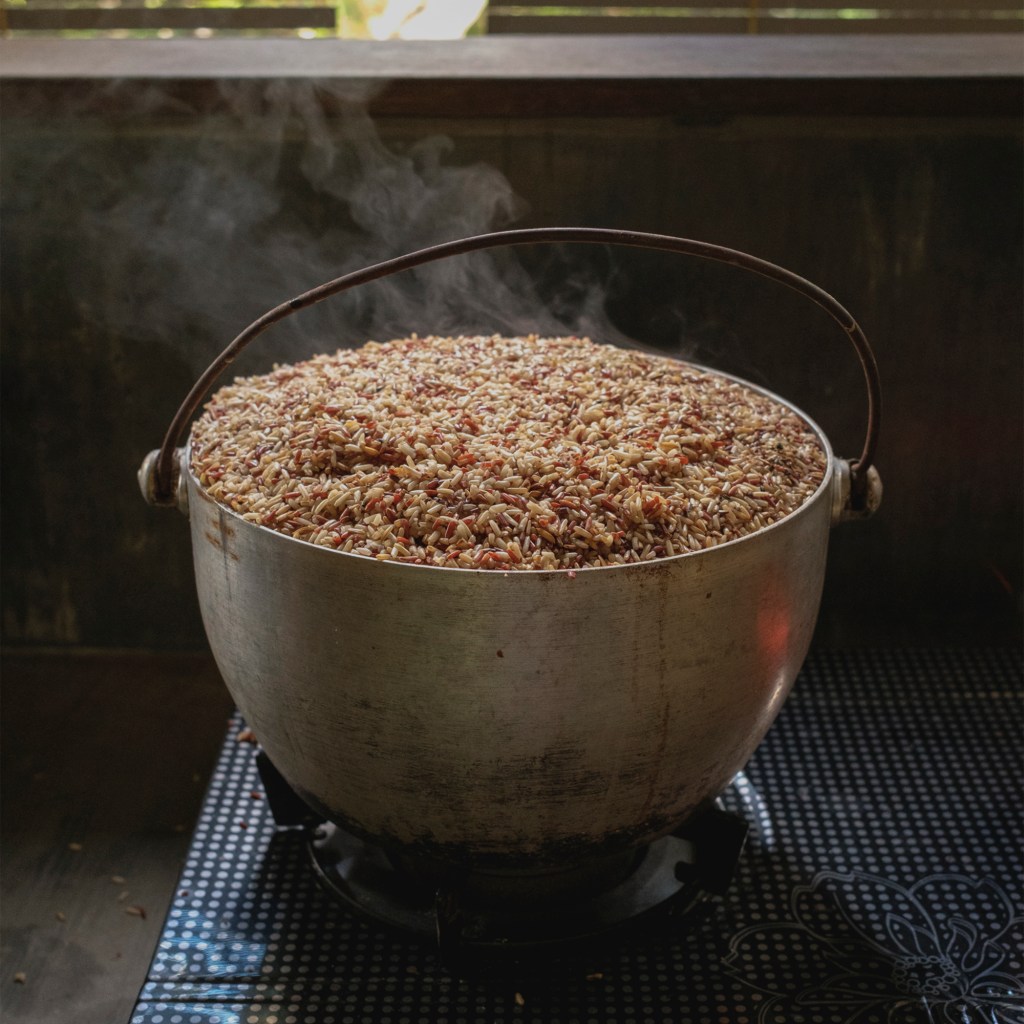
Where does rice come from? The oldest rice grain found in Malaysia is in Sarawak, but rice likely didn’t originate from there. The tale of everyone’s favourite grain tells us a lot about Borneo and its people.
In this Season 2 premiere episode, we take a look at the Borneo side of Malaysia. We look at the indigenous Dayak peoples and trace their lineage back tens of thousands of years ago, when Borneo wasn’t even an island.
Sharing her knowledge of Dayak cuisine and culture is Livan Lah, chef and owner of LePau Restaurant in Kuching, Sarawak. As a proud Kayan woman, she introduces us to exciting native foods you may never have heard of, as well as the stories behind them.
Credits
Hosted by Dr Noby Leong and Philip Gibson
Produced by Dr Noby Leong and Philip Gibson
Sound Design by Jack Barr
Satay? Okay! is produced by Kopi Productions Limited and supported by the Golden Chopsticks Scholarship, by the Oxford Cultural Collective Trust
Resources and References
A History of Malaysia (2016), Barbara Watson Andaya, Leonard Y. Andaya
Borneo: The History of an Enigma (2026), Olivier Hein
Wirawan, I. G. B., Suda, I. K., Adnyana, I. G., Sukadana, I. W., Winyana, I. N., & Yudabakti, I. M. (2025). The role of Yupa inscription as Yantra in Shiva worship: interpreting stone relics through contemporary practices in Kutai Kartanegara. Cogent Arts & Humanities, 12(1). https://doi.org/10.1080/23311983.2025.2521981
Transcipt
Please note that this transcript may contain errors and typos
Thank you. Welcome to Satay. Okay. A podcast
about the foods that have shaped Malaysia. I’m
Dr. Noby Leong, a scientist, food writer and
broadcaster. And I’m Philip Gibson, photographer
and part -time Ice Age enthusiast. And in this
series, we explore the history, cultures and
cuisines of Malaysia, from the ancient lands
of Southeast Asia all the way through to the
creation of a modern day nation. In today’s episode,
we take a look at rice and the birth of Borneo.
So look out your rice cookers and get ready for
Satay. Okay. Welcome back. It’s season two. I’m
so excited to be back, Philip. Back, back, back
again. We had such amazing time making season
one and sharing it with you all. And thank you
so much to everyone that’s listened, that’s left
reviews on Spotify, Amazon and Apple, and for
engaging with us on social media as well. We’re
just, I think, blown away by the feedback. Yeah,
no, it’s been really amazing, the feedback we’ve
had, not just from people within Malaysia and
Singapore, but also… people in the diaspora
across the world from that region who have, like
yourself, I think, been in maybe kind of like,
you know, separated from family or whatever it
might be or whatever kind of throw or tie back
to their mother country, for want of a better
word. It’s just been really nice that we’ve made
something that people seem to get a lot out of
and have learned things. feels worthwhile. I
really didn’t know what to expect from the feedback
when we released this. I didn’t know what people
were going to think of it. If they were going
to listen, first of all. Right. But it’s been
really nice to see that people have listened.
They’ve learned something. They found it funny
at times, which was… Very nice. Yeah, yeah.
I’ve had people that listen as they prepare for
a holiday to Malaysia. And perhaps the most touching
thing is that people have contacted us saying
that this podcast has helped them connect with
their Malaysian heritage. And that’s been really
special for me because that’s why I started this
podcast in the first place. Yeah, I think I’ve
also been blown away by the engagement in social
media and people kind of… adding little extra
anecdotes about the stories that we might be
talking about in some of the kind of the reels
on Instagram, what have you. Just, you know,
adding colour to the story, as people would say.
I’m learning so much from the listeners as well,
from that feedback. Yeah, I mean, I guess, you
know, for all the books that you’ve read and
then the interviews that we’ve conducted and
making this, there are obviously… tens of millions
of people in that area that all have their own
personal connections to whatever it’s the food
or the cuisine or the culture or the background
and things like that. And so that, I hope, just
keeps adding to this kind of tapestry of what
we’re trying to do here, which is amazing and
definitely fulfilling. Very much so. and so we
are back for season two and we’re going to continue
where we left off so in season one we spent that
time looking at the history of malaysia of course
but we were mostly looking at the events of the
malay peninsula so we looked at the arrival of
the first people about 50 000 years ago we talked
about the rise of those different ancient trade
empires like Srivijaya. We looked at the rise
of Malacca. We looked at the invasion by European
forces, first the Portuguese, then the Dutch,
and then the British. And then we also saw how
Britain slowly took over and colonized the Malay
Peninsula, which took us to the beginning of
the 20th century. But Malaysia has a whole nother
part of it that we haven’t touched yet. And that’s
of East Malaysia. Yeah. The Borneo side of Malaysia.
Yeah, which seems to have been taken over by
British forces in a very different way to how
the peninsula of Malaysia was. The whole history
of Borneo is really different. The whole culture,
the people of Borneo are so radically different
to the peninsula. Culturally, they’re different
groups, aren’t they? Yeah, yeah. You have different
indigenous groups there that are very different
to the indigenous peoples of the Malay Peninsula.
So there’s a lot to explore in… Borneo Malaysia’s
history so I didn’t know much about Borneo when
I was growing up my parents didn’t really talk
about it I learned more about Borneo from watching
David Attenborough yeah talk about you know the
natural wonder of Borneo than I did from my parents
yeah no I feel like I would have been the same
because I I think yeah as you say Attenborough
being kind of prolific on the BBC and what have
you I always kind of just thought that Borneo
was a nation in its own right and not actually
the three countries that govern it. Yeah, a good
reminder that for people listening, if you’re
not aware, Borneo is not actually a country.
It is an island and it’s governed by three different
countries. Indonesia governs the southern two
#NAME?
for the small parts of land that’s governed by
Brunei. And the Indonesian half is mostly known
as Kalimantan. Yeah, so different terms depending
on which language you’re using. But the same
island. Yes. So over the next few episodes, we’re
going to take a look at the beginning of Borneo,
the birth of Borneo, how it came to be, who are
the people, and kind of ramp our way up to the
20th century to meet where we left off in season
one. Okay, this is get your maps out. You don’t
have to have listened to season one in order
to listen to today’s episode. But of course,
hopefully we inspire you to do so in this series.
I definitely think it will fill a massive void
if you do listen to season one. I think so too.
But before we get to the history of Borneo, let’s
talk about the food of the day, that symbol that
connects us with the past. And that is rice.
Rice. Philip, for all Asians, is basically the
mother grain. I don’t know a single culture in
Malaysia that doesn’t have rice as the centre
of the table. Right. What’s your relationship
with rice, though? Well… It’s obviously a bigger
part of my life now than it maybe was in infancy.
But I actually vividly remember eating rice for
the first time. Oh, wow. I think I was maybe
seven or eight years old. I know I was fairly
young. And you used to get this thing in the
UK. I don’t know if you can still get it, but
it’s called Chicken Tonight. And it comes in
like three or four different… It’s basically
a… convenience sort of like, oh, if you’re
busy, you can still have a nice hearty dinner.
And so it’s like you get like chicken and mushroom
or like creamy chicken, I think. I remember the
commercials on TV. I feel like chicken tonight.
I feel like chicken tonight. Yeah, yeah, yeah.
Anyway, for whatever reason, and now that I think
back of this, I think there was like a creamy
chicken recipe version and that was just encouraged
to be sold with rice. And I don’t know why, for
whatever reason, my sister and I, when we were
kids, just never got fed it and my parents had
it. But then all of a sudden I was invited to
the dinner table one evening and I was forced
to eat it. And I was like, I don’t like rice
and I was just like I was really freaked out
by this like why is it not a potato or pasta
which I’m so used to I see rice as an adult food
for going home. You know, I’d reached ascension
and I was allowed to eat rice apparently. Wow.
Yeah, but I had a massive protest and it was
one of those dinners that took me about an hour
and a half to eat because I just sat there and
probably sobbed. I was so pathetic. Anyway, now
when I think about rice, I’m kind of like, God,
this is so easy. I just put it in the cooker
and it’s done. I don’t have to peel this. I don’t
need to wash. Well, you do wash rice, I suppose.
Yeah. Definitely favouring pasta and rice these
days. Although, you know, as a Scot, I should
probably love potatoes more. I do love potatoes,
but anyway. So that’s my rice lore. Yeah, I think
for me, I think probably for a lot of Southeast
Asians, we begin probably by eating rice porridge,
just because when you’re like a baby and you’re
first learning to eat, you want something that’s
like a bit stodgy to help. Yeah, and also given
the kind of congee is made by overcooking the
rice, it breaks the grains down even more so.
you know, not chewable. You can just swallow
it whole. So we would have rice porridge all
the time when I was little and we’d have it with
either plain, maybe with some soy sauce on the
side or something like that. A little spring
onion? Yeah, a little bit of that, but that would
be like the main carb. In Australia, I would
also sometimes have rice porridge with Vegemite.
Oh yeah, that’s savory, isn’t it? Vegemite and
soy sauce, they are very, very similar flavor
profiles. Salty umami, yeah. Yeah. Have you ever
tried a… You should make a congee with like
Worcestershire sauce. I can see that. You wouldn’t
make, you wouldn’t have the Vegemite stirred
through. You’d kind of have it on the side. Oh.
And you’d have like a little bit every now and
then. Just in the same way that you’d pour a
drizzle soy sauce over the congee when it’s finished.
Oh, see, I’m just such a kind of like a pie maker
that I just want to whip it all up and just completely
emulsify it. Right, okay. But then, as I grew
up, of course, introduced to so many rice dishes,
whether that’s just plain rice, glutinous rice,
so many of Malaysia’s iconic dishes are rice
-based, like nasi lemak. Hainanese chicken rice,
biryani. So it’s really central to all of the
cuisines of Malaysia. Yeah, I think what also,
as I’ve kind of grown up and learned a bit more
about the world, that there’s actually so many
different varieties of rice, like red rice and
things like that. But then you’ve also got people
talk about wild rice because everybody’s into
their more organic, whatever, blah, blah, blah.
But yeah, but rice can be found in South America,
Africa, like so many other parts of the world.
I guess it’s all just… Yeah, yeah. Well, there’s
kind of two main species of rice and… All the
rice that you get in the supermarket are derivatives
of those two main species. Okay. So one of them
is an Asian rice called Oritsa sativa. That’s
the species name. And the other is African rice,
which is Oritsa. Here we go. Glabarima. I’m not
sure if I’m pronouncing that correct, but then
again, it’s Latin. So who knows how to pronounce
any of it? Well, a lot of people, I think, but
it’s definitely a drag name. Ariza glabarima.
Welcome to the stage. So when you’re talking
about going to the supermarket and seeing these
two rices though, is that encompassing jasmine
rice and sticky rice and long and short and what
have you? Pilau, some rice grains are so enormous.
Is it just stretched and modified differently
or whatever? Yeah, those are all cultivars of
Oritsa sativa. So most of the rice that you find
in the supermarket today is Asian in origin rather
than the African rice. So basmati, jasmine, all
that sort of stuff. They would have been hybridized
or bred specifically in certain ways to favor
certain genetic characteristics. Got it. Asian
rice itself is pretty old. It was first domesticated
thousands of years ago. No one really knows where
or how this actually happened. And there’s a
lot of scientific debate of where Asian rice
originated and how long ago that was. So the
oldest accepted archaeological evidence of rice
is from an 8 ,000 -year -old site along the banks
of the Yangtze River, China. So again, it’s not
necessarily where it was domesticated, but that’s
the oldest evidence. From there or somewhere
nearby, it eventually spread to other parts of
Asia, including Southeast Asia to become a staple
crop. Okay. It becomes a staple crop for a few
reasons. So first of all is the flavor. People
really like the taste. It’s very addictive. So
while there are lots of other staple crops in
different regions, whether that’s tubers or something
like that, people just really like rice for its
taste. Okay. Second, the crop can be harvested
multiple times a year. Right, okay, yeah, yeah.
So this is, again, a massive advantage over some
other crops. So most rice, I think, is twice
a year. But I’ve definitely spoken to rice farmers
where sometimes it’s five times a year, they
say. Five? I had heard three, but like, yeah,
well, okay. Yeah, so I don’t know if this is
a particular region and a particular type of
rice. Yeah, it might be like a modern hybrid
or something. Yeah, yeah. but either way very
high yielding compared to most crops which is
just once a year i imagine it also stores better
than things like cassava and what have you yeah
so the reason why white rice in particular is
eaten and not brown rice okay is because once
you remove the husk you improve the shelf life
right so if you keep the husk on it’s more likely
to mold oh okay right and then the third reason
why rice is such a popular staple is because
it grows quite well in lots of different topographies
so in southeast asia particularly like look at
some countries like indonesia which is very very
hilly and mountainous right not a problem for
rice they can grow on the hillside and they can
grow in monsoonal conditions yeah they don’t
mind being flooded they don’t mind being terraced
covered in water and semi -drowned for a long
period of time, whereas a lot of other crops
do mind. Yeah. See, I always thought that it
had to be grown in water. I always thought they
were submerged, like almost like on a riverbank
kind of thing. So one of the reasons why rice
is grown in kind of a semi -flooded or drowned
condition is that it helps suppress weeds. So
rice can grow through water. Above the ground,
right. Above the ground, but others… Other
competitive plants cannot. Got it. Okay. I didn’t
realize that was like weed prevention. Okay.
Yeah. Makes sense now. And so that’s again why
it works so well in Southeast Asia where you’ve
got these periods where it’s just raining constantly,
constantly, constantly. So it’s for these reasons
that rice becomes a staple on the island of Borneo
itself. And actually the oldest evidence of rice
that we have in Malaysia comes from Borneo. Okay.
There’s a cave in the state of Sarawak called
Guasari, and there scientists found a single
rice grain embedded under a broken piece of ceramic,
and they dated it back to around 2300 BC. Okay,
so almost four and a half thousand years ago.
Yeah. Right? Yeah. So it’s really interesting
that they also only found one grain of rice.
rather than like a whole pot of rice or lots
of broken grains of rice. And it kind of shows
you just how precious rice was if the only thing
that was wasted was a single grain of rice. So
I think the question then becomes, you’ve got
this cave system in Sarawak with this single
grain of rice and you have to ask yourself lots
of different questions. Who was eating this rice?
How did this rice get there? How did it come
from China all the way to this island thousands
of kilometers away and so that leads us to basically
what do we know about borneo so we’re going to
go back to the very beginning of borneo to when
it wasn’t even an island what i know So let’s
take us back tens of thousands of years ago when
the world looked very, very different. Okay.
So from about 115 ,000 years ago, Earth was in
an ice age. My favorite topic. The movie or the
concept? Actually, definitely the movie. Yeah.
The first one. So in an ice age, everything’s
a lot colder, water freezes, and the polar ice
caps… in the arctic and the antarctic those
polar ice caps are growing in size so as a result
sea levels are actually dropping and in southeast
asia where we now have this huge archipelago
with you know 25 000 islands you actually had
this really large singular land mass called sunderland
and this is a continental shelf So Borneo wasn’t
an island at this point. It was part of this
landmass. Not to be confused with Sunderland
in northeast England and Sutherland in the north
of Scotland. Exactly. This is spelled S -U -N
-D -A. It was during this ice age, about 50 ,000
years ago, that we think that humans migrated
from mainland Southeast Asia to what is now island
Southeast Asia. And because there was no archipelago,
they could just walk. Right. Long walk. Thousands
of kilometers. Right, okay. We know shockingly
little about this period of time. So across Southeast
Asia, there are only six sets of human remains
that date back to more than 25 ,000 years. Okay.
And so we’ve got this fundamental question of
humanity of how people migrated from Africa to
mainland Southeast Asia to island Southeast Asia
and then on to Australia and other parts. that
region but we kind of don’t know that much about
how that might have happened. I guess if the
sea level was lower a lot of the places if they
were by the coast whenever wherever the coastline
would have been at that point are long underwater
at this point. Yeah and that makes it really
really difficult for scientists today to kind
of trace the past because all of this important
evidence is buried under the sea. Yeah and not
to mention the fact that in the tropics things
grow so bloody quickly that old camps and things
like that are going to be under probably meters
of like forests, vegetation and things like that.
And it should also be said that science is very
expensive and there’s not always a lot of funding
for Southeast Asian projects to happen. So hopefully
in the coming years, there’ll be more attention
paid. Maybe we’ll find more stuff. But in the
meantime, we’ve got these six sets of human remains
and one of them happens to be in Malaysia. And
the site is Gurnaya, which is a cave system in
Sarawak. And it was here that in the 1950s and
60s, a group of scientists, led by the curator
of the Sarawak Museum, discovered the deep skull.
Sounds pretty ominous. Indiana Jones in there.
And the deep skull. So they discovered this skull
in a portion of the cave called the Hell Trench.
And when was this again, sorry? In the 1950s
and 60s. Yeah, okay. These explorers just love
to be dramatic, don’t they? Apparently, it was
called that because of the oppressive levels
of heat and humidity. No, that’s just Malaysia.
But the deep skull is a complete skull, probably
of a middle -aged woman. And it’s been dated
to about 40 ,000 years ago. Okay, pretty good.
yeah yeah yeah so we definitely know humans were
in that region by that time right okay after
40 000 years i guess people were living had to
be they were settled in that area and then from
about 11 700 years ago the ice age ends the course
retreats the polar ice caps are melting sea levels
start to rise and they rise by up to 100 meters
that’s quite amazing And so that’s when Borneo
as an island is forming. Right. Yeah, yeah. From
about 4 ,000 -ish years ago, we then have a second
migratory event. And so this was the time of
the Austronesians. Okay. So we talked about the
Austronesians back in season one, episode three.
The Austronesians very, very quickly are a group
of people loosely linked by a common language
family. Okay. The Austronesian is… language
family not a group of people both okay science
loves to be clear -cut right and so you have
Austronesians that are migrating from the homeland
in Taiwan south to the Philippines and then they
make it to Borneo that seems like a logical route
to follow yeah so these were seafaring peoples
they were very very good seafarers had great
mastery of the ocean right so it’s these Austronesians
that probably brought rice with them Okay. That’s
one of the thoughts. They brought rice, perhaps
other tuberous roots, as well as animals like
buffaloes and dogs. Right, okay. And this is
to trade with the people already living on what
became the archipelago. They could have traded.
They could have just been migrating or, you know,
moving about. Okay. It could be lots of different
factors. How these Austronesians interacted with
the people that were already living on Borneo
Island is anyone’s guess. No doubt, initially…
Maybe those communities were separate from each
other. But perhaps over time, they started integrating
with each other as well. These communities, though,
aren’t like some kind of distant past of Borneo.
These are living cultures that are still around
today. And of course, that does then beg the
question of who are the indigenous people of
Borneo who get very little attention? So in Malaysia,
there are so many different indigenous communities.
but they’re different depending if it’s on the
Malay Peninsula or on the Borneo side. Sure.
In the state of Sarawak, we collectively call
the indigenous people Dayak. And this is a really
large category of people with dozens of subcultural
groups underneath it. Right, okay. But Dayak’s
definitely one of those words that I’ve struggled
to understand over the years. Like, who is Dayak
and who isn’t? And I wanted to get it right,
so I asked one of my Dayak friends, Anna Sulan
Masing, about what her definition is. Yeah, so
Dayak people are a group of indigenous peoples
in Sarawak. And it’s complicated because… All
Dayak are indigenous, but not all indigenous
people are Dayak. And there are certain indigenous
peoples that, for example, became Muslim. And
so they’re kind of bureaucratically defined as
Malay. I think probably on like form ticking
things, but they aren’t like Western Malaysian
Malay. They are indigenous to Sarawak. um there
are people that were part of kind of like Brunei
but then migrated same with like in the sort
of Sabah region and things like that so they’re
not Dayak um so I was asking a friend of mine
a little while ago because I was like this is
what I know what Dayak means and I have one friend
in particular who works with indigenous and Dayak
communities and I was like what is your definition
and she was like um I don’t know it’s like personal
changes I mean I know that these people think
they’re Dayak but sometimes they don’t think
they’re Dayak And it’s definitely not Dayak.
And this is blah, blah, blah. And I just jokingly
said, is it just a vibe? Like, do you just have
to be a vibe? And so obviously we’re all Dayak.
So like, we were like, yes, it’s got to be a
vibe. So I say that in jest, but sort of real.
Because there’s so many complicated histories,
again, around migration and religion and cultural
practices. But it is the sort of the larger group,
most. Most indigenous peoples in Malaysia are
Dayak. Is it only used in Sarawak that term?
I feel like in Sabah I didn’t really come across
Dayak. People are more likely to call themselves
by whatever cultural group they’re actually part
of. Yeah, it’s very much a Sarawakian term. So
yeah. Being dyke is a vibe. Yeah, okay. A dyke
state of mind. Yeah. Yeah. We could do a song
for that. Maybe. Bonus Instagram content. Yeah.
No, it’s funny to hear her kind of deliberate
and her friends deliberating about what it is
to be dyke. The fact that it seems to defy classification
or not defy… Even we can’t summarise it because
of course we can’t. Do you know what I mean?
I think there’s something in every culture where
there’s that… je le sais quoi this this intangible
thing that makes up that culture that’s really
hard to put into words and i don’t know maybe
that’s what she means by dyke is a vibe because
well you know our identities change so much and
our ideas of indigeneity and ideas of cultural
identity fluctuate in time yeah no we’ll leave
it at that i think Anyway, we will be hearing
more from Anna later in the season. So do stay
tuned for that. If you’re enjoying this episode,
follow us on social media at SatayOK. We’ve got
more stories and more food to share. You can
also find links to give us a donation or tip.
We’re an independent podcast and every ringgit,
dollar and pound goes directly to supporting
our work. So give us a follow and say hello at
SatayOK. So if all this is new to you, you’re
not alone. A lot was new to me, certainly. Definitely
to me. I was more just consumed about caves and
orangutans. Yeah, yeah, yeah. But, you know,
I can’t stress enough just how different West
Malaysian people and culture are from East Malaysian
people and culture. There are different languages
spoken, different religions. And the cuisine
is also so different. Like when you eat traditional
Sarawakian or Sabahan cuisine, it’s radically
different to what you would find on the Malay
Peninsula. So in order to learn more about Borneo,
Malaysian Borneo, we headed to Kuching, which
is the capital city of Sarawak. So Kuching is
a city of gastronomy by UNESCO. And if you’ve
heard anything about Kuching or Sarawak, you
might have heard about dishes like Sarawak laksa.
Sarawak pepper is also becoming pretty globally
recognised now. And if you want to know more
about that pepper, definitely listen to Taste
of Place podcast by Anna Sulin -Massing and read
her many written works on the subject too. You
might have also heard of some of the foods talked
about by Henry Golding, who is perhaps the most
famous person from Sarawak. I don’t think I can
think of anyone as famous as him. Not to me.
Yeah. And so you might have heard him talk about
Kuching. and Sarawak culture from his documentary
with… Oh, Anthony from Queer Eye. Yes. No Taste
Like Home. Yes, that’s the one. That’s the one.
But I think other than that, maybe people don’t
know that much, but it is a really, really rich
culture. And to learn more, we headed to Lapao
Restaurant. So this is a restaurant in Kuching
and they specialise in Dayak cuisine. So if you’ve
ever visited Kuching and you’ve sought out the
indigenous cuisine, you’ve probably gone to Lapao.
We spoke to chef and owner Levan Lah about opening
this restaurant, what is Dayak cuisine, and a
little bit more about the culture of Borneo.
So let’s hear from Levan. Have you guys eaten?
You guys want to eat something? So my name, so
I’m Levan, so I’m from Kuching Serawat, so I’m
the founder of Lepa Restaurant, which serves
authentic Serawat traditional cuisine. Levana
and I began our conversation with the topic of
recognition. And it’s not just foreigners that
don’t know much about Borneo. It’s West Malaysians
too. Now it’s slightly better because now that
they find out that we are one of the richest
states in the country. Before that, they were
always saying, you guys, they are… They always
say that, oh, you guys are different currency.
Or they still believe that we still travel using
boats. Yeah, we do. We do travel boats. I have
to admit. I mean, it’s not completely wrong.
We do have to travel from the city to the kampong
using boats. It’s true. You also use cars. But
we also have cars, we also have planes, you know
what I mean? There’s more variety. We do express
flights and everything. But even the West Malaysians
do not really fully understand. So what else
can we expect from the people outside of Malaysia?
The conversation then turned to food, and Luvan
explained that dishes that are readily promoted
in Sarawak, like laksa and kolombi, aren’t actually
part of traditional indigenous cuisine. I mean,
we have the kolombi and we have the laksa, but
those are more… more modern in a way, you know
what I mean? So the Colombe eating is way before,
it’s way after Pansor. Are they more Chinese?
More like Chinese, yeah, Chinese inspired. It
came later on. But if you look at, I’m talking
about, you know, my ancestors’ time, we didn’t
have a lot of spices. We cooked very plain, you
know. So what makes up indigenous Dayak food?
For us, when I think of Sarawak food, for me
personally, because in Kuching we have, in Sarawak,
we have different ethnic groups. So we have people
from, I myself am a Kayan girl. Kayan girl is
a subcategory or sub… It’s part of Orang Ulu
group. And in the Orang Ulu group itself, they
have more than, if I’m not mistaken, but 26 smaller
groups inside. So we are the Orang Ulu, but there’s
also the Iban group, the Bidayuh group, and then
the Melanaus, you know. So all these people,
we are the native of Sarawak, the ethnic tribe.
So when we cook… even though our food is different,
we have similarities. So one of the ones that
we usually, that I found before I started my
restaurant, doing my research for the recipe,
I realised that all ethnic groups have a version
of the pan soh, which is the bamboo, the meat
cooked in the bamboo. And then most of it have
salted fish or smoked fish. And I also realised
that we have a lot of similarities with small
little differences here and there, maybe just
an ingredient or maybe the way they cook for
slightly different, maybe a different fire method
or the wood that you use is different, you know
what I mean? So Sarawak Ethnic Group would be,
I think it is what the… what the community,
the ethnic community share. That’s to me what
traditional food, what our ethnic traditional
food is. Levan went on to describe dishes that
are specific to her Kayan culture. It’s very
interesting. This is a Kayan culture. I discovered
this way of preserving food. We call it, they
call it butong, butong wasik, which is… direct
translation to English is rotten, rotten fish.
Rotten fish. Rotten fish. So what happened is
that when they go fishing, they have this big
tapah fish, you know, have this huge tapah fish.
It’s like maybe about 50 kilo, 30 kilo. And then
we don’t have fridge back then. There’s no electricity,
definitely no fridge. So what they do is they
would hang the fish that they couldn’t finish
outside and just let the flies and everything
just, you know, preserve it. yeah and then it
will become this this uh i think rotten in a
way fermented you know i mean no salt i think
they just make it they just let it rot and then
that is an interesting taste if that fish doesn’t
sound up your alley then you probably won’t like
levan’s other fish preferences when i tell my
chinese friends they go like we eat um fish gut
oh i love fish the stomach fish the fish fish
stomach we just throw the bile away so it has
to be river fish it cannot be oh we just put
it in the pan put some we just put a little bit
of garlic and then we just stir fry it stir fry
it until the oil until it becomes the oil will
melt itself and then put chili and then yeah
and then salt So the thing is, some people are
really good at removing the bile. You have to
remember the bile, you have to know how to cut
it so it doesn’t go a bit. But I like a little
bit of bile, a little bit of bitterness. And
then I eat it with rice and chilli. You have
to eat it with rice. Yeah, it’s so good, you
know. I always tell my staff when they get, when
my chef, I always say, because we get a lot of
river fish, I say, remember to keep the stomach
for me. yeah and then you know the best part
is when they have when they have uh the fish
egg inside oh yeah so it’s like yeah my friend
we eat the fish gut they go like it’s like it’s
nice he’s trying no waste we don’t waste at all
you know we don’t waste at all the ice is what
we like i had my It was, who told me to stop
eating the brains? Because they say it’s high
in cholesterol and high in cholera. High cholesterol
and stuff, but the brain is so nice. The head,
and then they just open the brain and stuff.
It sounds as if we’re very barbaric, but no,
we save everything. It’s very sustainable why
we eat it. Yeah. Every part of it. Regardless
of what, any meat, any meat, especially if it’s
a wild boar, or if it’s a cow, what they do with
the internals. The internals, what they do with
it is that they would clean. The things that
we don’t eat are, of course, the bile and even
the intestine. This is normal. We eat it here.
We barbecue. We clean everything. But the other
parts of it, they would just chop it small and
stir -fry it. It’s really good. And they put
it into bamboo. I’ve tried one where they cook
it with glutinous rice in bamboo. So good. Yeah.
And then they put some of the… the fat inside
so you can imagine that the glutinous rice is
cooked in the wild boar fat and it was cooking
itself and it becomes so it becomes very oily
and things like that and they put a little bit
the little chunks of those the innards the organs
I don’t know what usually they say put everything
they just chop everything I say chop everything
I see them do it when you eat it you say oh it’s
very addictive you know it really is addictive
you stop eating the whole I can eat the whole
bamboo that’s why I love kampong food yeah yeah
and are people still cooking in that way they
are the older ones they do some people when you
my kampong don’t really do that because I think
the ones that it also I I think it depends on
whether your village are more experimental or
not. You know what I mean? Some people they do
just the normal way, they just stir fry and everything.
But all these things, these special things that
I’m doing, I think I had it in another kind,
a different kind of village where the family
is more experimental. So they strike with food,
you know, they try, oh, let’s do this and everything.
Apparently they say that it’s what the parents…
the mothers used to do. You know what I mean?
So I found out this is what they did last time.
In my kampong, no. Even though we are Kayan,
we don’t do it. So it depends on the village.
The tradition of eating every part of the animal
is common to many cultures, even if people don’t
always practice this anymore. But Lavon stressed
that eating fish and meat isn’t the crux of the
culture. I don’t know whether your mum has ever
told you how she grew up, but my parents used
to tell us how they grew up. in back in kampong
because when they were so poor there’s nothing
to eat and then only when people go hunting if
they can find meat you have meat or vegetable
but when the season when it’s like when they
don’t have vegetable they just have to eat rice
and salt have you have you have you heard of
that before so the kampong people they do the
older generation is that they say they only eat
uh rice and salt and oil yeah lard to be to be
more specific it’s like so they fry the pork
and then they use the lard and they eat that
then. So I can imagine it’s very interesting
how the older generation live. Is rice always
very central and important? Yes. It’s a staple
for every meal. Except for maybe the Penang community,
I think. They rely more on sago. Dayak cuisine,
however, is more than just the dishes. It’s about
the community spirit of cooking too. And Levan
shared with me what it’s like to cook in the
traditional villages, the kampongs. I mean, in
the kampong, I mean, I love it. It’s very communal.
So what happens is that during festive season,
even when, as long as you know people around,
if you have an event, or you say you have a,
oh, I’m doing a party, I’m doing a wedding, or…
I’m just doing anything lah. I’m just going for
Christmas and I’m having an open house on that
day. So you just say, eh, you come and then one
auntie then will come over. So you just provide
the thing. So it’ll be like in the kitchen, somebody,
the men will be, will be cutting the meat outside.
And then the women, and then the kids will be
like looking, they will usually kill, they will
kill, kill the, the, the pig. The kids are killing?
No, no, the kids will be watching and then they
will kill, I mean one person will be killing
the pig at the backyard and then they do it straight
away because you know what they do they collect
the blood as well so they would drip the blood
and then the blood would be they would cook do
something with the blood or something they will
cook you know we don’t eat blood but my our our
relatives they do eat blood so what happened
is that everybody will come and then somebody
they’ll start everyone talking you know what
I mean and then the older ladies they will cook
rice together and they start wrapping rice And
then somebody will be cooking. There’ll be like
two or three people cooking. So it’s a very,
it’s a whole kampong type of feel. Everybody
come and then usually, usually something, I believe
that if you give a professional kitchen, it will
take faster to do. You know what I do? But it’s
a communal thing. It’s a community thing. What
happened is that… It takes maybe half a day.
It’s not even half a day. For a morning, for
a dinner, it starts from morning. Start doing
things and then you just prepare things. And
then you will have, they will do the soup and
they will serve it to you. I mean, it’s a very
different feel. I do miss it. As Malaysia has
modernised, more and more people have moved from
the kampongs to the cities. People still often
go back to the kampongs to visit, especially
for holidays, but the cooking spirit during these
times is not what it used to be. They don’t really
do it now that often because what happened is
that I think now people think it’s still tiring.
So what they do, people who want to do it, they
pay. Last time they did it for free. They would
come over and they would voluntarily. offer their
help but now i find that now we have to call
people yeah so you think we’re losing a bit of
that cultural tradition of communal cooking and
some of those techniques the techniques yes the
techniques yes because you learn from watching
the other people do it you know i how i learned
how i learned to cook all these dishes and how
i learned to develop the recipe back then was
by I watched the aunties do the stir -frying
and how they do it. That’s how I know that when
you do tapioca leaf, let’s just stay to tapioca
leaf. How we did tapioca leaf, that’s when I
found out that they put a lot of oil inside and
it would actually last for days. And then I found
out that how to do the meat tender was when they
boil certain herbs or something, they become
tender and then they will fry it again. That’s
where I learned. And I was not staying there
just staring at people. No, I was like, what
I was doing, I was like staying there talking
to people. It’s not really just cooking, you
know. The reason why is you do this thing where
you talk about people. You’re gossiping while
you talk. So you’re gossiping. I was like, did
you know? And things like that. That’s the real
purpose of cooking. It’s not actually the food.
The reason why it takes the whole day is because
the gossiping takes half of it. So we’re talking
about that, talking about this, and then, did
you know what happened the other day? Things
like that, you know, because you don’t see each
other that often. So only during that time you
see each other, you catch up on how your kid’s
doing and stuff like that. So I will be listening,
you know what I mean? So it’s very interesting.
It’s a nice feel. if if you stop doing it means
people less gossip less i guess yeah all right
so that was just the first part of the interview
with lavan but i just wanted to pause there just
sort of reflect on some of the things she was
talking about with uh diet cuisine and the traditional
food of the kampongs being quite different to
what people maybe expect yeah no definitely it’s
uh it’s totally different to i think what i’ve
like sampled on peninsular Malaysia. Yeah. But
yeah, no, it was really interesting, really fresh,
really, I don’t know, just felt good for you.
Yeah. So one of my favorite ingredients in Sarawak
is called midden fern. Yeah. So this is a fern,
but you kind of eat the really young, soft tips
that kind of got lightly sweet. And when you
just stir fry them with a little bit of, you
know, salt and garlic, whatever. it just feels
really good for you. There’s also like lots of
local herbs like ka chang ma which is motherwort
I believe and it’s got this slightly bitter flavour
but then Levan was also talking about pan so
which is meat like chicken cooked in bamboo,
lots of fermented fish that were really important
in the days before refrigeration and then there’s
just so many other dishes as well. Yeah I think
the one thing that kind of caught me off guard
was fermented durian which I I actually think
I prefer to regular durian. I’m putting my linguistic
hat on here. To me, it’s more pickled because
it was a bit more vinegary than like, it was
like a sharper and acidic. Actually, it was quite
fresh. It was quite textually very different.
Well, a bit different, I think. Durian is quite
soft anyway, but anyway, I’m getting quite obsessed
with this fermented durian. So fermented durian
is called tempoyak and you can also get it in
Malay Peninsula, but it does seem to be quite
popular in… in Borneo as well. And when I think
of something being fermented, I think it’s going
to be much stronger in flavor and taste. But
I actually find that Tempoyak is quite milder
than fresh durian. And I think it’s really good
for beginners to durian to try because it is
softer in flavor to me. Yeah, which seems counterintuitive
because you think you’d just be adding more complexity
to it. But actually it kind of stripped away
for me the… the kind of hotter elements like
when when i say hotter like the heaty kind of
like warming characteristics that i feel like
durian might have and because it was a bit like
pickled and acidic or whatever it kind of it
added um quite a nice tanginess to it actually
and i found myself just every mouthful of whatever
i was putting on my fork just adding a little
bit onto it just as i i guess in a way that people
would use like chutney and stuff like that over
here on like sausages or something where you’ve
got something fatty and meaty and you want something
acidic to kind of cut through it and add more
complexity yeah so yeah big fan of that would
recommend yeah yeah and these dishes as Livan
was saying are much older than dishes like sarawak
lux and conlombi which is probably more chinese
right in origin and much more recent in in southern
culinary history But we sort of like continued
the conversation with Livan to talk about where
food culture is at the moment. And when I was
in Kuching, I really got the sense that Sarawakians
are really, really conscious of the changes that
are happening in the food world at the moment.
That things are modernizing very, very quickly.
People are moving away from kampong lifestyles
or city lifestyles very, very quickly. Right.
That there is that threat of losing one’s traditions.
But at the same time, Sarawakians are so proud
of their heritage. Right. And I think they’re
striving for even more recognition. So I think
there’s a lot of work that’s being done in Kuching
at the moment where people are trying to promote
their culture. And so we talked to Levan about
this. We asked her why she opened her restaurant,
what that process was like, and what she’s doing
to pass on culture to the next generation. So
when we started in 2014, there was only one or
two places that were doing… traditional ethnic
Sarawak food, you know what I mean. The rest
were doing either fusion, they were doing, and
then people, if you, back then if you talk about
Sarawak food, people would say the kolok mee,
the laksa, you know what I mean, the kek lapis.
Nobody knew much about the panso, terong asam,
pekasam fish, you know, all those things. So
I was thinking like, okay, I… I really miss
my kampong food. I don’t want to always have
to travel to go there. So I said, why don’t I
just start a restaurant that serves the food
of my kampong people? You must never lose your
identity, especially one day if you ever go into
the bigger community where everybody else is
like, you know, Chinese is there, Malay is there.
You know, you might feel yourself, who am I?
So identity keeps you grounded. So my identity
is the one that keeps me grounded, reminding
me that, okay, I’m a Kayan girl. this is what
I’m going to do. So that made me very very gungho
So when I went to LePau, my motorbike dancer
remembered and said, making my identity my business.
I was thinking like, why? Making my tradition,
my identity, my business. I told my friends.
Because they were asking me, why you want to
do this food? Nobody’s going to be familiar with
it. right before i went into it right i said
thinking like there’s only so much of cayenne
dishes that i can i can do we do stir fry we
do boil barbecue smoke things like that but i
was like oh no this is not enough for me to sustain
this business so i went to travel i went to travel
around sarawak for fighting a couple of months
and when i say travel means i go visit kampongs
go visit kampong, go to mukas, a few aunties
there. And then the aunties will go like, oh
come and I go to, they were cooking, you know,
they cook. And I was like, why so nice this thing?
So I will go to the kitchen and I will go and
look at what they’re doing. Lapao opened in 2014,
selling not just cayenne food, but other diet
foods from across Sarawak. But getting the people
of Kuching on board wasn’t easy at first. Locals
around Gainsborough, They like it, especially
the local native community because to them, it
means that they don’t have to go back to the
kampong anymore to find it. The other races,
the ones that are not used to our food, it took
some convincing. For the Malay community, our
food was too mild, too bland because their food
is usually more salty. more have a kick and punch
in it. For the Chinese community, our food was
a bit too salty. Le Van said they tweaked some
things here and there, and I guess that worked,
because more than 10 years later, they’re still
going. Le Pao is now one of many food businesses
in Sarawak. This led to an interesting discussion
with Le Van about the role of kampongs in the
food economy, and the trade -offs between commerce
and traditional values. We cannot get things
from the kampong because it’s too far. Logistics
is too far. By the time the things arrive, it
takes maybe one day. So it’s not that fresh anymore.
But it also means that it opens up this opportunity
for them to be suppliers. So if they are business
savvy enough or they have a vision and they are
able to organise themselves, they can actually
transform this into a business. I think that’s
the struggle with our world. our government they’ve
been trying to get people to go into business
you know i mean making this like a livelihood
for them but it’s hard to change people mindset
especially the the maybe because we are not used
to business mindset you know i was excited enough
already enough we’re not used to to pushing more
we’re not pushing we’re not used to making profit
and then we have this we’re a bit more soft -hearted
in a way we are very soft -hearted we are not
willing to to Sell too high. I still remember,
one night I was buying some fish and some meat
from another villager. And I said, how much ah?
He said, whatever price you want to pay. I’m
like, hello? You are doing business, okay? Can
you please tell me the price? If I think it’s
too expensive, I’ll tell you it’s too expensive.
If it’s too cheap, I’ll be happy lah. But he
asked me, and what price you want to pay lah?
You know, that’s how we do it. If your buyer
is somebody who is like, who is honest, right?
Then you are good. But what if somebody will
say, oh, this is only worth RM5. You know what
I mean? It’s like half the price. You know what
I mean? But that’s the mentality that we’re trying
to break. With so much excitement and attention
around traditional foods, I asked Levan what
the future holds for her and her business. And
she’s got some exciting plans for new premises.
I really want the younger generation to see that
there is a business opportunity in traditional
heritage food. but I also want to sort of like
introduce the older generation. So that place
I want people who are I want to bring in aunties
who basically just cook for the family, cook
out of love. So I want them to come in and then
it’s like an event where we let people dine with
them and then they get to interact with her.
She gets to tell her story because a lot of times
we just don’t give opportunity or the platform
for these people to tell their part of the story,
how they grew up. how the food was made, what
made them love cooking, how was the experience
cooking for the family, or how the mother cooked
for them, you know what I mean? So they get to
interact, they get to ask everything. And then
for the younger generation to be able to write
their own stories as well. They can do fusion
if they want, they can do traditional, you know,
they can do collaboration with the parents, the
mothers, but it’s a place for them to come and
showcase and tell their story. Levan is clearly
working hard to promote her culture, which she
hopes to spread even further. I hope to maybe
just bring it to the furthest that I can. And
then later on someone, another younger person,
will bring it further. Maybe just open doors
for people to see that it’s possible. I mean,
I don’t plan on being super big, like, you know
what I mean, to go. internationally and everything.
I think that one requires another energy level,
another leadership level. And I’m very happy
where I am and where we are going. And that was
Livan Lah from Lepau Restaurant. I love some of
the quotes she had of, you must never lose your
identity, making my identity my business. So
clear how proud she was to showcase her heritage
and how much motivation she had to really…
promote it to all of Sarawak, to all the different
communities in Malaysia and all the tourists
that come too. Particularly given that she was
saying there seems to be so much ignorance in
Peninsular Malaysia about what the food and the
culture and the way of life is in Sarawak and
Sabah. The whole kind of… patronizing, you
know, oh, do you not have to take a boat everywhere?
And things like that. And it’s kind of like,
no, they have roads and bridges and things like
that. You know, they have internet, they have
infrastructure. And that became more apparent
and will become more apparent in future episodes
as we interview more people, just kind of trying
to showcase what’s going on in Sarawak. It’s
a fascinating divide between East and West Malaysia
that I was both… Shocked, but not surprised.
Yeah. Yeah. The ignorance was kind of unreal.
Yeah. But yeah, I totally see why she felt so
motivated, I think, in order to showcase her
identity and what have you. And it’s so great
that it seems to be so well received that she’s
now got two restaurants and coaching. Yeah. And
doing well, seemingly. Delicious food. We’ve
been there a couple of times now. Yeah. And Lapao
that is in, you know, the Kuching centre is in
this garden setting. It’s really beautiful, lovely
for an occasion or just to stumble across. Yeah,
yeah, yeah. No, and the food is delicious. It
is great. I would strongly recommend when you’re
in Kuching going to check out Lapao. The other
thing that I thought was really interesting hearing
from her were all the challenges in promoting
the local culture and trying to balance tradition
with commerce. So tradition can be foraging for
food. It can be also taking only what’s necessary
from the jungle. It can be paying fair prices
and having fair trading systems. But commerce
can sometimes be the opposite, particularly Western
ideals of commerce and trade, which can mean…
taking more from the jungle that’s sustainable
it can mean exploitation somewhere along in your
supply chain and it can also mean concentrating
wealth at the top so there are clearly diet ways
of doing business chinese ways of doing business
western ways of doing business and it does feel
like diet attitudes to hospitality business and
relationships are also part of the culture that
is worth preserving right which I think is an
interesting idea because it’s a level of intangible
heritage that I don’t think we really talk about
or acknowledge enough. So we talk about intangible
heritage as being things like food. but so is
hospitality as a concept. Right, yeah, yeah,
yeah. Being nice to others, treating each other
fairly. That’s also intangible heritage in some
ways. Yeah, etiquette and things like that, yeah.
Yeah, and as Livan was saying, it’s really easy
to bully a culture that values being nice, and
it’s easy to lose those things in the process.
Yeah, yeah, yeah, which is so messed up. So we’ll
certainly hear more from other voices in the
diet community and also the indigenous community
around Borneo. So do stay tuned for the episodes
to come. No, definitely some great stories coming.
So if we go back to the food of the day, rice,
it is common to all cultures of Malaysia. We
all love rice. I do now. But remember that the
oldest evidence of rice in Malaysia comes from
Borneo. So when you’re eating rice, don’t forget
about Borneo. Yeah, definitely don’t forget about
Borneo. No, there’s so many amazing parts of
Malaysia, but I do have a real soft spot for
Kuching actually as a city. I think if you’re
going to Malaysia and you’re in the absolute
kind of hustle of Kuala Lumpur, Penang Island,
even Malacca’s traffic is terrible. Like, don’t
get me wrong, actually, Kuching, I think, probably
has its own fair amount of traffic jams. But
there’s something about downtown Kuching by the
river. It’s very walkable. It’s very chill. Like,
it’s just a way more laid back than what the
city is, which… I love how they’ve developed
that river side. Yeah, it’s nice. I do sometimes
find that Malaysian cities aren’t super walkable,
whereas I’ve found that Kuching actually is quite
walkable. You can kind of get your steps in between
meals, which for us is obviously a priority,
because you can’t just go from taxi to taxi between
restaurants. You’d like to kind of burn some
of that off. So yeah, no, I really like Kuching,
and I think every time I try to go back to Malaysia,
I’ll always try to go over there, definitely.
Absolutely. So in the next episode, we’re going
to continue our tour of Borneo, and we’re going
to bring you into the more recent past, starting
from about 2 ,000 years ago. Because after people
arrived and settled in Borneo, they began to
form much larger communities, sultanates, and
even trade empires, connecting them with lots
of other parts of Southeast Asia. So that’s going
to be the topic of our next episode, Ginger and
the Empires of Borneo. So stay tuned for another
episode of Satay. Okay. Thank you.

