
6. Sambal and the Portuguese Invasion – Satay? Okay!
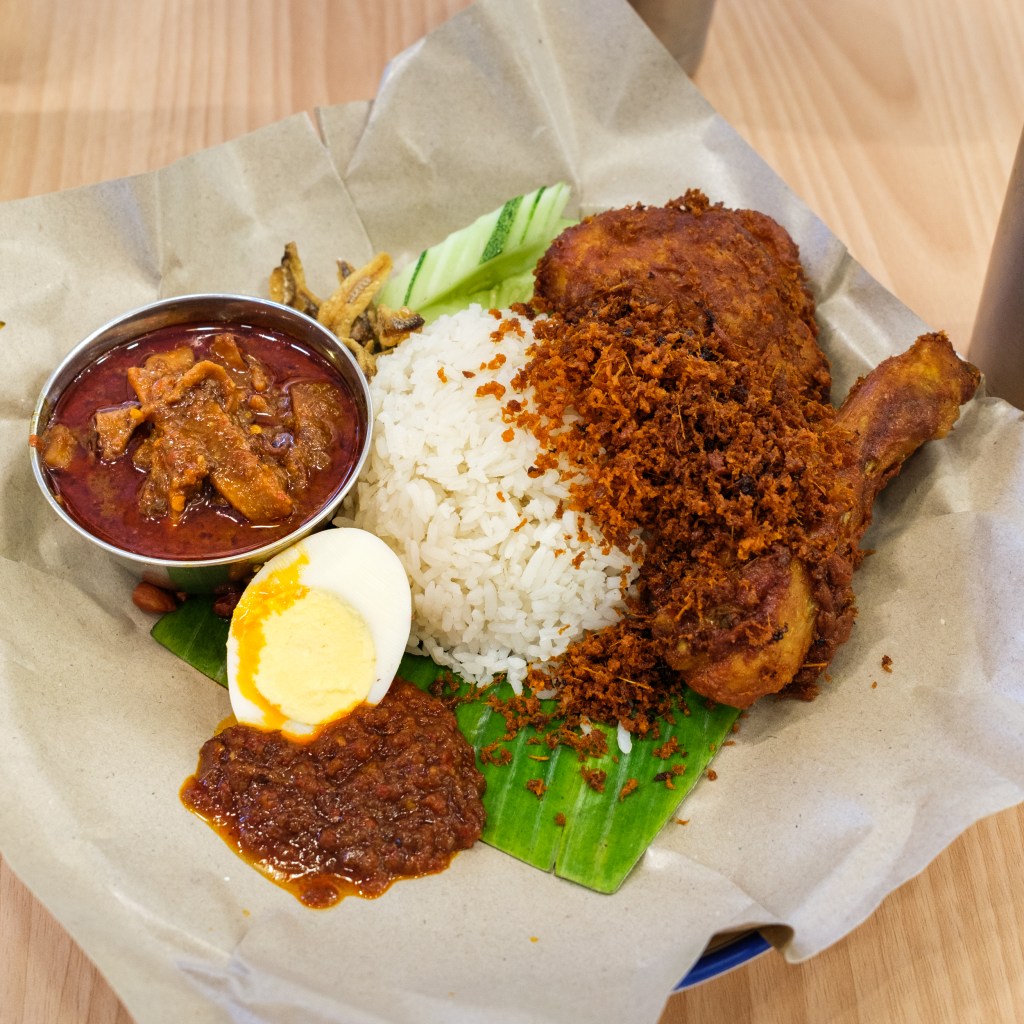
If Malaysia has a national condiment, it would be sambal. Yet as central as sambal is to Malaysia’s culinary heritage, it wouldn’t exist without Portugal.
As Melaka’s fortunes grew, the empire attracted the envy of Europe. By the 16th Century, Portuguese merchants began trading with Melaka, introducing new products like chillis and tomatoes. But this trade partnership wasn’t enough and Portuguese rulers soon wanted more from Melaka. And so kicked off a long era of European colonialism in the region.
Portugal left a significant mark on Malaysia’s culture, best represented by the Kristang community. We hear from chef Melba Nunis (@chefmelbanunis) about her Eurasian roots and the uniqueness of Kristang cuisine. She shares her experience in keeping traditions alive by publishing a cookbook, which remains one of just two cookbooks specialising in Kristang cuisine.
We also hear from community leader Martin Theseira, who grew up in the Portuguese settlement of Melaka. We learn about the Kristang creole language, a once thriving dialect that is now spoken by just 2,000 people.
Credits
Hosted by Dr Noby Leong and Philip Gibson
Produced by Dr Noby Leong and Philip Gibson
Sound Design by Jack Barr
Satay? Okay! is produced by Kopi Productions Limited and supported by the Golden Chopsticks Scholarship, by the Oxford Cultural Collective Trust
Resources and References
A History of Malaysia (2016), Barbara Watson Andaya, Leonard Y. Andaya
A Kristang Family Cookbook (2015), Melba Nunis
The Melaka Portuguese Eurasian Heritage Arts and Culture Society
The Majestic Melaka – 188, Jln. Bunga Raya, Pengkalan Rama, 75100 Melaka, Malaysia
Kumi Cafe – 21, Lorong Setiabistari 2, Bukit Damansara, 50490 Kuala Lumpur, Wilayah Persekutuan, Malaysia
Quentins Eurasian Restaurant – 139 Ceylon Rd, Level 1 Eurasian Heritage Gallery, Singapore 429744
Noel Felix – Kristang Musician
Transcipt
Please note that this transcript may contain errors and typos
Welcome to Satay? Okay! A podcast about the foods
that have shaped Malaysia. I’m Dr. Noby Leong.
scientist food writer and broadcaster and i’m
philip gibson photographer and treasure hunter
and in this series we explore the history cultures
and cuisines of malaysia from the ancient lands
of southeast asia all the way through to the
creation of a modern day nation in today’s episode
we take a look at sambal and the portuguese invasion
so get ready to spice up your life because it’s
time for satay okay I know that was two Spice
Girls jokes back to back, but it is about chilli
today. Yeah, I thought you were saying that to
me almost off mic, but now I realise it’s on
mic. In the last episode, we talked about the
rise of Melaka in the early th century. Melaka
became this massive trade empire in the region,
following in the footsteps of Srivijaya before
it. In today’s episode, we look at what happened
to Melaka in the early th century, following
the arrival of the Portuguese Armada. But first,
let’s take a look at our food of choice for today,
our symbol that connects us to the past, and
that is sambal. Yeah, a lot of Australians in
the s were perhaps calling it sambal. The first
time I saw it on TV. was uh iconic chef ian huey
hewitson uh -huh uh use a sample on his uh cooking
show which i can’t remember what it’s called
anymore but it was like so popular in the s
right and i actually didn’t know what he was
talking about at first oh not realizing that
it was something that you probably eaten a thousand
times yeah yeah exactly yeah well i mean you’re
saying that with a pretty heavy uh australian
accent there so that doesn’t surprise me it’s
um yeah anyway for those of us that speak with
uh a more british version of the english accent
One of many. Sambal. I don’t know how we would
say that in received pronunciation. Sambal. I
don’t know. What was it? The rain in Spain. Anyway,
Ian Huey Hewitson. Some kind of a name that is.
It’s almost Icelandic. Well, no, he went by Huey.
Oh, Huey’s Cooking Adventures. Oh, there you
are. That was the name of his program. So everyone
called him Huey, but his name is Ian Hewitson.
Oh, right. So it’s not some Icelandic Olaf Olifsson.
Right, okay, right. Anyway. Getting to the point,
it was introduced to the Australians in the s,
but it was introduced to Southeast Asia when?
A long, long time ago. So for those that don’t
know, sambal is sort of a catch -all term to
describe a range of chili -based foods across
Nusantara. So most people would call sambal a
chili relish or condiment. It is that, but it’s
not just that. Sometimes it’s a dish in its own
right. like sambal squid, sambal prawns. Sometimes
it’s like a paste that you would add to dishes,
other dishes. Okay. So I think it’s broader than
what people kind of give it credit for. Yeah,
the way you were describing it there, I was kind
of like, oh, chutney, but then it’s not because
you wouldn’t really make like a vat of chutney
to just sit there and eat liberally with potatoes.
Maybe some people might, but I wouldn’t. No,
I wouldn’t either, but you know. So a few examples
are nasi lemak, which is Malaysia’s national
dish that consists of coconut rice and sambal
on the side. So that’s it being used as a condiment.
Yeah. There’s also nasi goreng, which is a type
of Malay fried rice where typically you’d probably
add sambal to the rice as you’re frying it. You
would get that. beyond just Malaysia, but this
is one of these very much pre -colonial dishes
that everybody had the version of fried rice,
right? Yeah, yeah. Which is what nasi goreng
means. Nasi being rice, goreng being fried. Look
at you go. I know, almost fluent. And then there’s
also, you know, sambal prawns, as I mentioned
before, sambal squids. There’s some, Peranakan
would do like a sambal pork. And Bella Chan features
pretty heavily in this one, doesn’t she? Bella
Chan, Bella Chan, can be added to sambal. Also,
there are Hundreds, if not thousands of different
varieties of sambal. Right. Some have red chilies,
some have green chilies, some have both, some
have belacan, some don’t. Some are fresh. You
just pound up the chilies into a paste. Others,
you fry it off. So there’s so many different
varieties of sambal. And so when you were talking
about spices in the last episode, to keep throwing
it back, as our listeners start to learn more
and more about what makes Malaysian food. You
asked me, I think, where chili comes from, and
I said it comes from South America. Yeah, and
you got that correct in our game of Leong family
spices. Philip knows plants. And I think that’s
what’s interesting about sambal. It is so critically
important to not just Malaysia, but also Singapore,
Indonesia, Brunei, so many places across Nusantara.
But the dish has probably only been around for
about to years because it is from South
America. And Nusantara never really traded with
Central and South America in the same way that
it did with India and China. Did it ever? Was
anybody traversing the Pacific? No. So it wasn’t
until Spanish and Portuguese traders in the th
century, during Europe’s age of discovery, quote
unquote, discovered the Americas, set up trading
ports along the way, and then traded those around
the world. Right. so chili’s become part of now
the global spice trade if you like it’s not taking
the same route as some of the other spices but
nonetheless it is a spice and if we remember
from the last episode in the early th century
malacca was becoming a prominent trade empire
and a big part of that global spice trade but
when you become so rich and so powerful as the
malaccan empire do did does where were you start
to attract the attention of others and this is
how portugal started to become important in malaysia’s
history okay so let’s think about portugal for
a moment and let’s set the scene at the beginning
of the th century the king of portugal is king
manuel And his empire is expanding because as
we mentioned, this is now the age of exploration
when Europeans are starting to discover, oh yeah,
there are other places around the world that
aren’t just Europe. Yeah. At the time, spices
are worth a lot of money and pepper in particular
is being used as a currency. But Portugal doesn’t
actually have direct access to spices. They’re
probably relying upon Venetian middlemen and
also Arab traders in order to get the pepper
and whatever other spices they’re trading. So
the king is a bit stressed out by this scenario.
He’s sort of worried that he is reliant on other
trade empires for something as vital as spices.
He’s worried that he’s gonna get locked out.
of the spice trade and maybe his economy is going
to suffer as a result. And so he starts looking
for a way to get a more direct access to spices.
And so he turns to Asia. So for a bit of backstory
about where Portugal was at at this point in
time, they’d recently just defeated the Moors
and gotten rid of them out of Iberia, where Portugal
is situated. And at this point, the Portuguese
were probably feeling a bit cocky and then decided
to try and take over more trading posts in the
North African coast. After this, they then decided
to start going down the west coast of North Africa,
around the coast of Morocco and Western Sahara.
At this point, maps of Europe only extended as
far as the Cave of Bojadar, which is around about
where Western Sahara is just now. There is a
whole bunch of myths and legends around what
was happening there, because the sand dunes along
the coast of Africa there constantly are changing.
So from a cartographer’s point of view, incredibly
hard to map. Early explorers also like to have
the coastline at sight. They knew that they could
get to land should they come into difficulty.
The problem with this part of the land is that
the reefs extend about three kilometres into
the sea, which even to a report from the
Royal Navy still cannot guarantee that that area
has been properly surveyed. Wow. this is why
europeans did not go any further however the
portuguese were determined and so they decided
to go further out into the sea in order to get
past it they then continued further and further
down the coast but it should be reiterated that
it took them from cape bojador to get to south
africa over a hundred years very determined quite
at one point i think one of the kings of portugal
got so pissed off with these navigators that
he was a bit kind of like right you need to start
surveying kilometers a year otherwise we’re
not going to get anywhere this spice trade is
happening and we need to start saving money here
and we need more gold etc i’ve had demanding
bosses in the past, but that sounds particularly…
I think to navigate kilometres of coastline
a year in old sailing ships when you’re fighting
against all of these different kind of winds
and what have you is a big ask for sure. So after
years of navigating down the West Coast,
they finally get to South Africa and they realise
that they can turn a corner and to their surprise,
the Indian Ocean isn’t landlocked and they can
then go straight from South Africa onto India.
Where we have… our spices okay so with this
now the king of portugal who now at this stage
early th century is king manuel he now has
a physical way to get to asia and then to get
to the spice trade and in he seizes goa
which is part of india so that was his first
step he then sends out ships to a variety of
other different places across asia one of them
being malacca So he doesn’t approach Melaka
with the intent of violence. Unlike what he did
in Goa, he actually just sends a trade delegation
first to Melaka in order to get some trade terms
going on. So at least that would be some sort
of direct access to spices. However, the Sultan
of Melaka, Sultan Mahmud, hears how Portugal
treated their Muslim counterparts in Goa. Very
upset by this. And therefore, he imprisons this
trade delegation. Right. Portugal, the king,
finds out about this imprisonment and is pissed
off himself and therefore sends an armada to
retaliate. This armada is led by Viceroy Albuquerque.
Okay. ships, over a thousand men. They reached
Melaka in July and they pretty much destroyed
the place. They are much more powerful in terms
of their military than Melaka. Right. They already
had intelligence on Melaka from previous trips
over there. So they knew the layout of the land.
Yeah. And so they launched their very highly
successful attack on Melaka. They burned Gujarati
ships that are stationed offshore. They bombarded
Melaka day and night by cannons. They set warehouses
on fire. This is where people have their stock
and that sort of thing. I mean, yeah, to reiterate,
Melaka would have been one of the biggest trading
points in all of Southeast Asia at this point
in time. The royal palace was burned and probably
so was the great mosque. If not then, then at
another point. And so Melaka falls to Portugal.
The sultan doesn’t die in this fight. Sultan
Mahmud and his family… end up escaping and
set up a new residence in Johor, what’s now Johor.
They’re obviously not in a good place. No. They
want revenge. Quite understandably. And the sultan
tries on at least nine separate occasions to
retaliate. And reclaim Malacca. And he does so
unsuccessfully. Hmm. Poor bastard. Yes. So Portugal
has now successfully claimed Malacca for their
own and tries to run it like a trade empire.
And in doing so, Portugal becomes the first European
power to establish a presence in the region.
And it’s really the beginning now of a centuries
-long period of European influence, control and
colonisation in Southeast Asia. It’s a massive
turning point for the region. Yeah, I mean, I
feel like if word got back to Europe as it did,
other intrepid naval countries would have been
sending boats trying to find their own way over
that way. I think it’s also probably good to
consider having just gotten rid of the Moors,
well, not just, a hundred years prior, getting
rid of these Muslim occupants of Iberia, there
was quite an anti -Muslim sentiment from these
Portuguese at the time. And at this point, Islam
was very, very embedded into Southeast Asia,
certainly Malaysia and Indonesia at this point.
So I could imagine that would have not gone down
well, as you say, with the Muslim leaders, for
all of these other sultanates that existed around
that region, from Aceh to Johor to even back
to… Palembang, which still existed at this
point, they would be under no inclination to
trade with Melaka any longer. Why would they?
Yeah, I mean, well, that’s the thing. So Portugal
managed to capture Melaka, but they can’t actually
capture the same prestige and they can’t attract
the trade that the Melaka Empire had. And that’s
because they just kicked out the Muslim leaders,
replaced them with Christian leaders. And the
rest of Southeast Asia. who are also Muslim,
don’t like this. Yeah. So they end up not really
trading with Portuguese Melaka much. Yeah. You’re
probably not going to be inclined to trade with
the invaders, are you? No. Like, oh, those guys
are dicks. Maybe not. And word will definitely
get around between all of these other trading
points, just to kind of embargo. Yeah, yeah.
I think there was a lot of religion -based embargoing
happening at the time, which weakened Portugal’s
attempts at establishing Melaka. They also don’t
really like the way that Portugal is running
Melaka from an administrative point of view.
It’s messy. Their governance is a bit rubbish,
apparently. Policies aren’t clear. They’re inconsistent.
They’re not predictable. All these really, really
boring things that make trade empires great.
Portugal doesn’t have that. And it’s worth saying
as well. The Melaka was very dependent on international
trade for its own sustenance as well as a trading
port. So Java was sending routinely thousands
of tons of rice every year in order to feed the
population of people that lived there. So if
those ships from Java aren’t coming, where are
people getting the rice from? Because they’re
not growing wheat over there. So where are the
staples coming from? So with Portugal establishing
a presence on the Malay Peninsula, It ends up
being there for quite some time, such that we
do have a legacy of Portuguese influence on the
culture of Malaysia today. So last week we talked
about Peranakan culture and how sailors from
particularly China and India would come to Malacca,
settle and then marry local Malay women. And
this gave rise to new hybrid cultures like Chinese
Peranakans, like Melaka Chettis. And now we
can add a European Peranakan to this list. And
this is Malaysia’s Eurasian community. I see.
So today we’re just going to talk about one.
And that’s the Portuguese Eurasian community,
also known as the Kristang. And so Kristang comes
from the Portuguese word cristao, meaning Christian.
So you can see just how important religion was
to the Portuguese Empire at this stage. For sure.
So the community arose during Portuguese Malacca’s
reign as a result of, again, mixed marriages
between Portuguese sailors and local Malay women.
And this gives rise to a really unique culture
that does combine Portuguese religion, Christianity,
with the culinary traditions of Portugal and
the Malay world, as well as a combination of
language. Okay, yeah. So Philip, did you know
that Malaysia had a Eurasian community? No, I
would have thought that the ruling classes being
the white Europeans would have probably stuck
to their own kind. I would have thought that
there would have been a bit of white supremacy
going on there to kind of reinforce that they
were the rulers. Yeah, yeah. I’m sure there were
people like that. I imagine. So I do have some
cousins that are Eurasian. Okay. But it’s not
a culture that I know that much about. So to
find out more, we spoke to Melba Nunis. Melba
Nunis, I would call her custodian of Kristang
cuisine. Right. She is a chef. cookbook author
and just a really lovely person. We met her at
her house in KL for one of her supper clubs that
she runs regularly and she told us the story
of her Kristang childhood and where the culture
is at today. So this is my spot one day it’s
going to open up it’s going to open up and then
swallow me. Philip is looking there. Yeah so
this is where I do my cooking. I’m Melba, Melba
Nunis from Melaka. I was born in so that
would make me My father was a government
servant. Garden City, I don’t know if you’ve
heard of that. Now it’s a city that’s gone because
they’ve taken away all the government. quarters
and built like apartments and condominiums and
all that so i was born there and and in that
area we had many eurasian families you see way
back in the s s so there were many eurasian
families then they migrated to australia many
of them intermarried so i myself married an indian
anyway but growing up there yes we felt the Eurasian
community, everything, because the settlement
was nearby, a Portuguese settlement. Then my
mum, we are in the centre. We are typical Eurasians,
you know, and we had many Eurasian families back
in the old days. Sad to say it’s no longer. So
who are the Kristang then? Alright, first of
all, you know when the Portuguese went to Melaka,
they got married to all the local women there.
They were men, you know, so they married the
Chinese, the Nyonyas, Malays, Indians. I think
mostly was Nyonya and the Malays. Because our
food have got a lot of sambals and chilies and
all. everything is so rempah based paste you
know all made from scratch so that that is what
i think kristang food is because the influence
comes from the portuguese of course you know
with their stews and their non -spicy stuff and
then you get the malays with their sambals and
then you get the indians with the indian curry
some of our curries all of our curries have got
Kristang names. So it’s like curry sekuk. The
word sekuk means dry. It has the Indian spices
in it. Whereas the rest, no, every curry would
have a name, a Kristang name. And the ingredients,
the rempah, the paste, is all made from scratch.
Melba shared with me life growing up in Melaka
and the unique food traditions that she grew
up with. and the people were nice you know they
were very happy knowing Eurasians at that time
and Christian people they used to like Christmas
for instance our doors will be open Philip no
there’s no such thing as oh I must invite you
to come I’m cooking this no such thing on Christmas
morning you will find the doors are open you
come in not for a meal to eat cakes tarts cakes
whatever biscuits and whatnot and those days
it was the seaweed jelly that was the most agar
agar the seaweed from the sea have you heard
of that philip that you can’t get anymore you
can’t people say can you i said cannot no no
way i i can make it but i can’t get the seaweed
it’s very tedious to clean it to cook it you
used to get make that agar agar From the sea,
the fishermen come and they sell you the seaweed.
And then my mum, of course, will know how to
wash and take away all the shells and bits of
dirt that’s in it, soak it, and then start boiling
it for hours. And with gula batu, rock sugar.
And then you kind of bring it down to very little.
The colour has to be like… a whiskey color
or brandy color then it’s perfect so when you
cut it it’s super sweet but very um how do you
say like a sticky kind of uh feeling you know
but it’s very nice it’s really very nice it’s
like a lost art it is it is another one was uh
bluder have you heard of bluder the dutch uh
also have something similar they have this kind
of a cake pan with a ring in the center have
you seen that if you do what do you call it i
can’t remember the name yeah yeah yeah that’s
right ah yes yes we use that kind of a mold to
make a toddy cake called blue duck oh okay yeah
so interesting what’s the toddy toddy toddy is
from the you know the one ah the drink yeah yeah
yeah you had it yeah did you like it I don’t
like it anyway. Yes, yes, because that acts as
yeast. It’s like, you know, it ferments. So it’s
very, very lost also now. I try to get toddy
now and again people ask and all but it’s so
tedious la you know no way and then in the end
you know you get so fed up because you have to
wait for the thing and then no la I think it’s
too much trouble yeah but if I were to try and
like do for to preserve it to show some maybe
I would yeah maybe just once film it yeah yeah
something like that you know yeah you mentioned
Christmas was a time where beautiful open open
doors for anyone Could just come in. Neighbours
were all… No, they were all our neighbours.
We knew everybody. You know, because we lived
in like government quarters and it’s all like
in a row. And you find people, you know, all,
you know everyone. And they were so happy to
come, you know. And especially they knew my mum
was a well -known cake person. She used to cook
and all that. So Mercy, everybody called her
Mercy. Her full name is Mercedes. So, Aunty Mercy
South or Mercy, oh, everybody will be so happy
because she makes beautiful cakes and tarts and
all. But these days, I don’t think she could
compete with anybody. In my time, we never worked
at Nobi. My mum never worked. I never worked
because we were home people. You know, it was
easier in that way to learn and do what you wanted
to do. Yeah, at home, make the rempahs. Every
day, mum will… You know, we have that grinding
stone? The big one. Have you seen that, really?
No, no, no. That’s the Indian one. Is it the
rolling? Correct. Diling batu lah, we call it.
So it’s like a rectangle. And with anak, we call
it like a… So every day, can you imagine? To
make one curry, mum will do one rempah. So you
come back from school, you know, okay, there’s
ambila today or there’s devil. Just one curry,
one vegetable, one fish. It sort of complements,
the dishes complement one another. For Melba,
food was always a big part of her life. But it
was only after her husband retired that she got
into the restaurant business. So I left Melaka
in when I got married and went up to started
my married life in Klang. you know Klang right
and then from there my husband was transferred
to other states so we were up in penang and and
alosta and everywhere until we decided to come
back to kuala lumpur to settle here because we
had grandchildren to take care of yeah and that’s
when i uh actually started you know i had a restaurant
right my daughters got together and wanted to
make this little dream of mine come true i always
wanted to have a little cafe I like people, so
I enjoy cooking and entertaining. So my girls
got together and said, let’s open up a restaurant
for her. And it was a restaurant, not a cafe.
So it was in Bangsar sao. So unfortunately, we
closed after six years because my daughters were
migrating to Australia. No choice. I’m not a
money person per se. I’m more kitchen, onions
and chilies and whatnot. So we decided to close
the business. And it was at that time that YTL,
you’re familiar with YTL? Majestic Hotel in Kuala
Lumpur? Oh, yes. They have one in Malacca as
well? Oh, yes. I know the one as well. Yes. And
so they offered me and they gave me the opportunity
to actually… run their restaurant there or
rather to work for them and they only had one
restaurant called The Mansion so they gave me
for me it was an honor really because it was
like Melba at The Mansion serving only Kristang
food because I guess they thought that you know
being from I’m coming I’m from Melaka a Eurasian
so what better person they would have taught
for me to And I did pretty well. Unfortunately,
when I joined Majestic, my husband passed away.
Yeah, so that took a toll on me. I had to leave,
go away and grieve, decide if that was what I
wanted to do. And I went back. I went back to
complete my two -year contract with them and
then decided that I wanted to be home. In
Melba published a cookbook called A Kristong
Family Cookbook. But there aren’t many chefs
like Melba. And now, Kristang culture is on the
decline. But yeah, I think it’s on the decline
because honestly, I want to open up a restaurant.
I’m just dying to do that again, you know? Because
I want to leave this. It’s a legacy I want to
leave. I’m not going to be here, well, you know,
so soon. I might just go. But if I can train
people and leave this, just this. I think it
will work, don’t you think? I think so. Okay,
great. Why do you think it’s on the decline and
not thriving as much? Because there are no restaurants.
Unlike the Nyonya, the Chinese, the Malays, you
go everywhere. You get a restaurant that is very
Nyonya, very… So many, you have choices. Where
are we? Even with her efforts to publish a kristang
cookbook, she said it’s not enough to preserve
the cooking culture. They don’t know the flavours.
Even if you follow my recipe, right? Poor thing,
I don’t know how my devil curry turned out. I
liked it, but as you said, I don’t know if I
made it correctly. Did I make it the way it’s
supposed to taste? Because the chillies I use
are different to the chillies you’ve got in Malaysia.
Yes, yes, you’re right there. So it’s actually
difficult. That’s why I want to have a restaurant
so that I can leave the… The kind of food I
know, you know, and everybody can enjoy it the
way that I remember eating it and cooking it.
While her desire to open a restaurant and keep
her culture going is alive and well, the means
aren’t necessarily there. And so the practical
aspects of preserving culture become a lot more
of an issue. And as it so often does, it boils
down to money. So there’s no, like my book. for
instance to get it printed to get it published
was not easy we did it on our own luckily we
had the means that’s why if I open a restaurant
also I need to have people with the money and
the means and the know -how of how to get around
the because it’s not so easy you even to put
up a signboard you need certain criteria certain
you cannot simply go and put mail or mailbox
or whatever for sure I can I can I can, but I
don’t have the means. I don’t have, you know,
and we need investors and whatnot for that, for
setup. I can teach, I can be there. I can try
the food and tell them, no, it’s not like that,
you know, or it shouldn’t be like this, you know,
or something like that. And that was Melba Nunis,
chef and cookbook author. Philip, what did you
make of her interview? Yeah, no, she was such
a lively individual at years older. She was
very maternal, I think, in the way that she conducted
herself, in the way that she wanted to kind of
spread this stuff. And she understood the kind
of the joy of her foods as a way of preserving
her culture, I thought was really, really obvious.
I think what’s interesting about Kristan culture
in Malaysia is that unlike some of the other
cultures that we’ve talked about, I do think
Malaysians know about the Eurasian community
and they know about the Portuguese community
because… Malacca still has a Portuguese settlement
where people live and a lot of tourists like
to go there as well. But I don’t think they really
understand the depth of the culture. Yeah. I
mean, we went out to the Portuguese settlement
just to try to go to one of the restaurants to
try a couple of these dishes prior to interviewing
Melba. But I think we found that a lot of the
food that was on offer was… just malaysian
food for want of a better word they do sell kristang
food but a really small part of it right so at
a lot of these restaurants you can get devil’s
curry which is probably their most iconic dish
it’s a really really spicy curry that the pungency
just keeps building in your mouth. Yeah, there’s
a saying apparently that where a Christang person
shits, the grass dies. Yeah, I can believe it.
Yeah, and, you know, thank you to the Portuguese,
I guess, for introducing chili to their diet,
but you can obviously tell that they took the
chilies with them everywhere. Yeah. important
this food is. Yeah. And at the Portuguese settlement,
you could also get baked fish, another iconic
Cristang dish. But you can’t really get the other
stews, the roast, the baked goods. Right. Those
Cristang Christmas dishes, you can’t really find
them in many places. Melba mentioned a few off
record. So you can still go to the mansion, which
does have her Cristang menu. And the mansion
is based in Melaka. Right. And there’s also
a Kristang restaurant in Singapore called Quinton’s
and one in KL Kuala Lumpur called Kumi. So there’s
really not many opportunities for Malaysians
or visitors to experience Kristang culture. Yeah,
only marginally better than the Chetti Melakans
one restaurant in all of Malaysia. And I thought
that was such an interesting point that it’s
all very well that you can buy a cookbook, but
you don’t know when you’re making it, if you’re
making it right, because you don’t have a…
a taste memory to go back to, or a flavour memory,
I guess. And I think that’s a really important
point that she made, which then made me think,
for all of the previous people that we’ve interviewed,
and certainly all of the people that we went
on to interview, is that how on earth can you
replicate this if you don’t know what it’s supposed
to taste like? Especially, I think, with things
like stews and curries, where if you use the
wrong chilli, it… might not be as spicy as
it’s supposed to be, for instance. And the tears
should be streaming out of your eyes when you
eat this. Yeah, yeah. And if you kind of have
spices that are really old and aren’t so potent,
you’re going to get something different. But
you’re not going to know that that’s wrong. So
the other places that you can actually get Kristang
food from is from Melba herself, which is mental.
So Melba Nunis, she does run supper clubs. You
have to contact her in advance through social
media or WhatsApp. But the fact that if you’re
in KL, you can just like ring up a custodian
of Christian cuisine and have her cook for you.
Or you can like buy cakes from her. Yeah. That
to me is crazy. Yeah. Let me slide into Paul
Hollywood or Mary Berry’s DMs and see if I can
get some of, get them to cook me dinner. Yeah.
Like you say that as a joke, but that is the
British equivalent. Right. Mary Berry, she is
the custodian of. certainly british baking if
not british cooking in general i would say so
and imagine if you could just hire her to do
an afternoon tea certainly a matriarch of it
yeah yeah um no that that that is i think the
best kind of analogy i can think of given melba’s
kind of like esteemedness with her age and an
experience and i would i would encourage anybody
to do it because you will just be entertained
and you will be in stitches laughing i think
at her dinner table she is So many anecdotes,
so many great stories. And just a really, really
loving and maternal person, I think. And it comes
off so easily. I rate Melbourne really highly.
Yeah. I think this is what frustrates me about
aspects of our food culture today, where people
pay attention to something that’s Instagram worthy.
People pay attention to the Michelin guide. Right.
But here you have someone like Melba Nunis,
who’s cooking. is so deeply connected to her
heritage, deeply connected to history and is
delicious, but we’re sleeping on her. Right.
I mean, she gave us a tour of her kitchen and
she’s got all of these handwritten recipes that
are just literally kind of like blue tacked or
like pinned up to the, you know, the back wall
where she’s cooking all this food. And, you know,
if she’s having people over for dinner, then,
you know, she’ll be cooking this stuff days in
advance. Like, you know, it’s no small feat for
her. Like, it’s a big deal. Yeah, just, you know,
what an experience. Yeah. Obviously, not everyone
lives in Malaysia. That is true. So definitely
go out and get yourself a copy of A Kristang
Family Cookbook by Melba Nunis. And I believe
it’s actually one of only perhaps two Kristang
cookbooks in the world. All right. So they are
such an important resource for now and into the
future for Kristang culture. Yeah, no, I mean,
it strikes me again, like what we had with the
Chetti Melakans last week. You know, these books
have to exist as references, particularly when
these cultures are possibly on the cusp of dying
out. If you’re enjoying this episode, you can
follow us on social media at Satay OK. We’ll be
sharing beautiful photos taken by Philip of Malaysia,
its people, and of course, the food. We’ll also
share photos of Malaysia from the archives, so
you can see how the country has changed over
time. You can also find links to give us a tip
or donation to show your appreciation for the
work we’re doing. So head to our socials at SatayOK
or visit our website, SatayOkay.com. Cuisine,
of course, is just one aspect of culture. And
for Kristang communities, there’s also the language.
So the Kristang community have their own Creole
language, which is also Kristang. And we wanted
to find out a bit more about this language and
efforts to maintain it and other aspects of culture
into the future. So we went to Melaka and we
spoke to Martin Theseira, who is the president
of the Melaka Portuguese Eurasian Heritage,
Arts and Culture Society. We joined Martin and
other members of the Kristang community for one
of their regular language meetup sessions. There
is no such thing as we speak ancient or antique
Portuguese now. Ours is a thriving language that
is still evolving, and it’s like any other language.
It is as original as possible. We have our own
grammar. Unsurprisingly, the Kristang language
is on the decline, and as early as the s,
the community came together and recognised the
need to preserve their unique language and culture.
When did it actually start going down? It actually
started many, many years ago. Okay, you see,
we talked about the Melaka Portuguese Cultural
Society, -That was actually the, how
should I say, the emergence of the community’s
passion to save the language. Other than that,
it was like, it was just drifting. Then when
he came to the picture he set up with society,
that was when that real wow. One of the reasons
for the decline of Kristang language and community
in general is major changes to the landscape.
Traditionally, a large part of the Kristang community
lived along the shore, around a road called Prior
Lane. Fishing is a major part of the community,
and much of the lifestyle was based around the
ocean. However, In the s, land reclamation
projects began across Melaka. One of the major
areas impacted was Praya Lane. Land reclamation
saw the shoreline shift much further out. This
development displaced local communities and disrupted
traditional ways of life like fishing. Martin
was one of the people that used to live on Prior
Lane. I lived here and this was actually a former
enclave or in fact the last historical enclave
of the community. You see, it was thriving. If
we say 20 years, 30 years, years ago, when
the seafront was here. It was a thriving community.
I mean, he grew up here. Mona grew up here. We
grew up here. It was thriving. We had lots of
kids running around. The seafront was there.
We swam in the sea many, many times. We had festivals
in the sea. We had procession in the sea. We
had so much activities here. And the community
was so close -knit. Very multi -racial, Chinese,
Indian, Malays, Indians. We live harmoniously.
But the majority was Kristang. So over the years,
after the Reclamation came in the say 80s, people
started to move out. Worse still, when the government
came with the announcement that they wanted to
acquire this street to build an access road to
Pulau Melaka, the new Reclamation area. More
so, people grew better and then they moved and
bought elsewhere. Our aim is to slowly bring back some activity and this is one of it.
Today, the need to preserve
the language has become incredibly urgent, as
the number of native speakers in Malacca has
plummeted. Speakers of Kristang, I think less
than a thousand. Less than a thousand. It’s really
endangered. My main focus is always on the fishermen.
For me, they are the real custodians of the language.
The real custodians of even the festivals. San
Pedro, good example. You hear them speak. If
they are among themselves, any age group above
or so, you witness more or less. They will
be speaking in their own lingo. Among themselves,
above especially. The moment one Chinese fishmonger,
no discrimination here, he comes, he speaks Bahasa,
everybody speaks Bahasa. You get a young fishman
coming, speaking English, all speak English.
This is a danger. So I keep telling our senior
fishermen, try and keep the language. Especially
among yourself, even if anybody comes, continue
with the Kristang language. Because they are
the real custodians. They are the only ones who
speak on a daily basis among themselves. And
even when they go home, among the family. Because
the fishing community that I see are the ones
that… for me, are the real custodians of the
language, of the customary practices, of the
festivals. So that is a very important segment
of the community that have to be given focus.
In order to revitalise Praya Lane and the Kristang
culture, the community started Melaka Portuguese
Eurasian Heritage, Arts and Cultural Society.
Part of their work is to host Sunday sessions,
where members of the public can come along to
learn about Kristang language and culture. It
was here that Martin taught us a few basic Kristang
phrases. So, some people say ki sorti. That is
maybe like among friends or fishermen. It is
not so common. Ki sorti. But I think more proper
is Ki nobas. Ki nobas. It can be, yes, hello, how
are you, like. Or even can be news, also can
be news. News. Ki nobas. What is the news? Ki nobas.
How are you? How are you, like. And then, okay,
one more is bong pamiang. Direct translation,
good morning, bong pamiang. Bong atadi, good afternoon.
Goodbye, in Portuguese is adios. Adios in Portuguese.
So I will not say adios. I will always say, Ngkontrah di tona. Ngkontrah di tona. So, okay, that is
till we meet again. Ngkontrah di tona. Martin
also taught us about music. and some famous musicians
that sing in Kristang. Some of these Kristang
songs can be found online. Yes, some songs. wehave, but sadly of late, not many new songs being composed. People like Joseph, Jo Bosco, he had his own album. I think he did about 20 new songs, new songs ah. The other is Noel Felix. Mr noel Felix more or less was a very active member of the Portuguese Cultural Society in. the60s and then he went on having his own group. He’s also an iconic cultural leader in that sense. And then prior to that, there were people like Rosa De Costa.
Unfortunately, convincing
others in his community to learn Kristang isn’t
easy. It’s become a particular issue when trying
to bridge the gap between older and younger generations.
and one thing to learn is that that you desire
you know phrase speaking no no yeah maybe
percent no real interest the interest is more
outside yeah that means it is more outside it’s
people like you like you correct not true you
are you are here you tell me where is our it
was posted that value or the urgency or that
passion in wanting to keep it’s people like you
and it’s in truly a friend is beginning if the
day the this language this disappear wow i mean
it’s fine our cultural fabric imagine it becomes
with the creole if say our grand grandfathers
all ran away and then became other and spoke
other languages we we will not be what we are
today we cannot call ourselves a community because
we don’t have our own language you know so it’s
so important The Sunday language sessions aren’t
the only activity that Martin is undertaking.
He’s also documenting conversations between native
speakers and using theatre to promote the language.
I want to do this. I want to maybe even make
a competition for the best speaking fisherman
in Kristang. And later also do a play, a simple
play, Kristang. I will start with a comedy sketch
or just a competition between fishermen. Talk
about your daily experience today at sea. and
the way they express that’s the way it should
be not not not static not so like you know it
should be the way especially if you really hear
families quarreling between neighbors over the
fence my goodness all kinds of bad words all
kinds of swearing that is something i tell you
i want to really look into and record That you
cannot get. It’s disappearing because the native
speakers are going. Okay, you just ask any young.
I think you ask maybe anybody, maybe the below
They don’t know what it means. Actually,
it translates to one leg of rain. If you translate
it to English. It doesn’t make sense. Currently,
it’s a small group of people that are working
together to preserve Kristang culture. But hopefully
that’s enough of a catalyst to propel the community
forward. should I say passion, real now want
to get this, I think hopefully like this. And
if we really later get maybe a bit more help,
people do proper recording right, we do it maybe
on a weekly basis or at least two or three times
a week and get it online. But then I say you
need resources, you need personnel, it will take
a lot of time. But let us start at least this
way because I think very important is people
like you come and give that support and that
interest. It makes us even want to go further
and do more. And that was Martin Theseira, Kristang
community leader. I think for me there’s such
an urgency with which Martin spoke about preserving
his community because he’s on the front line.
He’s in those communities where there’s still
native speakers of Kristang language and he can
see the decline happening in front of his eyes.
There’s also been those massive shifts. to his
community that’s been happening over the past
few decades he mentioned mostly that land reclamation
that’s been happening across malacca really since
you know the s yeah don’t get me started on
the land reclamation it’s uh it is it is a shame
you know this is a city that is what six or seven
hundred years old and you know malaysia exists
almost because of malacca the seafaring is the
cultural heart of malacca yeah and you you go
to the the river where the old port was built
around in malacca and it’s just this like uh
i mean there’s a couple of like remnants of like
the old fort that the portuguese built and um
but it’s all just been so heavily developed like
you know when martin says that the the coastline
was pushed back he’s not talking about maybe
like or meters it’s like a kilometer at
least and there’s nothing on that land no it’s
like the land that they’ve reclaimed is so underutilized
they’ll build one story kind of condo tower
in one corner of the square kilometer that they
might have reclaimed in one like phase and then
the rest of it we walked through some of it to
try and get to the shore and um you’re just walking
through like a field of long grass and and you’re
like what’s the ecological impact of this like
and but then like you also see these developments
that have gone up and they’re they’ve got like
stories and they’ve been abandoned and i’m
like what is going on malacca um so yeah anyway
but like that’s that’s that’s not about the Kristang
but yeah i think it’s a shame though that he
was talking about all of these festivals that
used to happen in the sea that possibly no longer
happen because how much the coastline has changed
and how the communities have been disrupted because
they’ve had to be resettled and moved or, like,
you know, where the Kristang settlement is now
maybe isn’t where it always used to be because
that, I think, is kind of new land. And certainly
when we walked about it, going out to the Portuguese
settlement, those condos or those houses, the
family homes only looked years old or
something. And it’s just a shame that, like,
they’re old. street in their old kind of like
kampung I guess and now is irrelevant to them.
Yeah because it’s not connected to the ocean
anymore. And there are so many barriers I think
that Martin and this community are facing when
you’re trying to revive a language because I
think it’s really easy to think about reviving
the language the same thing as learning a new
language like if I was to learn French or if
I was to learn Cantonese. Right. If I wanted
to learn any of those two languages There are
so many resources of which I can draw upon. There
are textbooks, there are films, there’s a lot
of music available. There’s so many ways that
I can engage with that language. I could go to
France if I wanted to. I could go to South China
and do immersion if I wanted to. I could also
pay teachers who have studied for years on the
best way to learn a particular language. doesn’t
really exist for the Kristang community. Yeah,
I mean, I think that’s what Martin was saying
there, that, you know, it takes a lot of time
and resources to prepare these teaching materials.
And when we say teaching materials, sometimes
we even just mean a poster of A to Z with Kristang
equivalents of apples, bananas, and cat. Just
basic vocab. Yeah, yeah. It’s crazy. I mean,
like, there is this… A dictionary has been
published. Yeah, there are some resources. I’m
not saying there’s nothing, but yeah, there’s
dictionaries. And I think these days some digital
resources have been created. Yeah. And you can
learn a language by reading the dictionary. No.
And you need a community because as he said,
there’s only perhaps speakers left. Right.
And so if you don’t have anyone to practice speaking
with. then it’s difficult to get that language
off the ground again. And I think with speaking
with Martin, there was no shortage of ideas in
his head that he had to kind of stimulate young
people to learn the language. I mean, I think
the idea of making a play about two fishermen
kind of just chewing the fat with each other,
you know, I think is a good way of doing it.
I think it’s particularly like comedy, I think
is a good way of engaging people because at least
it’s light. Well, we saw that a few episodes
ago. when we were talking to Ilya Katrinada about
the Onglawut communities, and they were using
theatre to really get the message across about
their community. Yeah, and again, using the tool
of being able to record those spoken word exchanges,
I think, you know, at least the language will
never be lost in that sort of way because it
will go into an archive, hopefully. Absolutely.
So if you were to go to Malacca today, there’s
actually very little evidence of Portuguese Melaka
left. Probably the most prominent are the remnants…
of the old Portuguese fort and that’s now called
Afamosa. So back in the day this fort would have
been massive but there’s very very little of
it left but well worth seeing if you are going
to be in Melaka. And so the reason why there’s
not much evidence of Portuguese Melaka left
is well because that empire didn’t last for very
long and it was quickly replaced by another power.
That so often seems to be the case in this region.
Very much so. And so in the next episode, we’re
going to take a look at the next European player
to enter the region. We’re going to look at the
Dutch. And the Dutch really, really did totally
transform Southeast Asia in really profound ways,
far more than Portugal ever did. And the impacts
of the Dutch Empire, well, you can see that today,
not just in Southeast Asia, but really across
the world. Yeah, I mean, fair to say that capitalism
as we know it might have been started by the
Dutch East India Company. Precisely. And so if
we just go back to our food of the day, our symbol,
which is sambal. Sambal is something that all
Malaysians know and love. It’s quintessentially
Malaysian in many ways. And yet it wouldn’t be
part of our culture had it not been for those
Portuguese and Spanish traders who brought chili
from Central and South America. to Southeast
Asia through historic trading around the th
century. So every time you have a bite of sambal,
remind yourself of where that came from. No,
it does start to paint a bigger picture of how
all of this food that I’ve been introduced to
came to be. Yeah, I mean, I think that’s what’s
amazing about Malaysia. You can literally eat
history off the plate. That’s a way to put it.
Yeah. Yeah, no, you take it for granted, don’t
you? Somebody puts a piece of food down in front
of you, but you don’t think about how chili’s
ended up in Southeast Asia. And not just in Southeast
Asia, into the greater network of trade that
was happening in Southeast Asia and the region.
Think about how much chili is in Thai food. Chinese
even. The more you think about it, the crazier
it is because people associate Asia with Chile
so much. Well, yes, and it wouldn’t be the same
if the Spanish hadn’t gone across the Atlantic
in search of the spices, but gone in completely
the wrong direction, bringing back spices to
Europe. Indeed. So in the next episode, we’re
going to continue our journey. We’re going to
look at Portuguese Malacca, our new European
player in the region, the Dutch. And our Malacca
rulers that have set up in Johor. And that episode,
we’re calling Kueh and the Unlikely Dutch Affair.
And if you don’t know what Kueh is, well, that
gives you even more reason to join us for the
next episode. How compelling. So join us then
for Satay? Okay!
 Satay? Okay!